Hey Fam,
Every year, without fail, the air shifts sometime around November 1st.
Not December.
Not even Black Friday.
Yep, we disrespectfully skip right past the Thanksgiving sweet potato pie and go straight into yule tide joy and mistletoe.
Why?
Because Mariah said so.

Forget sleigh bells ringing and all that jazz.
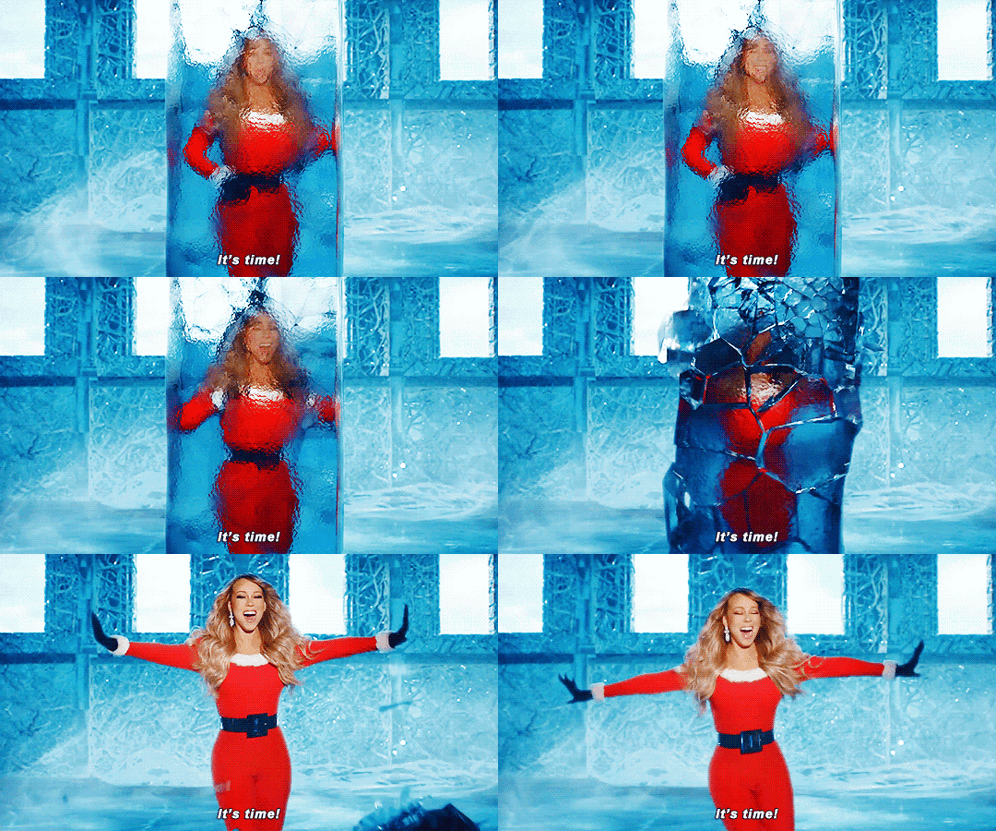
The real signal that the holiday season has begun is Mariah Carey shattering the sound barrier with five crystalline words: “It’s… tiiiime!”
Suddenly, the grocery store aisles are blaring All I Want for Christmas Is You.
The Starbucks playlist bends the knee.
Children who weren’t even born in 1994 somehow know every note of the bridge.
DJs at Halloween parties are already queuing it up before the fog machines clear.
At this point, Mariah Carey did more than enter the holiday canon; she owned it.
She is Christmas.
She is….that girl.
And she’s turned nostalgia into a multi-decade revenue stream.

But…heavy is the head that wears the crown.
With that level of cultural dominance comes legal scrutiny—and in recent years, that scrutiny took center stage in a lawsuit claiming Mariah stole her holiday anthem from another artist.
The case? Vince Vance vs. Mariah Carey, a battle over who really owns All I Want for Christmas Is You.
And while it may sound like just another celebrity headline, the lawsuit offers a powerful lens into how copyright law actually works—and how it doesn’t.
In this Founder’s Letter, we’re peeling back the wrapping paper (see what I did there?), to unpack three common misconceptions that even savvy creatives often get wrong about copyright law.
Ready?
Let’s get into it.
But first, let’s pay some bills…
Loving This Post?
Show us some love by adding a “❤️,” giving a share, or commenting below; this will make our hearts s

And Second, Church Announcements:
Have we connected on LinkedIn yet?
As many of y’all know, LinkedIn is my favorite platform.
Yes, partly because I like to shake things up and lovingly troll the buttoned-up conservative crowd — but mainly because it’s a great platform for genuine connection, powerful networking, and meeting brilliant clients (ahem, like you).
So if we haven’t connected yet… what are you waiting on?

Let’s fix that.
Connect with me here: www.linkedin.com/in/rukayatutijani
See you in the comments section.
Also, let’s have a quick community check-in:
So tell me in this poll:
Now, back to our regularly scheduled program…. :)

Vince Vance, the plaintiff, claimed Mariah Carey stole his 1989 country ballad All I Want for Christmas Is You.
Problem is, both songs just so happen to share the same title—and in copyright law, that doesn’t mean much.
Unlike trademarks, copyright law doesn’t protect titles, names, or short phrases.
But…why?
Well, copyright only protects creative expression, not the little building blocks of language we all use every day.
A title like All I Want For Christmas Is You is too short, too common, and too functional to count as “creative expression” under copyright law.
It’s more like a label — a pointer to the actual work — not the work itself.
However, Copyright DOES protect original creative works fixed in a tangible medium—songs, books, choreography, screenplays.
That’s why there are multiple books named Homecoming, multiple songs titled Forever, and at least a dozen films called The Gift.
It’s not unusual.
It’s not infringement. It’s just… the system.
The main time a title or short phrase becomes legally protectable is when it’s registered as a trademark—because trademarks protect the branding of goods and services, not the content itself.
So, yes, Mariah and Vince can both belt their hearts out about Christmas desires.
But the title alone doesn’t give either of them a monopoly.

Here’s where things get more nuanced—and where most copyright disputes collapse:
Copyright infringement isn’t about whether something feels familiar.
It’s about whether it’s “substantially similar” in legally protectable ways.
That’s a very high bar.
Mariah’s legal team didn’t just argue that her song was original.
Or that Vance’s song “sounded different.”
Because that’s not enough to overcome a $20 million lawsuit.
They brought in musicologists.
They compared the rhythm, structure, harmony, melody, and lyrics of both songs.
They looked at instrumentation, genre, tempo, and even the use of the term “bells” (Mariah had “sleigh bells,” Vince had “silver bells”).

Experts concluded that, despite sharing the same name, the two songs were fundamentally different in every major compositional category.
And here’s what people don’t understand:
Even if two songs do sound alike, you can’t win a copyright claim unless you prove that the similarities are in protectable expressions, not general ideas or common elements.
Which brings us to the third—and most important—lesson…
Songs, like language itself, are built on shared foundations.
Holiday songs, even more so.
Snow.
Santa.
Stockings.
Sleigh rides.
Love over gifts.
The whole genre is a snow globe of clichés.
And that’s not illegal—it’s expected.

In copyright law, these generic ideas are called “scènes à faire”—elements so standard to a genre that they’re considered unprotectable.
Think:
The curmudgeon detective in mystery films who is somewhat mean but has a heart of gold.
A teen protagonist in YA novels.
Or, as in this case, wanting love instead of materialism in a Christmas song.
All of that gets filtered out during legal analysis.
In fact, before Mariah’s experts even compared her work to Vince’s, they identified 38 Christmas songs released before his 1989 track that used the same themes and lyrics—phrases like “All I Want for Christmas Is You” were already baked into the holiday musical lexicon.

That’s called “prior art.”
And here’s the kicker: When courts analyze copyright infringement, prior art gets subtracted from the equation.
Only the original stuff counts.
Everything else? Tossed like last year’s out of season Labubu purchased at the dollar tree.
No shade…ish.

Copyright law is…complex.
Which is why I love it, but is also why you don’t want to navigate it alone.
Copyright law demands hard work, analysis, and a show of numerous receipts.
Copyright law doesn’t operate on gut feelings or headlines.
It runs on legal standards, granular comparisons, and expert testimony.
Mariah didn’t just say “this song is mine.”
She…well, showed the receipts.

Meanwhile, the plaintiff’s experts didn’t meet the required standards.
They didn’t analyze prior art.
They didn’t separate protectable elements from clichés.
And they missed filing deadlines (and yes, I am judging them).
In the end, not only was the case dismissed—but Mariah Carey’s team was awarded attorneys’ fees.
As the court effectively said:
If you’re going to waste the Queen of Christmas’ time, you’re going to pay for it.


What surprised you most about how copyright law actually works?
Drop your thoughts below. Let’s unpack it together.

Want help figuring out whether your name—or brand—is ready for trademark protection?
Need help determining if you have intellectual property worth protecting?
We’ve got you.
Book a Strategy Session with Firm for the Culture (price going up in 2026!) and let’s make sure your brand isn’t just recognized—it’s protected.
Need Help Protecting Your Creativity?
If you are unsure—or if you know you need to take action—reach out to us.
We have helped countless founders and creatives safeguard their intellectual property, and we would love to do the same for you.

If you need further guidance, reach out to me and my team at Firm for the Culture.
We’re here to help you navigate the copyright, trademark, and thought leadership journey.
Can’t wait to help you protect your dynamic impact.
And #ThatsAWrap
The Doors of the Church Firm Are Open
Thanks for reading
See you next time.
You clearly outlined the steps I need to protect my work. I understood the difference between trademark and copyright, but now that I understand both more clearly, I need to rework my budget to ensure I have the proper legal protection.
Three words for the plaintiff's legal team?
Ho! Ho! Ho!