

Hey Fam,
Lady Gaga is back.
Lady Gaga’s seventh studio album is titled Mayhem, and was released on March 7, 2025.
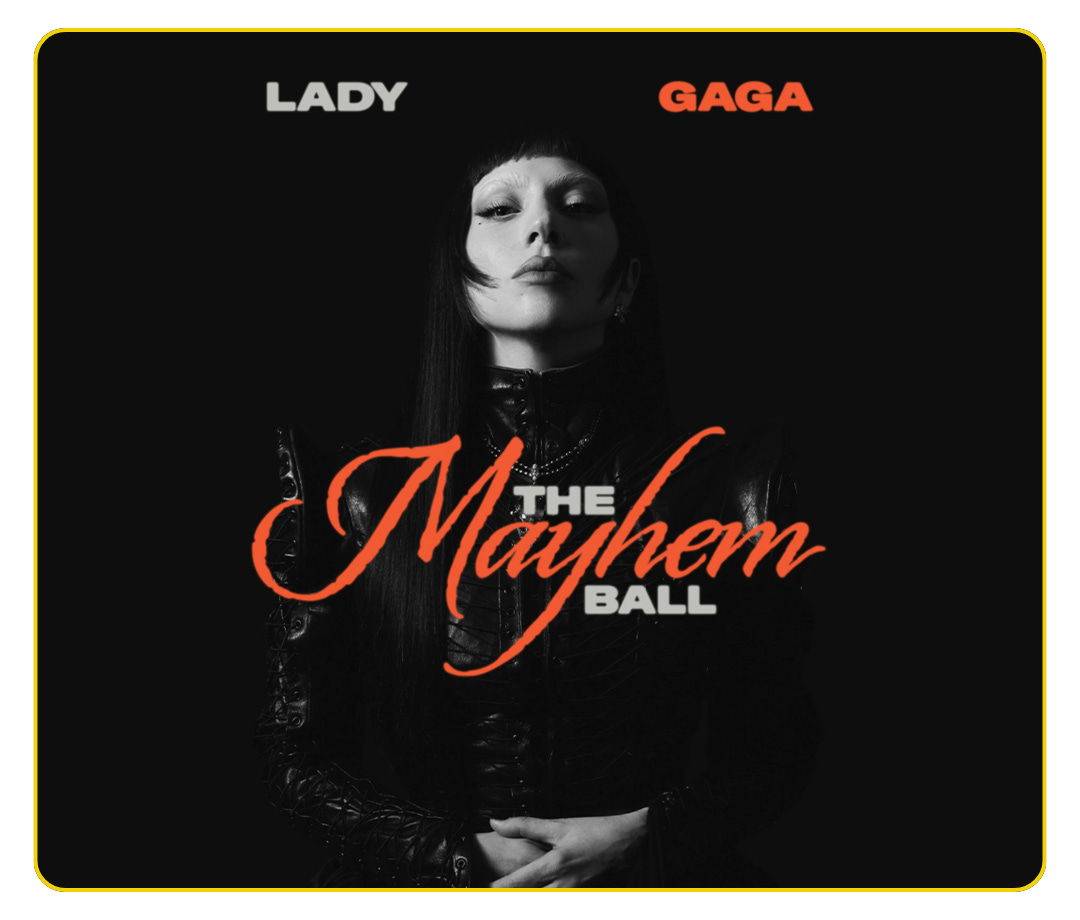
In the marketing buildup, Gaga released merchandise bearing the word—hoodies, shirts, apparel tied directly to the album rollout.
Around the same time, a California-based company, Lost International, pointed out that they had been using the term “Mayhem” for years on surf equipment and apparel.
Same word.
Similar goods.
Different worlds.
So the question practically asked itself: Did Lady Gaga commit trademark infringement?
The federal court didn’t think so.
Yeah, you heard it right.
Same name.
Same products.
But different story.
And this, my friends, is where the beautiful, sometimes frustrating, love story of trademark law really shows itself.
So how did Lady Gaga walk out of the courtroom unscathed?
Let’s break it down together.
In this Founder’s letter, we break down why trademark law is rarely as simple as shared words or similar products. This piece explains how context, evidence, and consumer perception shape real outcomes, and what founders should pay attention to before assuming infringement.
Ready?
Let’s get into it.

Loving This Post?
Show us some love by adding a “❤️,” giving a share, or commenting below; this will make our hearts sing.

But first, some church announcements...
The Firm for the Culture - Power Moves Series
We have two more workshops in this power moves series.
You’ve already heard about some of the top moguls in our industry—including
Kevin Hart; and
Ryan Coogler
Next, we’re going over some red flag contract provisions to look out for, all while looking at the iconic Issa Rae—as we unpack her story, break down the contractual decisions that shaped her careers, and highlight the IP power moves that helped her build longevity and leverage.
More importantly, we’ll translate those lessons so you can apply them directly to your own business.
Registration is FREE; in case you’re unable to make it, sign up and you’ll get the free notes.
After event recordings are $20.00 each.
Hope to see you there!
EVENT #3 — DO NOT SIGN THAT CONTRACT | February 26, 2026
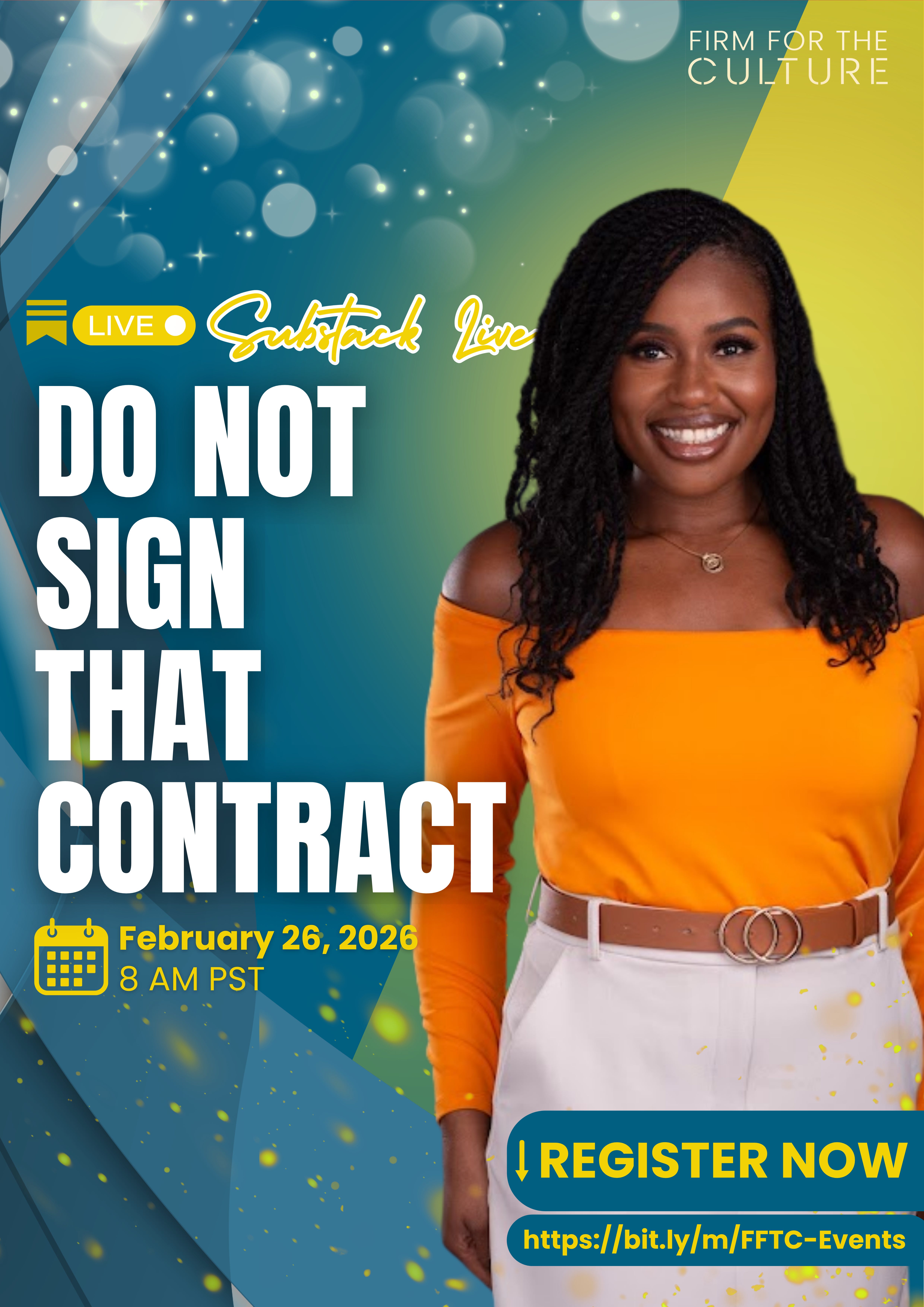
This session keeps getting requested — and for good reason. Too many creatives sign contracts they don’t fully understand because they don’t want to miss an opportunity. In this live session, we’ll walk through what to slow down for, what to question, and what not to sign without clarity.
No fear tactics. Just practical guidance.
If you’ve ever thought, “I hope this is okay,” before signing, this one is for you.
🔗 Sign up here: https://bit.ly/m/FFTC-Events
EVENT #4 — THE POWER MOVES SERIES: ISSA RAE | March 12, 2026
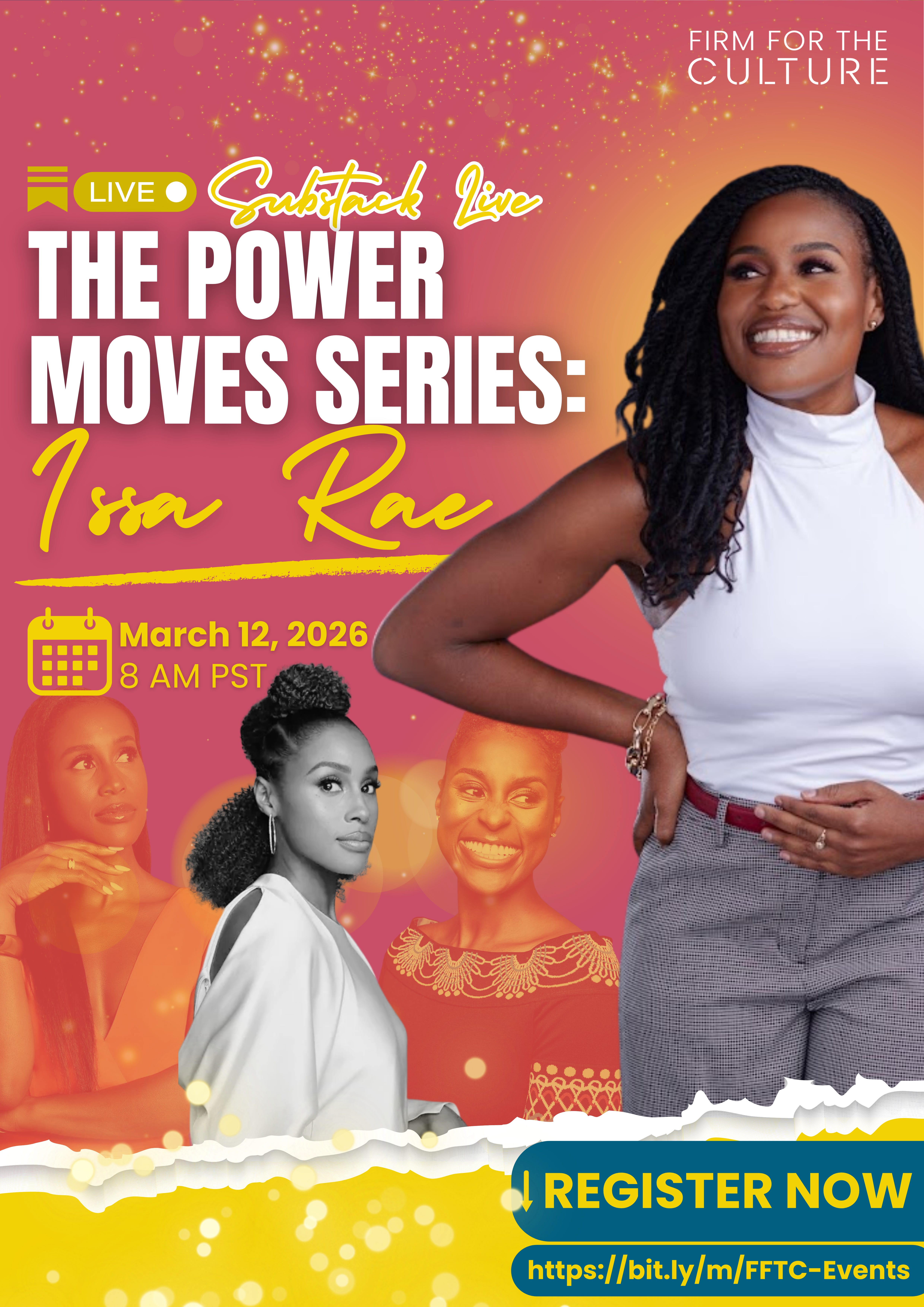
Issa Rae didn’t just create culture. She protected it.
Her career is a case study in building with intention, owning your voice, and using IP to support creative freedom instead of limiting it.
In this final session, we’re breaking down how trademarks, ownership, and smart legal strategy helped turn authenticity into longevity.
🔗 Sign up here: https://bit.ly/m/FFTC-Events
Now, back to our regularly scheduled program…. :)

Most people are taught a very clean version of trademark law:
If you use another company’s trademark on similar products, that’s infringement.
Say it three times fast—and then immediately forget it.

It’s not that this statement is wrong.
It’s just…incomplete.
Here’s the thing:
Trademark law is not about word ownership.
It’s about consumer perception.
The question is not just:
“Did you use the word?”
The question is:
“Would consumers believe this product or work is sponsored, endorsed, or affiliated with the trademark owner?”
That’s a different analysis entirely.
And when expressive works enter the picture—music, film, books, art—the analysis shifts.
Let’s break this down some more.

Courts have long recognized that expressive works deserve heightened protection.
Music albums, films, books, and other creative works are not treated like cereal boxes or shoe labels.

But…why though?

Welcome to the First Amendment of the United States Constitution.
Yep, it still works out despite what our government may say…
The use of a trademark in an expressive work is less likely to signal sponsorship or endorsement by a trademark owner of an identical brand.
Because they are not primarily selling goods.
They are communicating ideas.
And that distinction matters.
When a trademark appears on packaging — on a shoe tag, a bottle, a storefront — the question is straightforward:
Would consumers likely believe the trademark owner made, sponsored, or endorsed this product?
That’s classic trademark law.
But when a trademark appears inside the title of an album or other creative work, courts apply a different framework.
They ask two questions:
Is the use artistically relevant to the work?
Is the use explicitly misleading as to source or sponsorship?
That’s why courts have repeatedly held that artists can reference, evoke, or even play with existing trademarks—so long as the use isn’t explicitly misleading.
In fact, this is the same logic that protected the song “Barbie Girl” when Mattel sued, arguing trademark infringement.
The court found that the song was expressive commentary, not an attempt to confuse consumers into thinking Mattel endorsed it.

So for Gaga’s album title, the analysis was relatively straightforward.

An album named Mayhem is an expressive work.
The word functions artistically, not as a brand identifier for surf gear.
That part of the case was never the hard question.

So…this is where things get interesting.
Merchandise is usually where trademark claims do gain traction.
Shirts, hats, hoodies—those are classic trademark goods.
And Lost International argued exactly that: that Gaga’s merch crossed the line from expression into commercial branding.

The court still disagreed.
Why?
Because the merchandise wasn’t being sold as a standalone brand competing with surf apparel.
It was being sold as a promotional extension of the album itself.
In other words, the court viewed the shirts not as independent commercial products, but as speech connected to an expressive work.
The takeaway here is subtle but powerful:
Merchandise that is closely tethered to an expressive work may inherit the same First Amendment protection as the work it promotes.
And another kicker?
Lost International’s biggest problem wasn’t similarity of words—it was lack of evidence.
They could point to shared use of the term “Mayhem.”
But they couldn’t point to actual consumer confusion.

No evidence that buyers thought the surf brand was affiliated with Lady Gaga.
No evidence that Gaga’s fans believed the merch came from Lost International.
No marketplace confusion—just overlap.
And overlap alone is not infringement.

This entire decision came at the preliminary injunction stage.
That matters—a lot.
A preliminary injunction is an emergency remedy.
It’s what a party asks for when they believe something is so harmful, so urgent, that waiting for a full trial would cause damage that cannot be undone.
In other words:
“Judge, stop this now.”
Before discovery.
Before depositions.
Before months (or years) of litigation.
To win, the plaintiff must show:
they are likely to succeed on the merits, and
they will suffer irreparable harm without immediate court intervention.
This is a high bar by design.

The court was not deciding the ultimate fate of the trademark claims.
It was deciding whether Lost International had shown enough right now to stop Gaga’s use immediately.
The court said no.
Which means two things can be true at the same time:
Gaga wins this round.
The case could still evolve if evidence changes.
This is why early headlines often oversimplify trademark rulings.
A denied injunction is not a declaration of victory—it’s a declaration of insufficient proof at that moment.

This situation is a beautiful case study into how trademark law actually works.

It teaches three critical lessons founders can ofter overlook:
1. Context matters more than words.
Same term, different function, different legal outcome.
2. Merch isn’t automatically commercial infringement.
When tied tightly to expressive works, it can be protected speech.
3. Trademark disputes are evidence-driven.
Courts care about confusion in the real world, not assumptions on paper.
And the Biggest Lesson of them All? Trademark law doesn’t punish creativity. It punishes misleading use.
And sometimes, what looks like infringement at first glance dissolves once you zoom out and examine how consumers actually experience a brand.

Trademark law resists shortcuts.
It forces nuance.
It demands context.
It refuses to give easy answers to hard questions.
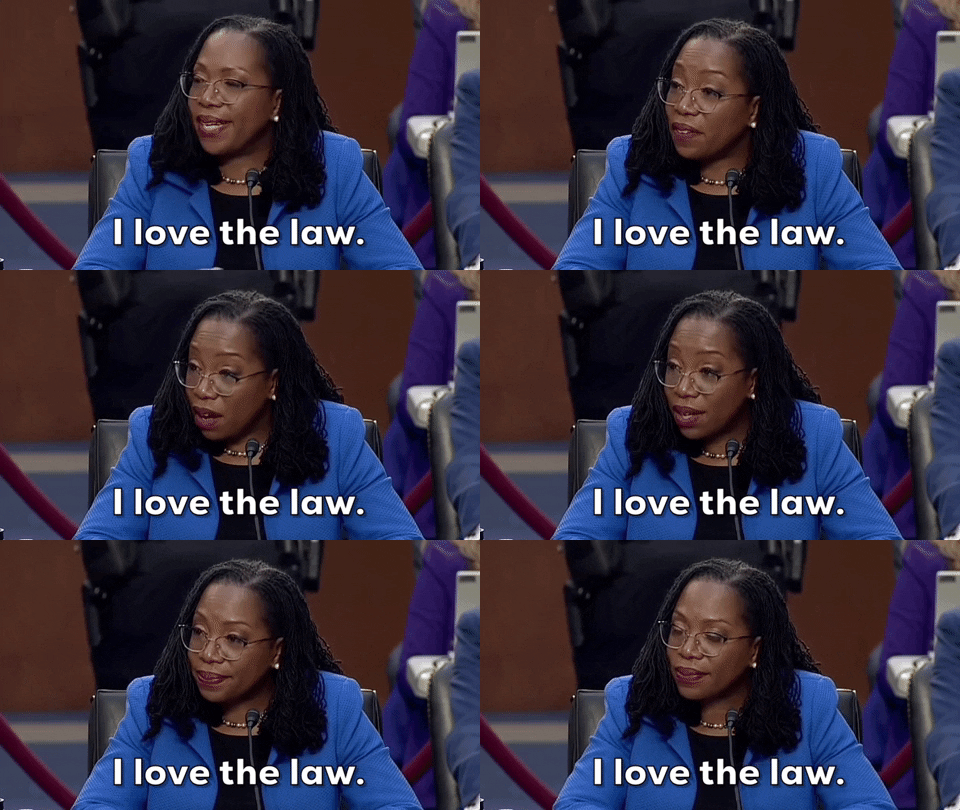
And that’s exactly why when someone asks me, “Is this infringement?” the honest answer is often:
It depends—and we need to look closely.
Because Mayhem shows us that trademark law isn’t about who used a word first.
It’s about how the word lives in the marketplace.
And that’s where the real work begins.

How do your customers actually experience your brand in the marketplace?
Let’s talk. Drop a comment or hit reply.

Want help figuring out whether your name—or brand—is ready for trademark protection?
We’ve got you.
Book a Strategy Session with Firm for the Culture and let’s make sure your name isn’t just recognized—it’s protected.
Need Help Protecting Your Creativity?
If you are unsure—or if you know you need to take action—reach out to us.
We have helped countless founders and creatives safeguard their intellectual property, and we would love to do the same for you.

If you need further guidance, reach out to me and my team at Firm for the Culture.
We’re here to help you navigate the copyright, trademark, and thought leadership journey.
Can’t wait to help you protect your dynamic impact.
And #ThatsAWrap
The Doors of the Church Firm Are Open
Thanks for reading
See you next time.