
Hey Fam,
I am proud to announce that I made my best pot of Nigerian jollof rice.
Party edition.
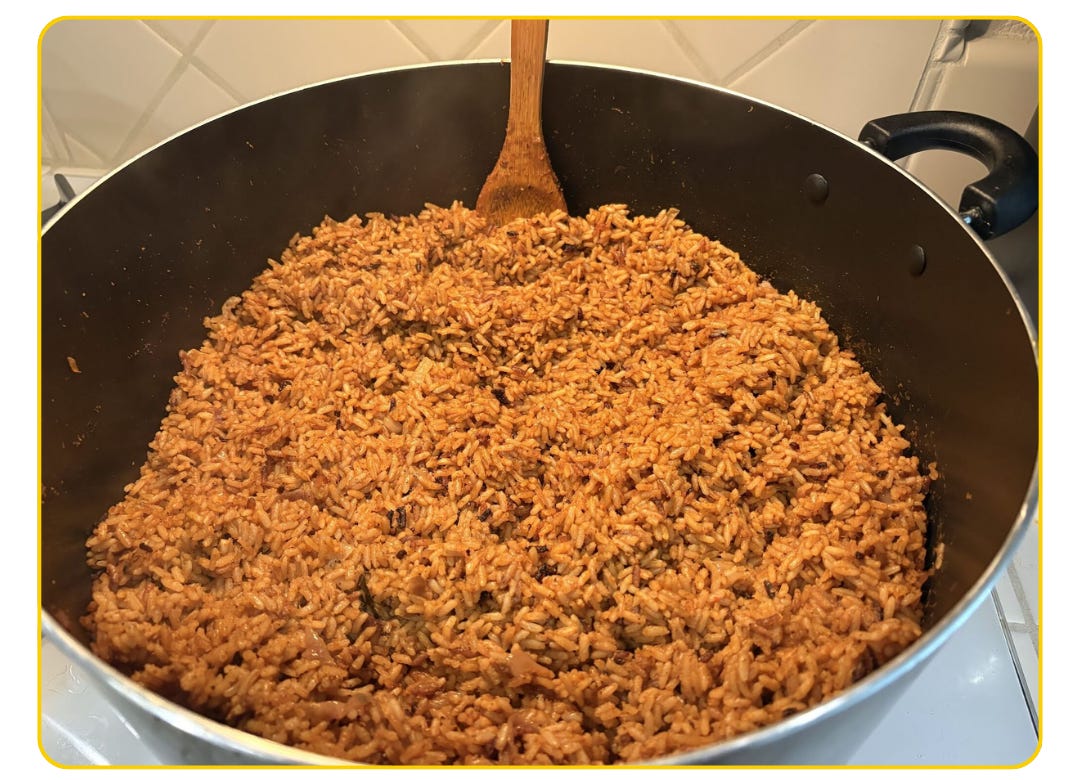
For children of immigrants, you already know why that is a LinkedIn-worthy moment.
I thanked Jesus and my Momma accordingly.
But I am an IP attorney.
And I cannot make jollof rice without also thinking about intellectual property.
Blame my neurodivergence; I have fully made peace with it.
So after I posted proof of my biggest accomplishment to date, I added a line almost as an afterthought: recipes can be trade secrets, but they cannot be protected by copyright.
*RECORD SCRATCH*
The responses I received told me that line deserved more than a footnote.
Because the truth is, copyright gets reached for constantly — by founders, by creators, by people who built something real and want to protect it.
But sometimes, believe it or not, copyright simply is not the right tool.
The law has lanes.
Knowing which lane applies to what you built changes everything about how you protect it.
So let us talk about it.
Party Rice & Protection
I sit across from — and on Zoom with — founders and creators every week who have poured themselves into their work.
A recipe perfected over years.
A phrase that became a movement.
A signature move that the internet turned into a meme and a video game turned into a product.

And the question underneath almost every conversation is the same one: Is what I built protected?
The instinct is to reach for copyright.
And I get it — copyright is the protection most creators have heard of, it attaches automatically the moment you create something original and fix it in a tangible form, and it covers a wide range of creative work.
Music, books, visual art, film, software, choreographic works. The list is real.
But copyright has edges.
And the edges matter.
I see this come up often enough that I want to name it clearly: there are things copyright was never designed to protect.
Not because the law does not care about creators, but because other legal tools were built for exactly those things.
The mistake is not reaching for protection.
The mistake is reaching for the wrong instrument.
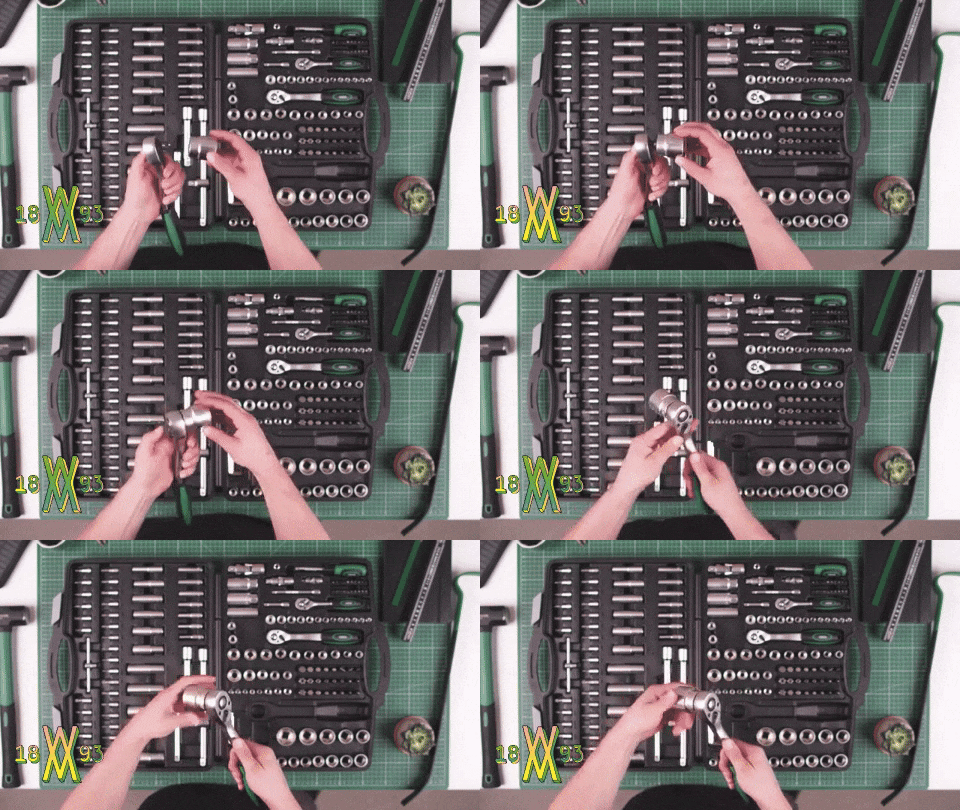
So let’s make sure you’re using your toolbox wisely.
In this Founder's Letter, we are going to talk about three things copyright cannot protect — recipes and processes, short words and phrases, and individual dance moves — and what the right tool actually looks like for each one.
Ready?
Let’s get into it.

Loving This Post?
Show us some love by adding a “❤️” or commenting below; this will make our hearts sing. Also, please share, we want this to get to as many folx as possible.

But first, Church Announcements.
The Firm for the Culture - THE SPEAKER PROTECTION Series
We’ve got a series of workshops, all for you!
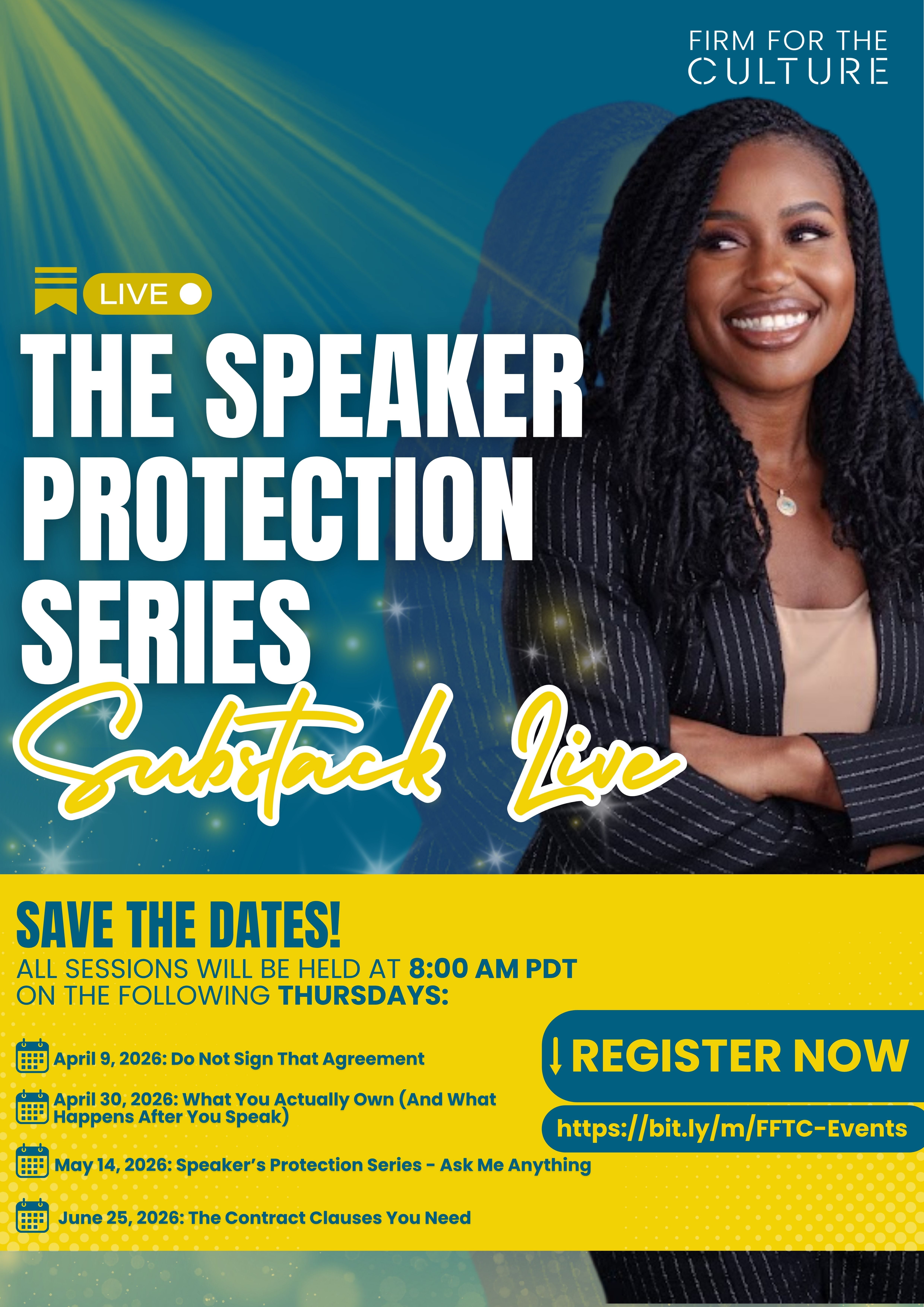
Speaking builds visibility. But it also creates intellectual property.
This series breaks down what actually happens to your ideas, your content, and your rights once you step on stage. From contracts to ownership to licensing, we’ll explore how speaking opportunities can either build long-term value—or quietly take it away.
We’ll cover: how speaking engagements intersect with intellectual property, what speakers often overlook when accepting opportunities, and how to approach speaking as both a visibility and ownership strategy.
What you’ll walk away with: A clearer understanding of how to protect, position, and leverage your content as a speaker—before, during, and after every engagement.
Here’s a preview for your viewing pleasure:
Workshop 4: The Speaker Protection Series: The Contract Clauses You Need
📅 June 25, 2026 at 8:00 a.m. PDT
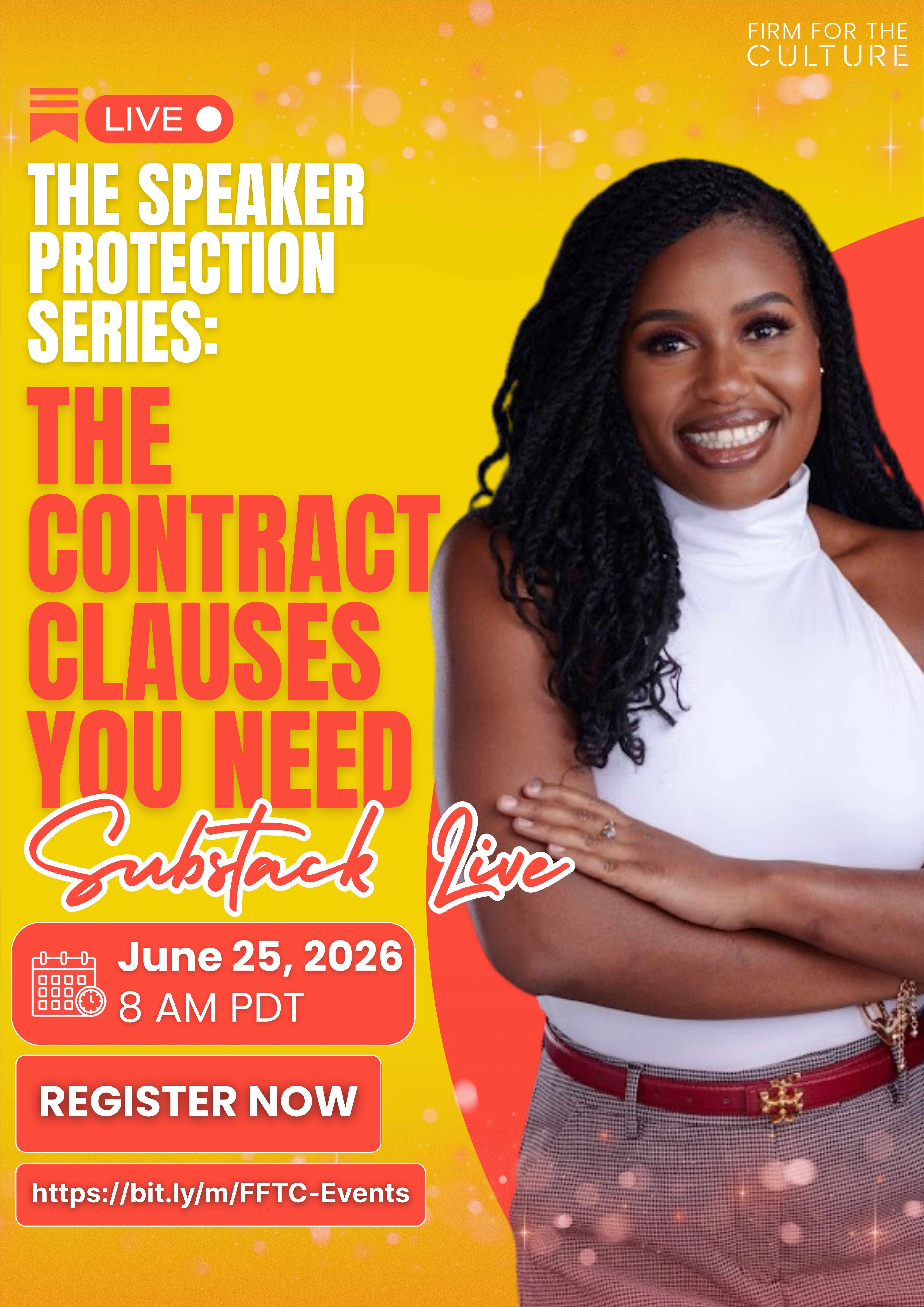
Growth usually comes with paperwork. Protection comes with awareness.
This workshop focuses on the specific contract clauses that directly impact your control, ownership, and long-term leverage as a speaker.
We’ll cover: key clauses around ownership, licensing, usage, distribution, and how to structure agreements that actually protect your work—not just your participation.
What you’ll walk away with: A clear understanding of the clauses you need in place and how to approach contracts with intention and strategy.
Register for The Speaker Protection Series: The Contract Clauses You Need workshop
For founders who are building brands. Creators who are shaping culture. Entrepreneurs who refuse to be extracted from.
Registration is FREE; in case you’re unable to make it, sign up and you’ll get the free notes.
After event recordings are $20.00 each.
Hope to see you there!
June 25, 2026 - The Contract Clauses You Need workshop

Here is the legal reality behind that footnote I dropped on LinkedIn.
Copyright protects expression.
But it does not protect ideas, methods, systems, or processes — even when those ideas are original, and even when those processes took years to develop.
A recipe is, at its basic foundational understanding, a process.
The instructions for how to make Nigerian jollof rice — the sequence of steps, the order of ingredients, the technique — describe a method.
And methods are not copyrightable under U.S. law.
This is sometimes called the idea-expression dichotomy: the underlying idea or process belongs to the world; only the specific, original expression of it can belong to you.
It’s a little complicated, but keep going with me…

Because the making of Jollof Rice, or your world famous chilli, or Tia Linda's dynamic coquito, or Dad's incredible Sloppy Joes — all of these are processes in the eyes of the law… and such processes cannot be registered for or protected by copyright.
BUT…what can be protected is the creative expression surrounding it — the story of how the recipe came to be, the headnotes, the photographs, the prose on the page.
That’s likely why you see the Pinterest ready recipe pages with fifty-leven photos before you see any recipe.

A cookbook can be copyrighted as a whole.
The recipes inside it cannot.
So what does protect a recipe?
So glad you asked.
Trade secret law — and only if you maintain it properly.
A trade secret is information that has economic value because it is not publicly known, and that you take reasonable steps to keep secret.
For example, the classic example is the Coca-Cola formula, which has been kept under lock, managed by a small number of people, never patented, and never publicly disclosed — deliberately — for over 130 years.
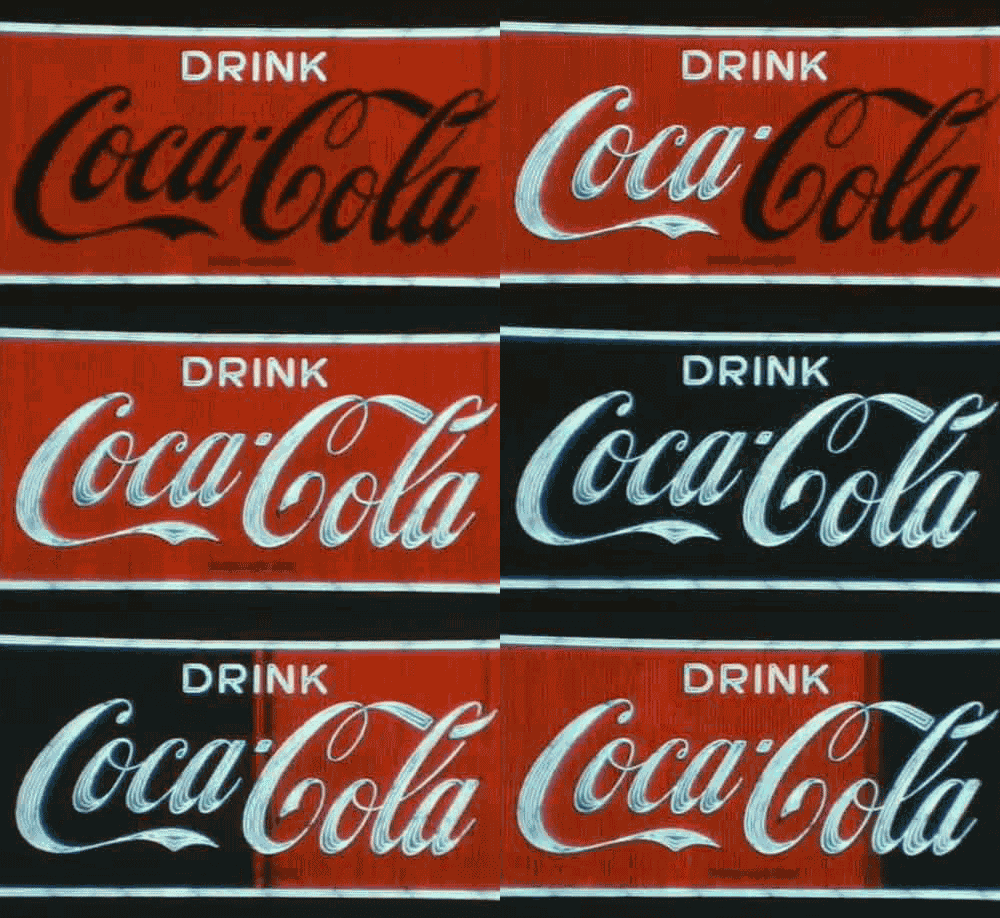
Patent would have required full public disclosure in exchange for time-limited protection. Trade secret gives indefinite protection, as long as the secrecy holds.
The moment you publish the recipe — on your blog, in your newsletter, in your cooking class without a confidentiality agreement in place — the trade secret protection is gone.
Disclosure without protection ends it.

So…back to the Jollof Rice.
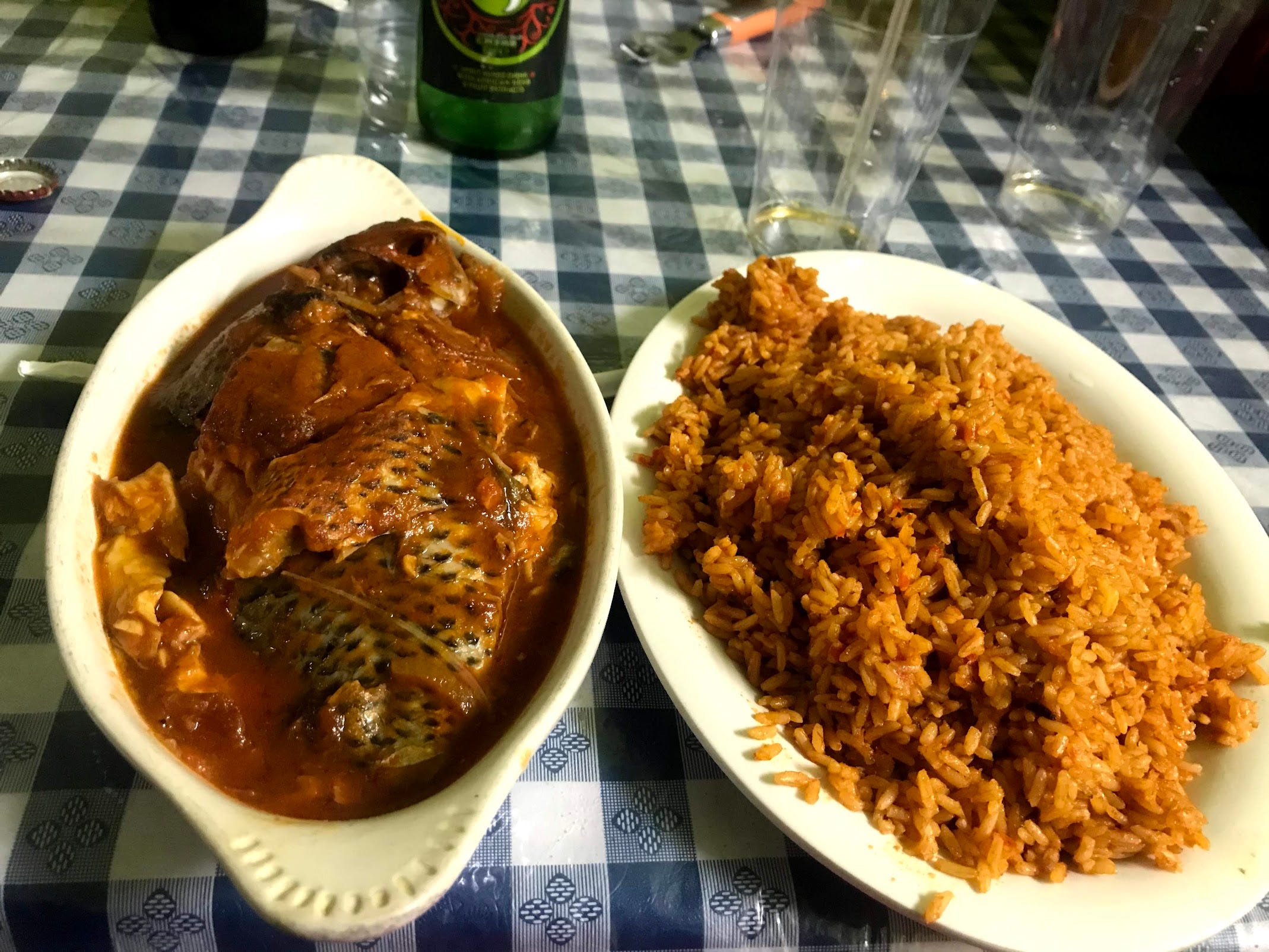
Nigerian jollof rice has been passed down through generations of families, adapted, perfected, and shared openly.
It has connections to many African countries, including Nigeria, Ghana, and Senegal.
This bold brilliant rice is a gift to the world, and the inspiration behind some of the boldest and vibrant rice dishes of the Diaspora.
And because of this, Copyright law will aim to keep it in the public domain for everyone to enjoy.
When Rice is for the Culture, no individual can claim ownership of the dish itself — and that is both the beauty and the limitation of how the law works.
If you have a proprietary formula, method, or process that drives your business, the question is not whether you want to protect it.
The question is whether you have taken the legal steps to actually maintain that protection.
Founder Gem: A trade secret is not protected by creation. It is protected by maintenance. The moment you stop maintaining secrecy — without the right agreements in place — the law stops protecting you.

“Just Do It.”
Three words.
No copyright.
This is one of the most common points of confusion I walk people through. Short words, phrases, titles, slogans, and names are not eligible for copyright protection.
The Copyright Office is explicit: a short combination of words, even an original and creative one, does not contain sufficient expression to qualify as a copyrightable work.

This is not a loophole. It is intentional. If short phrases could be copyrighted, the person who first wrote “good morning” could block everyone else from using it.
The law drew a line, and short phrases landed on the unprotected side of it.
But here is where the lane shift matters.
“Just Do It” is not protected by copyright.
It is protected by trademark — and it is one of the most valuable trademarks in the world.
Trademark law protects words, phrases, logos, and symbols that function as source identifiers — they tell the public who a product or service comes from.
The same applies to your tagline, your program name, your brand phrase.
Copyright is not the right tool.
Trademark is.
And trademark protection requires affirmative steps — selection, clearance, use in commerce, and in most cases, federal registration — to build and maintain.

I see founders sit on a phrase for years, assuming it is protected because they created it, and then discover that someone else has already filed.
So let’s make sure you’re protecting your diverse contributions to the culture.
Your creativity deserves it.
Founder Gem: Copyright and trademark are not interchangeable. If your brand identity lives in a word, a phrase, or a name, trademark is the lane. Get in it early.

🎶 It’s not unusual to be loved by anyone…

Oh the nostalgia…
And Epic Games, the makers of Fortnite capitalized on that cultural treasure without giving due compensation.
Fortnite had released an emote called “Fresh,” which Ribeiro alleged was a carbon copy of his signature dance move from the show.

He was, at the time, in the middle of attempting to register the Carlton as a copyrighted work.
In February 2019, the U.S. Copyright Office rejected his application. Shortly after, Ribeiro dropped his lawsuit.
The Copyright Office’s reasoning goes to the heart of how copyright treats movement. The Office denied his application saying the Carlton failed to meet the standard of a choreographic work because it was an individual, simple movement.
This is the legal line: there is a difference between a dance move and a choreographic work.
The Copyright Office cannot register short dance routines consisting of only a few movements or steps with minor linear or spatial variations, even if a routine is novel or distinctive.
Choreography is defined as “the composition and arrangement of a related series of dance movements and patterns organized into a coherent whole.”
An individual move — even one that is iconic, widely recognized, and culturally significant — does not clear that bar.
The Ninth Circuit has described individual, stand-alone dance movements as the uncopyrightable “building blocks for a choreographer’s expression, in much the same way that words provide the basic material for writers.”
In other words, you can copyright the arrangement.
You cannot copyright the building block itself.
The “Carlton” is a building block. It is a few movements, performed in a specific way, by a specific person, made famous through television.
But under copyright law, what Ribeiro created was a beautiful moment in cultural history — but unfortunately, not a choreographic work.
This does not mean creators of iconic moves have no options.
It means copyright is not the tool.
Ribeiro’s real leverage may have lived in right of publicity claims — the right to control the commercial use of his own likeness and persona — rather than copyright.
The instrument matters.

I think about this in the context of every creator who built something culturally significant and assumed copyright had them covered.
The Carlton did not fail because it was not original.
It failed because it was not the type of thing copyright was designed to protect.
Founder Gem: Copyright protects the composition, not the move. If what you built is a signature moment rather than a choreographic work, right of publicity and other tools may be the better avenue. Know which instrument fits what you actually created.

Recipes, phrases, dance moves.
Three things that feel like they should be protected.
Three things copyright does not reach.
And in each case, a different legal tool — trade secret, trademark, right of publicity — was built for exactly that situation.
The founders and creators we work with are not building generic things.
They are building specific, culturally rooted, deeply personal things.
And the law has tools for that.
The gap is usually not in what was built. The gap is in knowing which instrument to pick up.
This is what we try to bring to every client conversation: not just the filing, but the map.
Where does what you built actually live in the law?
What protects it?
What does it take to maintain that protection? And what happens if you do not?

Copyright is powerful. It is also specific.
And the most dangerous assumption in IP law is that one powerful tool covers everything.
The good news is that the alternatives are real.
Trade secret law, trademark law, right of publicity — these are not consolation prizes.
They are purpose-built tools for exactly the kind of value that copyright does not reach. The work is knowing when to use them.
Because at the end of the day, the recipe was never the problem.
Finding the right type of protection is.

Is there something in your business — a process, a phrase, a signature thing — that you have been assuming copyright covers? Drop a comment — I read every one.
Drop a comment—I read every one.

Want to know where your business actually stands on that gap?
Let’s talk — and make sure your name isn’t just recognized. It’s protected.
Book a Strategy Session with Firm for the Culture and let’s make sure your name isn’t just recognized—it’s protected.
Need Help Protecting Your Creativity?
If you are unsure—or if you know you need to take action—reach out to us.
We have helped countless founders and creatives safeguard their intellectual property, and we would love to do the same for you.

If you need further guidance, reach out to me and my team at Firm for the Culture.
We’re here to help you navigate the copyright, trademark, and thought leadership journey.
Can’t wait to help you protect your dynamic impact.
And #ThatsAWrap
The Doors of the Church Firm Are Open.
Come on it and share the love.
Thanks for reading
See you next time.