
Hey Fam,
There is a very specific kind of frustration that comes after you have already tried to resolve a business problem reasonably.
You explained what happened.
You pointed back to the agreement.
You gave the other side an opportunity to fix it.
And somehow...
you are still having the same conversation.
That is usually when the tone starts changing.
Because asking nicely is one thing.
Asking again while the problem keeps sitting there looking at you?
Different energy.
And eventually founders start wondering:
Okay. What happens now?

Do we keep negotiating?
Bring somebody else into the conversation?
Mediate?
Arbitrate?
Go to court?
And this is where I want you to resist the urge to choose the option that simply sounds the most serious.
Because escalation should not be about proving how mad you are.
It should be about choosing the process that actually moves the problem toward a resolution.
I have said before that most of my clients do not want to go straight into litigation.
I understand that.
Litigation can get expensive very quickly.
And there can be several steps before anybody files a complaint.
That is why the question after the first serious ask fails is not:
“How do I make this threat bigger?”
It is:
“What does this dispute actually need next?”
More structure?
Different decision-makers?
A process the contract already requires?
Or, eventually, a court?
Those are not interchangeable choices.
And they should not be made on autopilot.
Ready?
Let’s get into it.

Loving This Post?
Show us some love by adding a “❤️” or commenting below; this will make our hearts sing. Also, please share, we want this to get to as many folx as possible.
But first, Church Announcements!!
Speaking of this exact problem...
We’re in the middle of Contract Breach Academy, and our next session is next week.
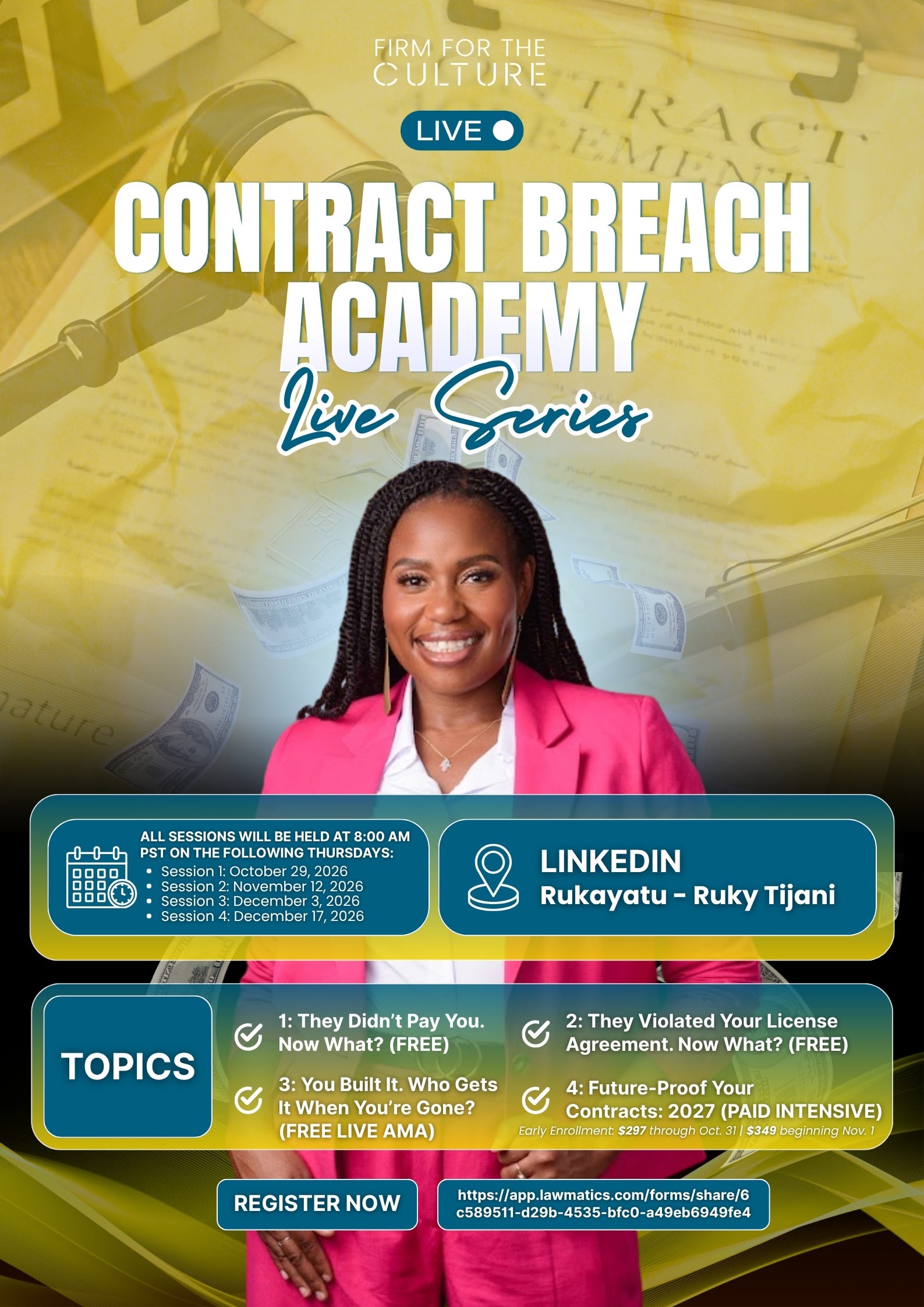
Here’s what’s coming:
November 12 | 8:00–9:30 a.m. Pacific | FREE
They Violated Your License Agreement. Now What?
We’re getting into license scope, unauthorized use of your IP, copyrights and trademarks, royalties, post-termination rights, remedies, and what to consider before you escalate.
December 3 | 8:00–9:30 a.m. Pacific | FREE LIVE AMA
You Built It. Who Gets It When You’re Gone?
We’ll be having a guest conversation about IP, contracts, estate planning, ownership, royalties, licensing income, succession, and what it actually means to build something that can outlive you.
And then we’re closing out the year with:
December 17 | 8:00–10:00 a.m. Pacific | PAID INTENSIVE
Future-Proof Your Contracts: 2027
This is our live contract strategy + vision-planning intensive.
You’ll work through a 2027 Contract Vision Workbook and leave with your own 2027 Contract Blueprint so your agreements can actually match the business you’re building next year.

1 CLICK — REGISTER FOR CONTRACT BREACH ACADEMY
Now, let’s get back to the program.

Here is something I want founders to remember.
A failed first conversation does not automatically mean you need the most formal process available.
Sometimes the conversation itself was the problem.
Wrong person.
Wrong level of authority.
No real decision-maker in the room.
Everybody talking around the issue without anybody having the power to actually resolve it.
That is one reason I have described mediation as more informal than people sometimes imagine.
It does not always have to turn into some big, drag-down, fight-out legal proceeding.
Mediation can be much more informal than people imagine. Sometimes it really is about getting the decision-makers in the room and seeing whether the problem can be resolved before everybody spends significantly more time and money fighting.
And honestly?
Sometimes that alone changes things.
Because there is a difference between:
“We have complained about this three times.”
and
“The people who can actually make a decision are now sitting at the table.”
That is also why I want you looking at the dispute provision in your agreement.
Not after you have already sent five increasingly irritated emails.
Before.
What did everybody agree would happen if a dispute came up?
Did you agree to mediation?
Is arbitration mentioned?
Is there another process spelled out?
Because your contract may already contain the next step everybody is arguing about now.
And if it does?
Read it.
Please.
Do not discover the dispute clause for the first time while you are already threatening to do something completely different.
Founder Gem: The goal is not to escalate for the sake of escalating. It is to understand the path available to you and choose the next move intentionally. The next step should move the dispute forward. Not simply make your email sound scarier.

Once a dispute becomes more formal, something else starts happening.
The dispute begins taking up more space.
And nowhere is that clearer than litigation.
I have said before that litigation can get really expensive, really quickly.
Once you move into court, the process itself starts making demands on the business. Filings, discovery, motions, attorney time, and a whole lot of attention that could be going somewhere else.
That does not make litigation the wrong choice.
It means the cost of the process belongs in the strategy too.
Very glamorous.

Now, that does not mean:
Litigation = bad.
Please do not leave here saying that.
Sometimes court is exactly where a dispute needs to go.
But if you are going to choose that route, I want you to understand that the decision is bigger than:
“Can we file?”
What is the business giving to this process?
What are you hoping to get back?
And does that exchange still make sense?
This is also where arbitration matters if your agreement requires it.
But I am not going to give you some cute chart declaring that arbitration is always faster, mediation is always cheaper, or one forum is automatically better than another.
But I am not going to give you some cute chart declaring that arbitration is always faster, mediation is always cheaper, or one forum is automatically better than another.
Real disputes do not work that neatly.
And your agreement may tell a very different story.
So instead of assuming you know what the label means, read the actual provision.

What did you agree to?
What process applies?
What are you asking the business to commit to by taking that step?
That is the analysis.
Because “more formal” and “more effective” are not synonyms.
Founder Gem: Before you choose the process, understand what that process asks from the business. Seriousness is not the goal. Resolution is.

Now this is where people sometimes start performing seriousness.
You know exactly what I mean.
The email suddenly has URGENT in the subject line.
“My attorney will be contacting you.”
“Govern yourself accordingly.”
A few extra legal words appear.
Everybody is typing in a much more formal font spiritually.

Listen.
That is not leverage by itself.
Leverage comes when the other side understands that your next move is real.
I have talked before about one matter where we had a fully prepared arbitration complaint.
We were not waving around some vague threat.
We were prepared to move.
And that single move reframed the negotiation. It made settlement the practical choice for the other side, not simply the fair one.
That is what readiness can do.
It gives the next step weight.
There is a huge difference between:
“You better fix this or else.”
and actually knowing what “or else” means.
That is why I keep coming back to enforcement.
Your contract is only as powerful as your willingness to use the provisions you put inside it.
If everybody learns that the consequence never comes?
Eventually, it stops being much of a consequence.
But readiness does not mean you always have to take the biggest possible action either.

Sometimes being prepared gives you enough leverage to settle.
Sometimes the information tells you the dispute is no longer worth pursuing.
Sometimes another path solves the issue without going further.
Those decisions can still be strong decisions.
The point is that you made them intentionally.
Not because the other side assumed you would never follow through.
Founder Gem: It’s not about hostility; it’s about clarity, consistency, and a willingness to act. You do not need to sound more threatening. You need to know what you are actually prepared to do next.

Getting More Serious Is Not The Same As Getting More Combative.
That is really the distinction.
Once the first attempt fails, the goal is not to keep turning up the temperature until somebody gives in.
The goal is to figure out what structure the dispute needs next.

Sometimes the people involved can still resolve it.
Sometimes mediation helps create a more productive conversation.
Sometimes the agreement already requires another process.
And sometimes the dispute really does need to move into litigation.
But every one of those decisions should answer the same question:
Why are we doing this?
Because once a dispute starts consuming money, attention, and energy, “because we were mad” is not enough.
Your next step should serve the business.
And if it no longer does?
You are allowed to reconsider.
That is not backing down.
That is strategy.
I have said this before, and it belongs here too:
You are not trying to win an escalation contest.
You are trying to resolve a business problem.
So the next step does not need to be the loudest one.
It needs to be the one you understand, the one that serves the business, and the one you are actually prepared to take.

Go pull up one of your current agreements.
Find the dispute provision.
And actually read it.
If the relationship went sideways tomorrow, do you know what everybody agreed would happen next?
More importantly:
Would you actually be willing to follow that process?
If you have never really thought about it before...
now is a very good time.
Before everybody is mad.
Tell me in the comments.

Join Us for Contract Breach Academy
If this article has you thinking about what happens when a contract breaks down—or what you can do before it gets there—join us for Contract Breach Academy.
Across four sessions this quarter, we’re covering nonpayment, license agreement violations, ownership and legacy planning, and how to future-proof your contracts for 2027.
Whether you’re trying to understand your options after a breach or strengthen the agreements behind the next stage of your business, there’s a session for you.
Need Help Protecting What You’ve Built?
At Firm for the Culture, we help founders protect, maintain, enforce, and strategically grow their intellectual property portfolios.
Because getting the registration is a major milestone.
Keeping the asset protected as your business grows is the long game.

Can’t wait to help you protect your dynamic impact.
And #ThatsAWrap.
The Doors of the Church Firm Are Open.
Come on in and share the love.
Thanks for reading.
See you next time.
#ForTheCulture
👩🏾⚖️⚖️