

Hey Fam,
A few weeks ago, I took my car to the car wash.

Now, I would love to tell you that I am the kind of person who washes her car with enough regularity that one trip through the car wash is sufficient.
I am not.
My car had collected dust, dubris from the season, and whatever else happens when you repeatedly tell yourself, “I’ll wash it this weekend,” and then several weekends quietly pass you by.
So when I pulled up to the attendant, I asked him a simple question: if I went through the wash once and my car was still dirty, could I come around and go through again?
He looked at me, paused, probably saw my desperation…
And finally said, “yes.”
I thanked him, pulled forward, and continued on with my day.
Now, this was not a particularly memorable conversation. There were no contracts. No conference rooms. No one made a counteroffer. I wanted something, I asked whether it was possible, and the person with the authority to give it to me agreed.
Believe it or not, that was still, for all intents and purposes, a negotiation.

And I probably would not have thought about that interaction again had I not been reading Negotiating While Black: Be Who You Are to Get What You Want by Damali Peterman.
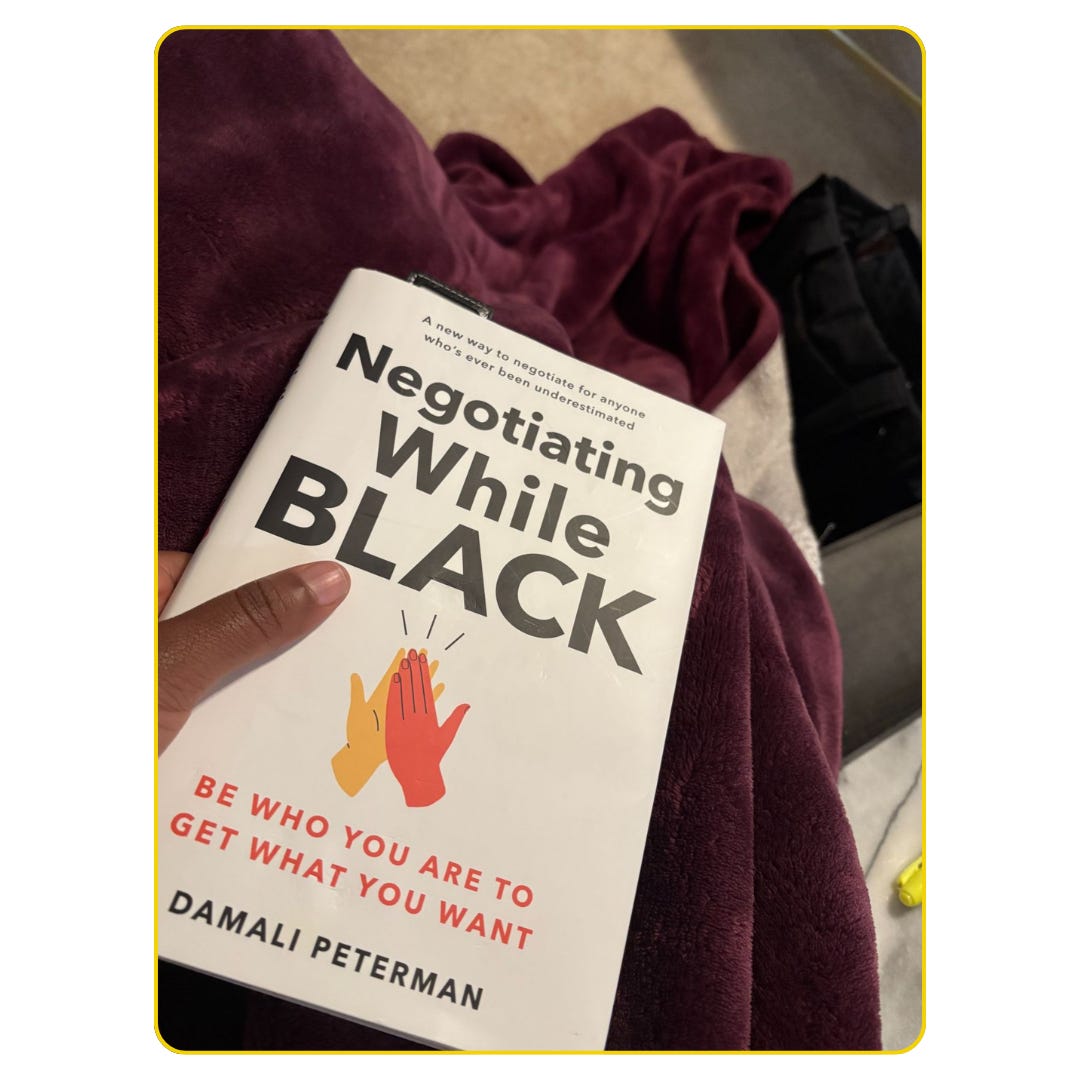
Damali's book expanded the way I think about negotiation because she makes clear that negotiation is not simply something we do when discussing a salary, closing a major business deal, or sitting across the table from opposing counsel.
We negotiate constantly—with our families, our friends, our clients, our colleagues, the businesses we patronize, and sometimes, apparently, the nice gentleman working at the car wash.
Once I started thinking about negotiation this broadly, another question emerged for me, particularly as an intellectual property attorney.
If negotiation is really about understanding what you want, what the other person wants, and what each person is bringing to the exchange, what happens when the thing you are bringing is your intellectual property?
For founders, speakers, consultants, educators, creatives, and thought leaders, this matters enormously.
Our expertise often shows up in deals as frameworks, methodologies, keynotes, curricula, courses, content, brands, recordings, and other things we have spent years creating.
Yet we may walk into a negotiation prepared to discuss our fee without being equally prepared to discuss the rights attached to the work itself.
So, in this Founder’s Letter, we are going to talk discuss the power of knowing your negotiation superpowers, knowing the value you bring to the table, and knowing what you actually own before you negotiate over it.
Ready? Let’s get into it.

Loving This Post?
Show us some love by adding a “❤️” or commenting below; this will make our hearts sing. Also, please share, we want this to get to as many folx as possible.

But first, Church Announcements!!
This week, the Women of Impact Workshop Series continues with Negotiate for Your Impact, featuring Damali Peterman, author of Negotiating While Black: Be Who You Are to Get What You Want.
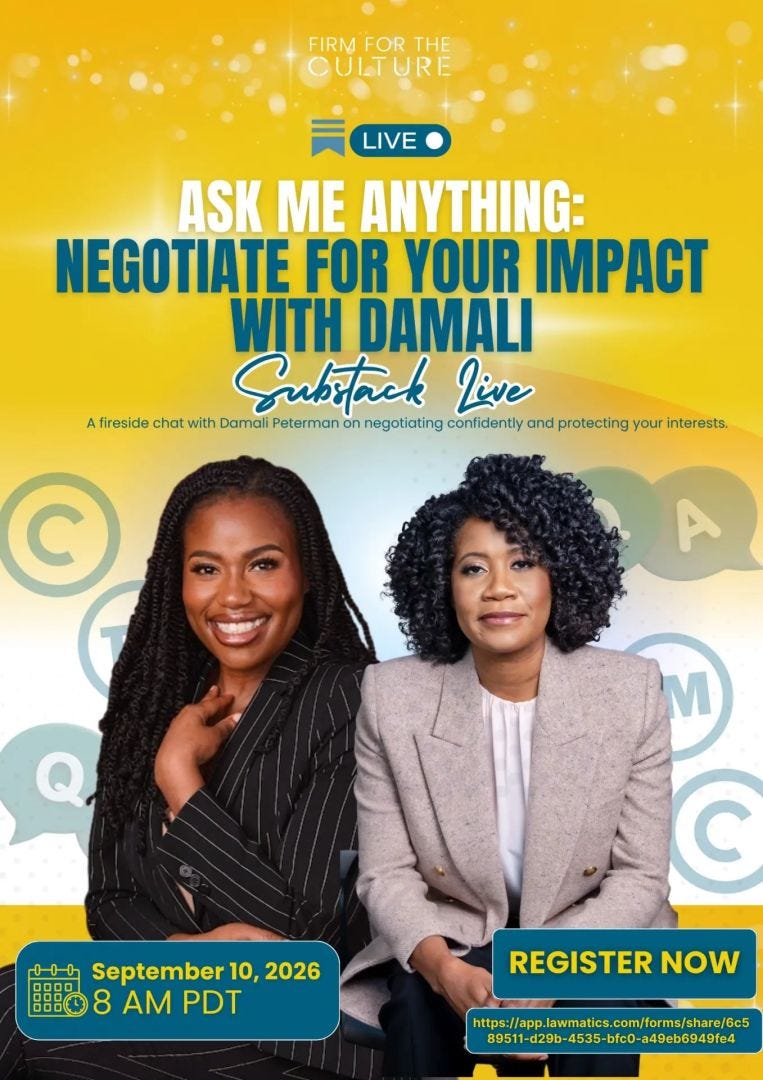
We are going to talk about what it means to identify your own negotiation strengths, understand the value you bring to the table, prepare for negotiations without abandoning who you are, and recognize the legal and intellectual property issues that can quietly become part of the deal.
Because whether you are negotiating a contract, a partnership, a speaking opportunity, or your next major business move, the strongest negotiation begins long before someone puts an offer in front of you.
If you have ever wondered whether you are asking for enough—or whether you even know everything you should be asking about—this conversation is for you.
And after that, we have an awesome finale of our series!
September 24 — Women of Impact: I’m in Love with the Coco (Coco Gauff)
Endorsements, image rights, NIL agreements, and personal-brand protection — Coco is building toward her own 1999 right now, and we’ll talk about exactly what she should be locking down.
All upcoming workshops begin at 8:00 a.m. Pacific Time, 11:00 a.m. Eastern Time.
Sign up even if you’re not able to attend—you’ll still get the workshop notes by email:

One of my favorite concepts from Damali's book is her discussion of negotiation “superpowers.”

I think many of us have inherited a very narrow picture of what a good negotiator looks like.
We imagine the person who is fearless, aggressive, quick on their feet, and completely unmoved by tension.
They make the demand, stare the other person down, and somehow never experience the urge to fill an uncomfortable silence.
Perhaps that is someone's superpower.
It does not have to be yours.
Throughout the book, Damali explores different strengths people bring to negotiation, including listening, patience, grit, steadfastness, flexibility, and fearlessness.
What struck me is that these skills do not require someone to manufacture an entirely new personality before entering the room. They simply require us to become more intentional about the strengths we already possess.
For me, listening is a big one.

And I do not mean hearing just enough of what someone says to prepare my response. I mean listening for what is underneath the words: What does this person actually care about? What problem are they trying to solve? What are they afraid of? What information are they giving me that could create another possible solution?
That kind of listening can fundamentally change a negotiation because someone's stated position and their actual interest are not always the same thing.
Patience matters for the same reason.

Damali discusses an example in which an offer was made, a counteroffer followed, and then there was silence. That silence matters because, for many of us, the anxiety created by waiting can become its own negotiating opponent.
We start wondering whether we asked for too much.
We begin explaining our number before anyone challenges it. Sometimes we even make a concession before the other side has asked us to concede anything.
In other words, we start negotiating against ourselves.
Knowing that about yourself is useful information.
So is knowing that you are a deep listener. Or exceptionally prepared. Or flexible enough to see solutions others miss. Or gritty enough not to abandon the conversation simply because it becomes uncomfortable.
And this is also where Damali's discussion of identity and authenticity becomes particularly interesting to me. Preparing for a negotiation does not mean becoming someone else. In fact, I think preparation can make it easier to remain yourself when pressure arrives.
I learned that lesson long before I became an attorney.

When I was studying for the New York Bar Exam, I spent approximately two months preparing academically. But the night before the exam, I also went to the testing center, put my hands on the door, and prayed and manifested that I would pass.
Yes, I had prepared myself for the exam, but in a way that reflected my own faith and identity, I was also preparing myself for the environment I was about to enter.
I did not walk into the exam room pretending to be somebody else. Preparation allowed me to walk in more grounded as myself.
Negotiation can work the same way.
Founder Gem: The goal is not to perform somebody else’s version of power. It is to understand the power you already bring into the room and prepare yourself to use it intentionally.

Of course, understanding how you negotiate only gets you so far.
You also need to know what you are bringing to the table.

Damali discusses the importance of understanding your unique value proposition, and this is where my intellectual property lawyer brain really started lighting up.
Because when we ask someone, “What are you good at?” the answer can sound deceptively simple.
Maybe you are an exceptional strategist. Perhaps you have spent fifteen years working inside healthcare organizations and understand organizational culture in a way that most consultants do not. Maybe you developed a process for helping executives make better decisions. Perhaps you have been teaching the same methodology for years and have now refined it into a recognizable framework.
At Firm for the Culture, we work with people who have often spent years—even decades—building this kind of expertise. They do not necessarily begin by thinking, “I am creating intellectual property.”
They begin by doing their work.
Then, over time, something happens.

The experience becomes insight. The insight becomes a repeatable process. The process becomes a framework. The framework becomes a workshop, keynote, curriculum, consulting methodology, course, book, certification, or other body of work.
And eventually, someone else wants access to it.
That is the point at which “What am I good at?” becomes a much more interesting question:
What have I actually built here, and what is it worth?
Knowing your value changes the way you approach negotiation because you stop evaluating an opportunity solely through the number someone places in front of you.
You begin thinking about the problem you solve, the expertise required to solve it, the years it took you to acquire that expertise, and the value the other party receives from having access to it.
This is especially important for women and founders of color who may already be navigating assumptions about our authority, credibility, personality, or what our work should cost.
Knowing your value does not mean every negotiation ends with you receiving every dollar or every term you request. It means you are making the decision from an informed place instead of allowing the other person's offer to define the value of what you built.
Founder Gem: Before someone else tells you what your work is worth, you need your own answer.

And this is where we get to the part that I believe founders overlook all the time.
Knowing what your work is worth is not enough if you do not understand what rights you are actually negotiating.

Let's say you are a speaker and an organization offers you $5,000 for a keynote.
You negotiate the speaking fee, everybody agrees, and you are feeling good.
Then the contract arrives.
The organization wants to record your presentation. It wants the right to use clips from the recording in future marketing. It wants a copy of your slides. Maybe it wants to place the full training inside a paid resource library. Perhaps your presentation includes a proprietary methodology or framework that you use throughout your consulting practice.
Now the negotiation looks different.
Because the question is no longer simply whether $5,000 is a good speaking fee.
The question is: What does the $5,000 buy?

Does it buy your time in the room for sixty minutes? Does it also buy the ability to reproduce your presentation? Does it buy ongoing access to your training? Does it buy the right to use your image? Does it buy permission to distribute your materials? Does it buy some form of exclusivity? And for how long?
Those are not small details sitting somewhere at the back of a contract. They are part of the economic deal.
This is why understanding intellectual property can become such an important part of negotiation for thought leaders.
Your trademark rights may matter when someone wants to use your brand or program name. Copyright may matter when someone wants to reproduce or distribute your original materials. Licensing matters when another person wants permission to use something you own without you transferring ownership altogether. Contracts are where the scope of many of those rights gets negotiated.
None of this means the answer should always be no.

Sometimes allowing an event organizer to record your presentation makes perfect business sense. Sometimes broader usage creates valuable exposure. Sometimes licensing your methodology to another organization is exactly how you scale your impact and create another revenue stream.
The important thing is that you know you are making that decision.
There is a significant difference between strategically licensing a right because the overall deal makes sense and casually giving away a right because you did not realize anyone was asking for it.
This is why I keep coming back to one central idea as I read Damali's book:
You cannot intelligently negotiate rights you do not realize you own.
The check is part of the deal. It is not necessarily the whole deal.
Founder Gem: A good fee does not automatically make a good deal. You have to understand what the other side receives along with the check.

So yes, apparently asking to take my embarrassingly dirty car through car wash twice was a negotiation.
A very low-stakes negotiation, but a negotiation nonetheless.
And oddly enough, that little interaction captures part of what I appreciate about Damali's approach to the subject. Negotiation is not a performance reserved for certain people or certain rooms. It is something we are already doing, often without calling it negotiation at all.
The opportunity is to become more intentional about it.

Know your superpower. Understand how you communicate, listen, prepare, persist, and respond under pressure.
Know your value. Understand what your expertise, perspective, experience, and body of work bring to the table before someone else assigns a number to it.
And know what you own. Because if your business is built around your ideas, frameworks, content, brands, methodologies, or creative work, the negotiation may involve much more than the fee sitting at the top of the contract.
That is also why legal strategy and negotiation are not separate conversations for the founders we serve at Firm for the Culture.
The clearer you are about what you have built, the easier it becomes to recognize what should be protected, what can be licensed, what you are willing to share, and what may require a very different deal.
Before your next opportunity arrives, you should not just know what you want to be paid. You should know what you are being asked to give in return.

Now I want to hear from you: What is your negotiation superpower—and where do you think you could become more intentional about using it?
Drop a comment — I read every one.
Drop a comment—I read every one.

Want to know where your business actually stands on that gap?
Let’s talk — and make sure your name isn’t just recognized. It’s protected.
Book a Strategy Session with Firm for the Culture and let’s make sure your name isn’t just recognized—it’s protected.
Need Help Protecting Your Creativity?
If you are unsure—or if you know you need to take action—reach out to us.
We have helped countless founders and creatives safeguard their intellectual property, and we would love to do the same for you.

If you need further guidance, reach out to me and my team at Firm for the Culture.
We’re here to help you navigate the copyright, trademark, and thought leadership journey.
Can’t wait to help you protect your dynamic impact.
And #ThatsAWrap
The Doors of the Church Firm Are Open.
Come on in and share the love.
Thanks for reading
See you next time.