
Hey Fam,
Imagine building your identity from scratch.
You create something that resonates.
You build a following.
You show up consistently.
And over time, your name starts to carry weight.
It becomes how people find you.
How they refer you.
How they recommend you.
It becomes your livelihood.
And then one day, you open your email.
A billion-dollar company is in federal court trying to stop you from using it.
Not for millions.
Not for a massive payout.
But for $1.
At first glance, that sounds light.
Almost generous.
But that’s not the story.
Because $1 takes your money.
A permanent injunction takes your name.
And if your business is built around your identity, that’s not small.
That’s existential.
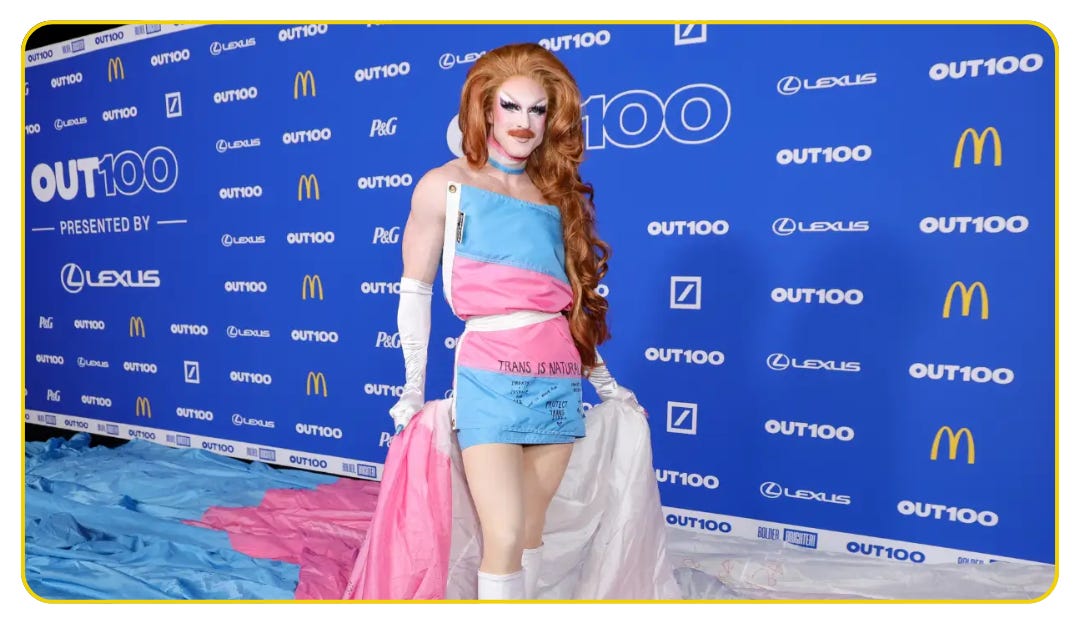
And it’s what happened in Patagonia, Inc. v. Pattie Gonia Productions.
So when the headline hit—“Patagonia sues drag queen for $1”—the conversation didn’t stay in the law.
It moved into culture.
Into questions about fairness.
Power.
Alignment.
Because conversations like this are not simple about what the law allows.
They’re about how founders enforce their rights—especially when the people on the other side are part of the communities they care about.
This, my friends, is where culture and case law start to collide.
And if you’re building a brand rooted in identity, impact, or community, you will face this tension.
So the question isn’t whether enforcement happens.
It’s how you navigate it.
In this Founder’s Letter, we’re breaking down three takeaways that will help you understand how to enforce your rights strategically—without losing sight of the culture you’re building within.
Ready?
Let’s get into it.

Loving This Post?
Show us some love by adding a “❤️,” giving a share, or commenting below; this will make our hearts sing.

Speaking of culture vs. case law, we’ve got some church announcements...
The Firm for the Culture - CULTURE vs. CASE LAW Series
We’ve got a new series of workshops, all for you!
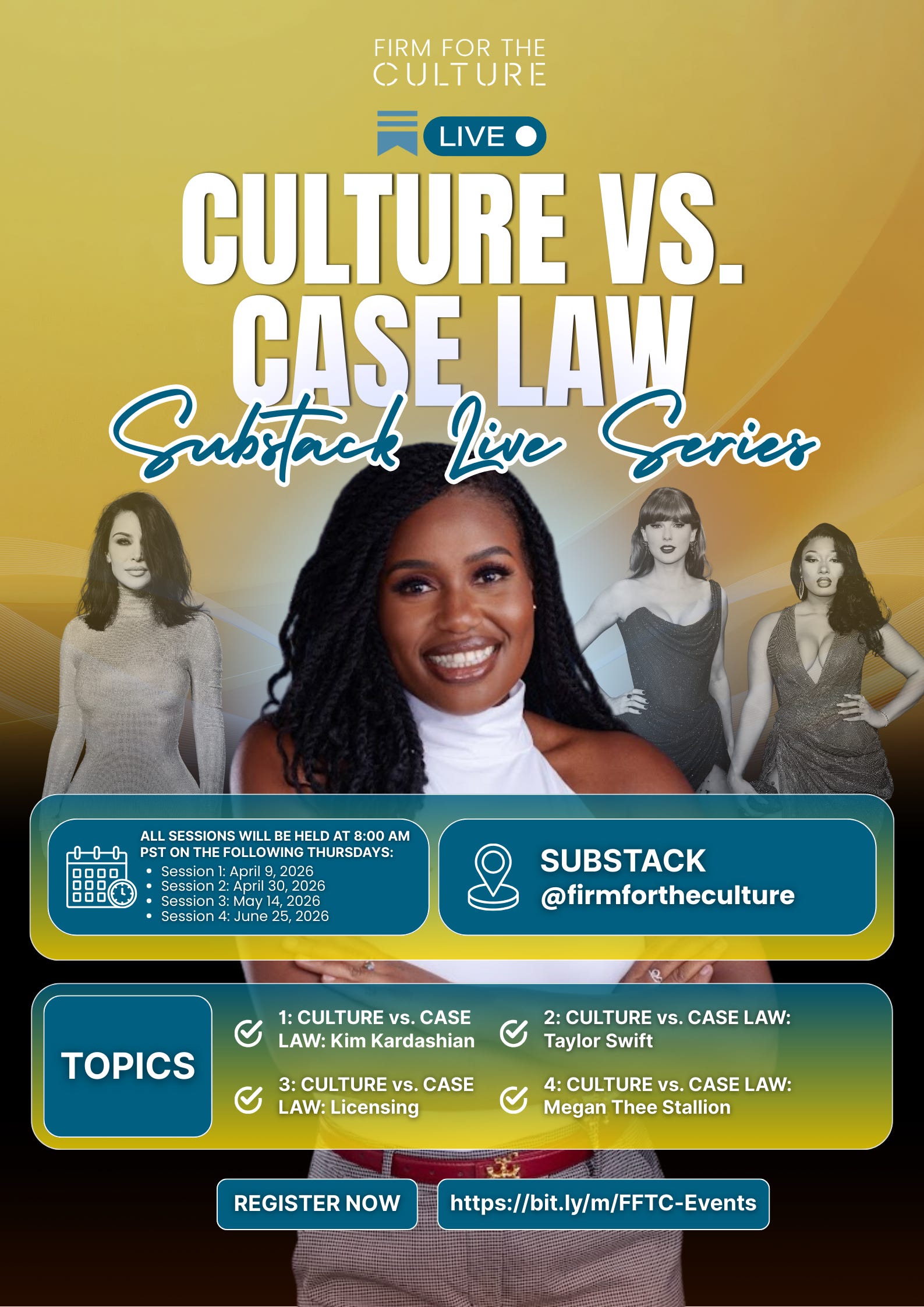
Culture moves fast. The law moves slow. And the gap between them is where creators lose ownership, revenue, and control.
This series uses real cases—celebrity trademark battles, IP disputes, licensing deals—to teach you how to navigate the system and protect what you build.
Each session breaks down how power, ownership, and legal protection actually work, then extracts the lessons founders need:
How do you trademark cultural phrases?
What happens when you can’t own your own work?
How do you enforce your rights when someone copies your brand?
The stakes are real. The strategies are transferable. The lessons apply whether you’re building a media company, a product line, or a personal brand.
Here’s a preview for your viewing pleasure:
Workshop 1: Kim Kardashian - The North West Trademark Strategy
📅 April 9, 2026 at 8:00 a.m. PDT
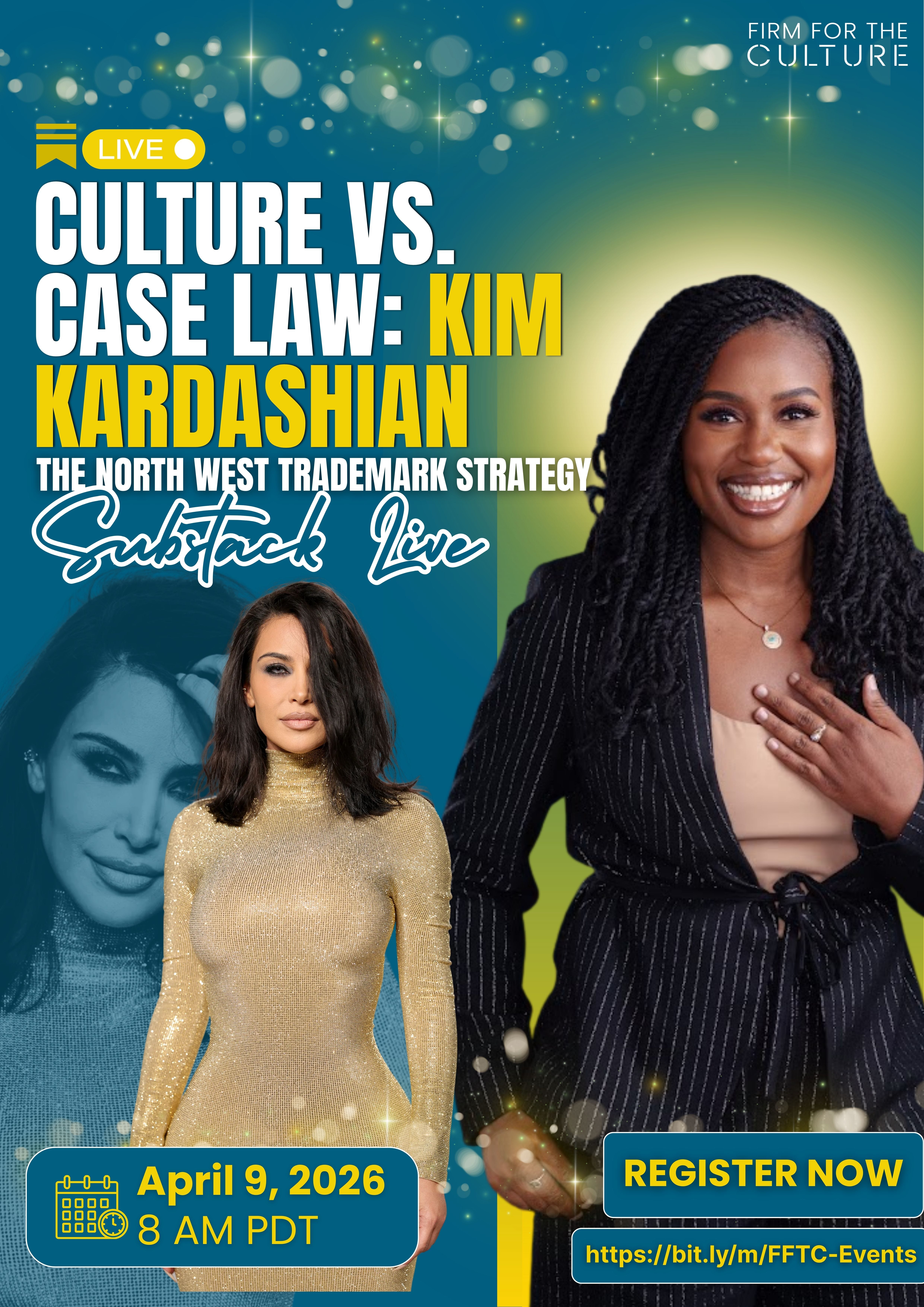
Kim Kardashian filed 9 trademark applications for her daughter’s name—8 are dead, only toys survived.
Learn when to file broadly vs. narrowly, how to read USPTO refusals, and whether aggressive filing makes strategic sense.
Register for Kim Kardashian workshop
Workshop 2: Taylor Swift - Re-Recording Her Way to Ownership
📅 April 30, 2026 at 8:00 a.m. PDT
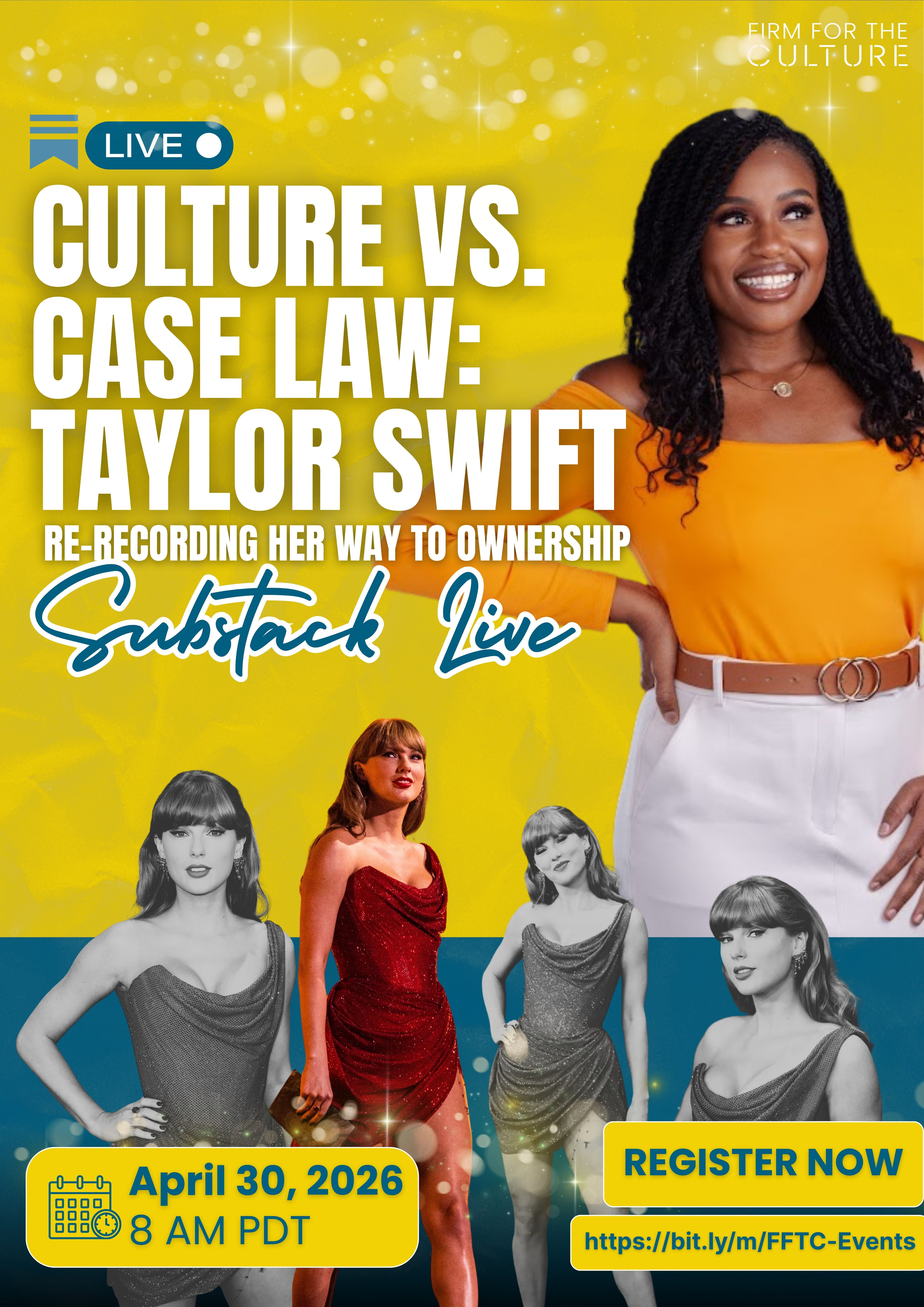
Taylor Swift couldn’t buy back her masters, so she re-recorded her albums, crashed their value, and forced a sale. Learn how she created leverage when she had none—and what that strategy looks like for founders who lost ownership of their work.
Register for Taylor Swift workshop
Workshop 3: Licensing AMA with Coulter “Coby” Henry - Trademarks, Copyrights, and Patents
📅 May 14, 2026 at 8:00 a.m. PDT
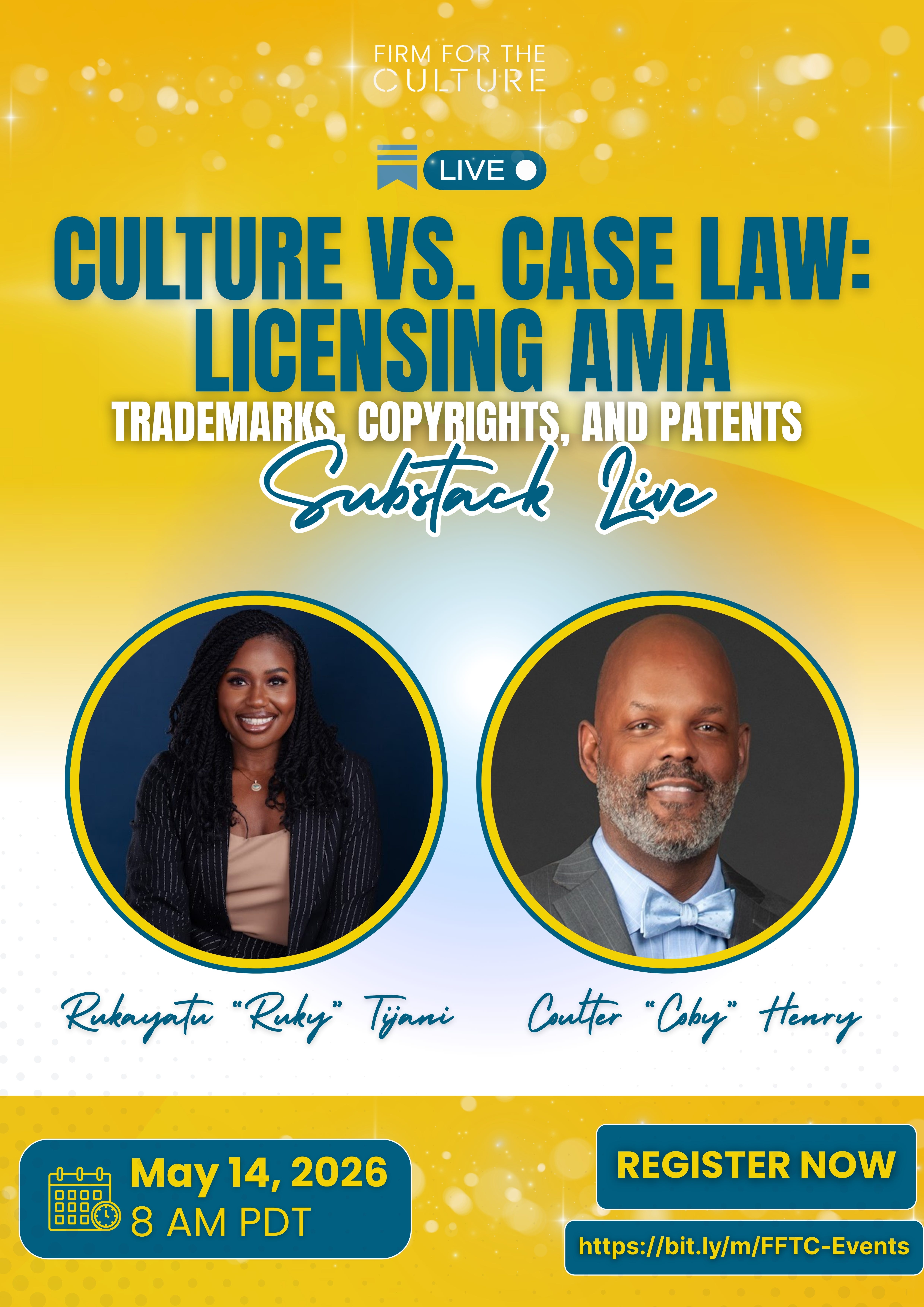
Licensing turns IP into recurring revenue—or locks you out of your own work. Bring your questions about royalty structures, deal terms, and how to protect yourself when licensing trademarks, copyrights, or patents.
Workshop 4: Megan Thee Stallion - The 6-Year Fight for Hot Girl Summer
📅 June 25, 2026 at 8:00 a.m. PDT
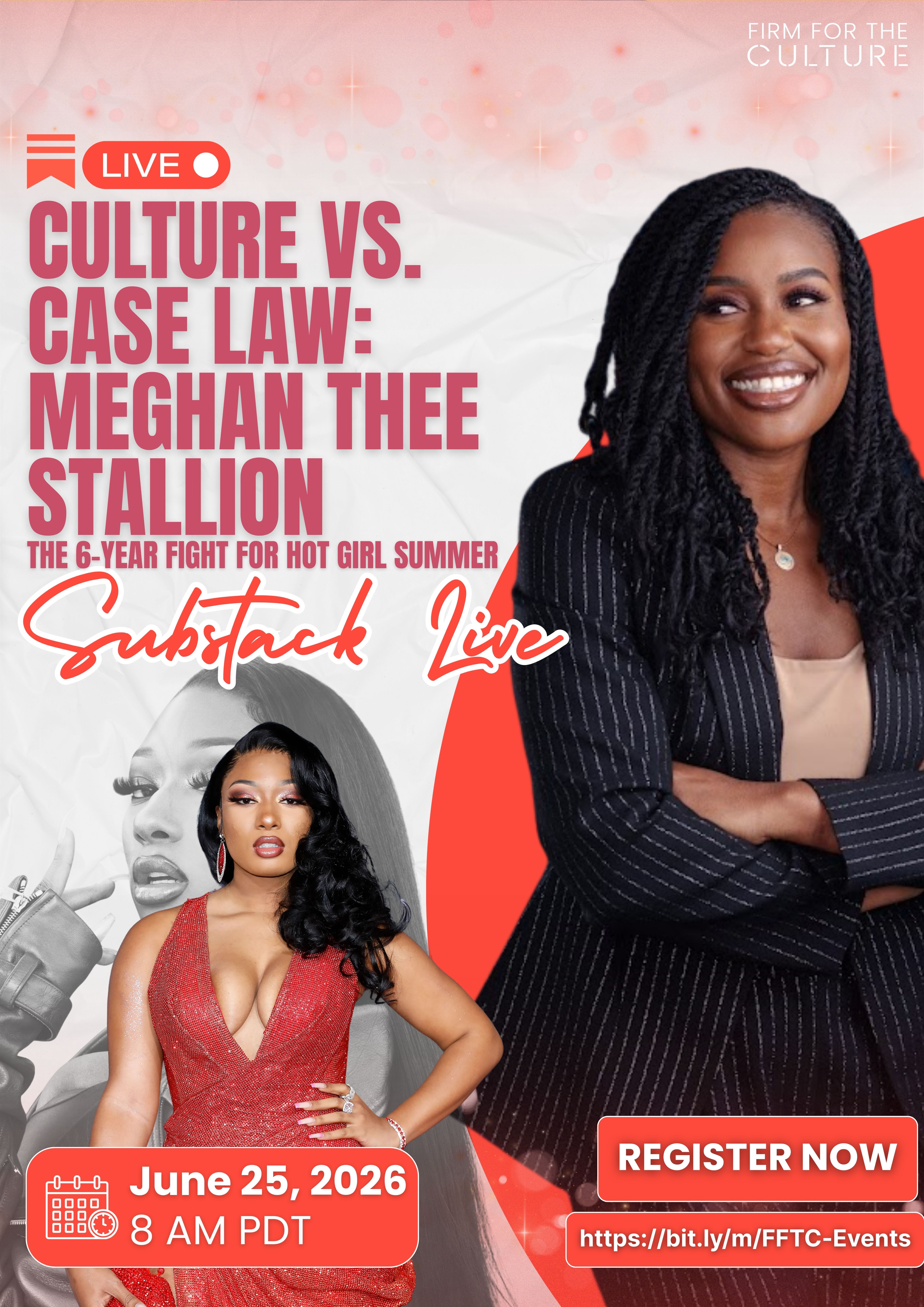
Megan created “Hot Girl Summer” in 2019—it went viral immediately, then took 6 years to trademark. Learn what happens when you try to own culture after it’s already everywhere, and how to file before virality costs you ownership.
Register for Megan Thee Stallion workshop
For founders who are building brands. Creators who are shaping culture. Entrepreneurs who refuse to be extracted from.
Registration is FREE; in case you’re unable to make it, sign up and you’ll get the free notes.
After event recordings are $20.00 each.
Hope to see you there!
🔗 Sign up here: https://bit.ly/m/FFTC-Events
And one more thing…
Behind the scenes, we’ve also been building something to support you beyond the workshops.
The new Firm for the Culture website is now live!

This is a space designed to make intellectual property clearer, more accessible, and easier to act on—especially if you’re building without a roadmap.
Inside you’ll find:
• Clear pathways to our trademark, copyright, and licensing services
• Access to the Intellectual Property Playbook
• A direct way to connect with us for concierge sessions
• Expanded resources to help you move with clarity and ownership
Because the goal isn’t just to learn.
It’s to protect what you’re building while you’re building it.
Explore the new site here: https://firmfortheculture.com/
Now, back to our regularly scheduled program…. :)
So before we even brought this conversation here, we had it in real time on Threads.
The post went viral—pulling in nearly 600,000 views—and the reactions came in fast.
Some people called it unfair.
Others framed it as a power imbalance. There were questions about whether Patagonia was out of alignment with the very communities it claims to support—and whether there was a more thoughtful, more measured way this could have been handled.
And look, I get it. It’s not hard understand the reactions.
Because this is a conversation we have with my clients all the time—especially founders building in social impact spaces.
These questions are hard, nuanced, and require intention.
For example, what does it actually mean to enforce your rights while still honoring the identities, backgrounds, and communities you serve? What does it look like to protect your brand without compromising your values?
Because sometimes, culture and case law don’t move together. And when they don’t, it can feel uncomfortable.
But this is exactly where strategy comes in.
So let’s break this down clearly.
Here are three takeaways that will help you understand how to enforce your rights in a way that is both legally sound and values-aligned.
When most people hear the word “lawsuit,” they assume it’s about money.
And sometimes, it may very well be.
But in trademark law, money is often secondary to something far more important: brand control and awareness:
Because when you own a brand, enforcement doesn’t have to be limited to financial damages.
You have a range of tools available to you—ways to respond that are strategic, calibrated, and aligned with what you’re actually trying to protect.
That can look like stopping use altogether through an injunction, negotiating a coexistence agreement, structuring a license, issuing takedowns, or even working toward a rebrand.
So when Patagonia filed this case, the $1 wasn’t the point.
But it was a signal.
They weren’t trying to extract value from the Patti Gonia, a trans activist whose views they are likely aligned with.
They were trying to define a boundary around their own.
And alongside that symbolic dollar, they sought something far more consequential: a permanent injunction.
What is an injunction?
Well, an injunction is an order from the court to stop doing something. It’s a way parties can prevent irreparable harm when monetary damages are insufficient.
An injunction is particulalry powerful because it shapes what the parties can and cannot do. In the case of trademarks, a case for injunctions can determine whether a name can continue to exist in the marketplace at all.
And once you understand that, the case reads differently.
You can be serving a community and still have to enforce your rights against someone within it. You can believe in the mission and still need to draw a boundary around your brand. And when that moment comes, the question isn’t whether enforcement makes you misaligned—it’s whether your approach is thoughtful, strategic, and grounded in what you’re actually trying to preserve.
So the takeaway here is simple:
Enforcement doesn’t have to be extractive to be effective.
You don’t always have to lead with money. You can lead with structure. With clarity. With boundaries that protect your work while still leaving room for nuance in how you engage.
Because at the end of the day, protecting your brand is what allows you to continue serving your community in the first place.
And that is the work worth doing.
In 2022, the parties reportedly reached an informal understanding—something that may have felt aligned, reasonable, even respectful in the moment.
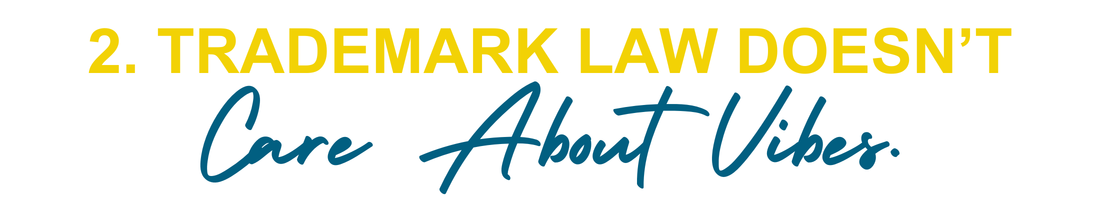
But trademark law doesn’t operate on informal understandings.
It operates on patterns, and informal understandings do not make trademark rights go away:

Because once you own a trademark, enforcement becomes part of the job. Not as a matter of preference, but as a matter of preservation.
The law is not evaluating how fair a situation feels or how well-intentioned the parties are—it’s looking at what you do over time.
And over time, silence has consequences:
If similar marks are allowed to exist without challenge, your rights can begin to erode. Your brand can lose distinctiveness. And in some cases, you can lose the ability to enforce your mark altogether—not because the rights were never there, but because they weren’t maintained.
That’s where doctrines like laches come into play. If someone builds their business while you remain silent, they can argue that they relied on that silence. And if that argument holds, you may be prevented from stepping in later—even if the conflict becomes more serious, even if the stakes become higher.
So what might feel like restraint in the moment can become a limitation later.
And this is the tension founders have to sit with.
I say this all to note that in cases like this, the question isn’t simply whether Patagonia wanted to act.
Good alignment does not override federal registration.

At a certain point, visibility for Pattie Gonia may have started to feel like protection.
And after looking at Pattie Gonia’s platform, it’s easy to understand why.
A large following, a recognizable name, a community that shows up and believes in the work—those are real signals of impact.
Over time, that kind of presence can create the sense that a brand is too established, too supported, too culturally embedded to be meaningfully challenged.

But trademark law doesn’t engage with that kind of perception.
It steps in at the point of conflict.
Because the question isn’t how visible a brand is or how much goodwill it has built. The question is whether that brand begins to overlap with rights that already exist—whether, from a legal standpoint, there is a likelihood that consumers could be confused.
And in that analysis, reach doesn’t create immunity.
It didn’t prevent the injunction here. It didn’t shift the underlying legal standard. The presence, the following, the recognition—all of that exists alongside the law, not in place of it.
What it does change, though, is how enforcement unfolds.
And that’s the tip I want you to take away from this.
Because once a brand reaches a certain level of visibility, enforcement no longer happens quietly. It happens in public, in real time, with an audience that is interpreting, reacting, and forming opinions alongside the legal process. The court of public opinion doesn’t replace the law, but it does shape the environment in which enforcement takes place.
And that’s where strategy becomes essential.
Because now the question isn’t simply whether you have the right to act. It’s how you choose to exercise that right in a way that is thoughtful, measured, and aligned with the broader ecosystem you’re operating within. It’s understanding that you can draw a clear boundary around your brand while still being intentional about the way that boundary is communicated and enforced.
For founders—especially those building in social impact spaces—this is the work. Not avoiding enforcement, but learning how to engage in it with precision. Recognizing that protecting your brand and honoring your values are not mutually exclusive, but they do require decision-making that goes beyond instinct.
Because the law gives you the authority.
But how you use it—that’s where your strategy, and your leadership, actually show up.

This case isn’t about sides.
It’s about structure.
Patagonia may be legally justified.
Pattie Gonia may be culturally resonant.
Both can be true.

But the real question for you is: If your name became a brand tomorrow,
would you own it?
Or would you be hoping no one contests it?
Influence feels powerful.
Ownership is power.
And trademarks move slower than culture —
but they last longer.
Ready to protect yours?

If someone searched the USPTO for your brand name today, what would they find?
Let’s talk in the comments.

Want help figuring out whether your name—or brand—is ready for trademark protection?
We’ve got you.
Book a Strategy Session with Firm for the Culture and let’s make sure your name isn’t just recognized—it’s protected.
Need Help Protecting Your Creativity?
If you are unsure—or if you know you need to take action—reach out to us.
We have helped countless founders and creatives safeguard their intellectual property, and we would love to do the same for you.

If you need further guidance, reach out to me and my team at Firm for the Culture.
We’re here to help you navigate the copyright, trademark, and thought leadership journey.
Can’t wait to help you protect your dynamic impact.
And #ThatsAWrap
The Doors of the Church Firm Are Open
Thanks for reading
See you next time.
As a patent owner-founder, the idea that "you can lead with structure" is food for thought.
'Reputation as leverage" is one thing that comes to mind for me.
A corporate Goliath like Patagonia can strangle any David it comes up against.
But Patagonia clearly trod on eggshells with Pattie Gonia, to minimise reputational backlash.
So in some circumstances, maybe a David could flip this, and weaponize Goliath's reputation. But as you say: "These questions are hard, nuanced, and require intention." And they cry out for professional guidance.
What an incredible analysis! I love the way you break down IP culture topics!