
Hey Fam,
Now, TLC was not talking about contracts when they gave us the award winning song Creep.
But whew...

Scope creep?
It will absolutely sneak up on you.
A few years ago, I agreed to give a talk for an organization.
The fee was around $5,000.
And my scope?
The talk.
That was it.
Not the recording.
Not a bunch of dress rehearsals.
Not the after-events.
Not several extra conversations with executives before I ever stepped on stage.
The talk.
Then, in the weeks leading up to the presentation, the asks started growing.
I was asked to attend no less than three dress rehearsals.
Then there were conversations with CEOs.
More time.
More preparation.
More of me.
But the fee?
Still the same.

And this is exactly how scope creep gets you.
It rarely walks into the room announcing:
“Hi! I’m here to give you a bunch of extra unpaid work.”
No.
It sounds more like:
“Well, obviously you’ll come to the rehearsal.”
“Obviously we need you on this call.”
“Can you send us those materials too?”
“It’s just one more thing.”
And because each request sounds small on its own, founders can keep saying yes without stopping to ask the question that actually matters:
Was this included in what I priced?
Because when the work grows but the compensation does not, the deal has changed.
Even if nobody calls it that.
In my situation, I finally asked the question directly:
Do you anticipate compensating me more for that?
They said no.
And I made a decision about whether that engagement still made sense for me.
That is what we are talking about today.
How scope creep happens.
Why “one more thing” can become expensive when you keep absorbing it.
And how to get much clearer about what your fee actually buys before resentment, confusion, and unpaid work become part of the relationship.
Ready?
Let’s get into it.

Loving This Post?
Show us some love by adding a “❤️” or commenting below; this will make our hearts sing. Also, please share, we want this to get to as many folx as possible.
But first, Church Announcements!!
Speaking of this exact problem...
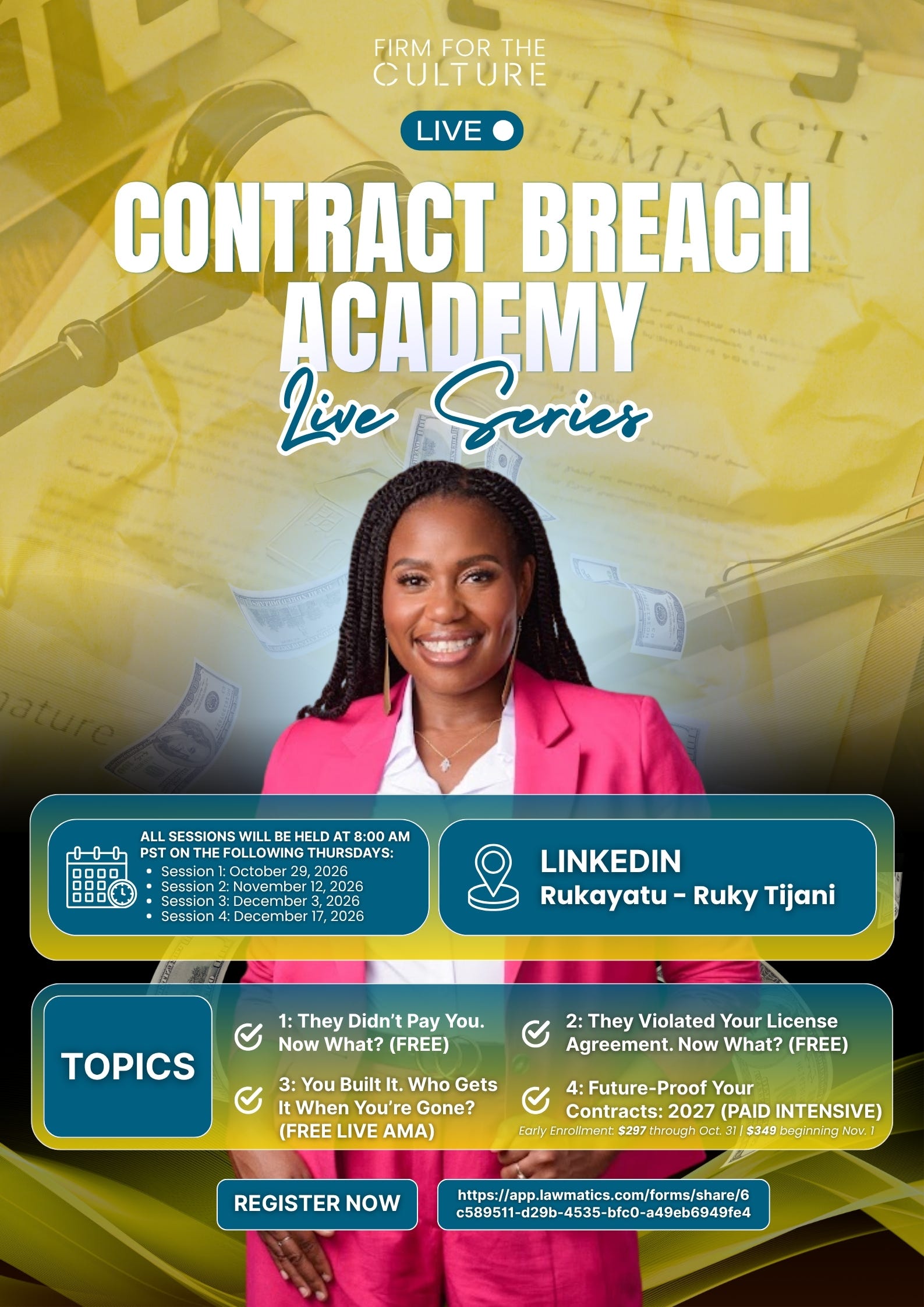
We’re officially kicking off our next education + workshop series at Firm for the Culture:
Because sometimes you did exactly what you said you were going to do.
You delivered the work. You met the deadline. You honored the agreement.
And the other side...didn’t.
Maybe they didn’t pay you. Maybe they used your intellectual property outside the scope of the license. Maybe the relationship changed, the contract broke down, and now you’re trying to figure out what happens next.
Too often, founders are made to feel like there are only two options when that happens:
Let it go or sue everybody.

But there’s a whole lot of strategy in between.
So this quarter, we’re talking about what it actually looks like to respond when someone breaches an agreement, how to understand the leverage you already have, and how to make decisions that protect the business you worked so hard to build.
Here’s what’s coming:
October 29 | 8:00–9:30 a.m. Pacific | FREE
They Didn’t Pay You. Now What?
We’re talking payment schedules, nonpayment, documentation, when to stop working, escalation, and the options available when somebody owes you money and the invoice is still sitting there unpaid.
November 12 | 8:00–9:30 a.m. Pacific | FREE
They Violated Your License Agreement. Now What?
We’re getting into license scope, unauthorized use of your IP, copyrights and trademarks, royalties, post-termination rights, remedies, and what to consider before you escalate.
December 3 | 8:00–9:30 a.m. Pacific | FREE LIVE AMA
You Built It. Who Gets It When You’re Gone?
We’ll be having a guest conversation about IP, contracts, estate planning, ownership, royalties, licensing income, succession, and what it actually means to build something that can outlive you.
And then we’re closing out the year with:
December 17 | 8:00–10:00 a.m. Pacific | PAID INTENSIVE
Future-Proof Your Contracts: 2027
This is our live contract strategy + vision-planning intensive.
You’ll work through a 2027 Contract Vision Workbook and leave with your own 2027 Contract Blueprint so your agreements can actually match the business you’re building next year.
Early enrollment is $297 through October 31.
Regular enrollment is $349 beginning November 1.

1 CLICK — REGISTER FOR CONTRACT BREACH ACADEMY
REGISTER FOR FUTURE PROOF YOUR CONTRACTS (EARLY BIRD PRICING)
Because being the bigger person does not require you to be the person who keeps absorbing the cost.
Now, let’s get back to the program.

One of the easiest ways scope creep happens is when everybody knows the price...but nobody is equally clear on what the price actually covers.
That is a problem.
Because a fee without a clearly defined scope can start feeling like access to everything you know how to do.
And that is not necessarily what you sold.
When I talk about Scope of Work provisions, I want founders to get specific.
What are you delivering?
When are you delivering it?
What tasks are actually required?
What is the timeline?
What standards apply?
And here is one founders sometimes forget:
What is explicitly not included?
That last one matters.
A lot.
Because sometimes the strongest boundary is not simply explaining what you will do.
It is making clear what the engagement does not include.
In my speaking example, that distinction was pretty straightforward.
My scope was the talk.
Not recordings.
Not dress rehearsals.
Not after-events.
Those things may all be perfectly reasonable things for an organization to want.
But reasonable does not automatically mean included.
And this is also why I typically like the scope to be flexible enough to match the actual engagement.
A virtual event might require one kind of preparation.
An in-person event may require something completely different.
One client may need a workshop.
Another may need materials.
Another may need a Q&A.
The work changes.
So the scope should actually reflect the work being purchased.
Because if your fee is based on one assignment but the client relationship quietly turns into five assignments?
That original number is now carrying work you never priced into it.
Founder Gem: If it isn’t in the scope, it isn’t automatically in the price. Your fee should correspond to a defined assignment, with enough clarity around deliverables, timing, and exclusions that both sides understand what they actually agreed to buy.
And once that boundary is clear?
Now you have to recognize when somebody starts pushing past it.

Scope creep does not always look unreasonable.
That is why it works.
Sometimes it sounds incredibly logical.

“Obviously, if you’re giving the talk, you’ll come to rehearsal.”
“Obviously, we need a couple of planning calls.”
“Obviously, you’ll send us the materials ahead of time.”
And individually?
None of those requests necessarily sound outrageous.
But that is not the question.
The question is:
Were they part of the agreement?
Because “obvious” is not the same thing as negotiated.
In my situation, those rehearsals and CEO conversations were time I had not priced into the original deal.
So instead of pretending they were automatically included, I asked about additional compensation.
And that conversation matters.
If the work changes, you are allowed to recognize that the work changed.
If the organization wants something additional, you can ask:
What exactly are you asking me to do?
What do you intend to do with these materials?
How many planning calls are we talking about?
Who is responsible for the additional costs?
Is this now something that needs to be reflected in the compensation?

I have said this before:
You can always negotiate what’s in the scope.
That can include things that seem small.
A networking dinner.
Another planning call.
Additional materials.
Another responsibility before or after the main deliverable.
Because the point is not to nickel-and-dime every interaction.
Please do not leave this Founder’s Letter charging somebody every time they breathe near your project.
That is not what I am saying.
The point is to notice when an occasional accommodation starts turning into a new version of the job.
Because somewhere along the way, “one more thing” can stop being a favor and start becoming part of the work.
And if it is becoming part of the work?
We need to talk about what it is worth.
Founder Gem: When “one more thing” shows up, ask what it is worth before you automatically say yes. Scope creep becomes expensive when the assignment keeps expanding but the fee stays frozen. Name the new ask, understand what changed, and have the compensation conversation before the extra work becomes the new normal.
Now here is the other part.
The best time to protect that boundary is not when you are already irritated.
It is when you are writing the agreement.

Listen.
A good check can make founders overlook a lot.
I have talked about this in the intellectual property context before, but scope creep has the same sneaky little energy.

Somebody offers you a strong fee and suddenly you’re feeling real flexible.
One extra call? Sure. A rehearsal? Okay. A “quick” set of materials? Fine.
Next thing you know, that check has brought cousins, aunties, and a whole plus-one list to the engagement.
Absolutely not.
The fee matters. But so does what you actually agreed to do for it.
Because the check does not answer every question.
And my speaker agreement materials make this point very clearly:
Define your scope of work, payment terms, and cancellation rights in writing.
Because those three things work together.
The scope tells everybody what you agreed to do.
The payment terms tell everybody how and when that work gets compensated.
And the cancellation or termination terms help establish what happens when the engagement does not go according to plan.
That is very different from everybody operating on goodwill and hoping you remember the deal the same way six weeks later.

I have taught, for example, that cancellation provisions can distinguish between what happens if the organization cancels and what happens if the speaker cancels.
The exact terms will depend on the deal.
But the larger point is that the agreement should contemplate the possibility that things change.
Because things do change.
Projects shift.
Organizations ask for more.
People rethink what they need.
And if you have already decided what you are selling, how you are being paid, and what happens if the engagement changes?
You have something concrete to point back to.
Instead of trying to renegotiate the entire relationship from memory.
This is also why I want founders drafting terms they are actually prepared to use.
Your contract should not be full of boundaries that disappear the second somebody pushes on them.
It should reflect the way you actually intend to run your business.
Founder Gem: There are so many steps that can occur before you decide to file your complaint in a court of law. The goal is not to escalate for the sake of escalating. It is to understand the path available to you and choose the next move intentionally.

Scope Creep Gets Expensive When The Work Keeps Growing But The Fee Doesn’t.
Here’s what I want you to remember.
Scope creep is not always dramatic.
Sometimes it is one extra call.
One extra rehearsal.
One more round of revisions.
One more deliverable that somehow became “part of the project.”
And individually, those things may not feel like a big deal.
But when the work keeps expanding while the fee stays exactly the same?
That is when you need to pay attention.

Because the issue is not simply whether you are willing to do more.
The issue is whether the agreement still reflects the work you are actually doing.
That is why I want founders getting clear about scope before the work begins.
What are you delivering?
What is not included?
What does the fee cover?
And what happens if the engagement changes?
You cannot prevent every client from asking for more.
But you can make sure every new ask does not automatically become part of the original deal.
Sometimes the answer will still be yes.
Sometimes the scope will change.
Sometimes the compensation needs to change with it.
The important part is that you notice the difference.
Because “one more thing” should not quietly become five more things that nobody ever agreed to pay for.

Think about the last client project, speaking engagement, or consulting agreement you completed.
What did you end up doing that your original fee never actually covered?
Was it the extra call?
The extra revision?
The additional materials?
The pre-event meeting?
The “quick” request that somehow became part of the job?
And here’s the bigger question:
If that same request came in today, would you automatically say yes again? Or would you stop and have a conversation about the scope first?
Tell me in the comments.
I have a feeling some of y’all have a scope creep story 👀
Let me know what you find in the comments.

Let’s Make Sure Your Brand Is Protected
Want to know where your business actually stands?
Book a Strategy Session with Firm for the Culture and let’s make sure your name isn’t just recognized—it’s protected.
Need Help Protecting What You’ve Built?
At Firm for the Culture, we help founders protect, maintain, enforce, and strategically grow their intellectual property portfolios.
Because getting the registration is a major milestone.
Keeping the asset protected as your business grows is the long game.

Can’t wait to help you protect your dynamic impact.
And #ThatsAWrap.
The Doors of the Church Firm Are Open.
Come on in and share the love.
Thanks for reading.
See you next time.
#ForTheCulture
👩🏾⚖️⚖️