
Hey Fam,
Licensing is very easy to understand when everybody is behaving.
You give someone permission to use your intellectual property.
They use it the way you agreed.
You get whatever value you negotiated for.
Everybody goes home happy.
The agreement gets a lot more interesting when you look up one day and think:
Wait.
You were not supposed to do that.

Now we have a conversation.
I have worked with a client who licensed curriculum to a state university.
And the permission was very intentional.
The university could use the curriculum within the state, for residents of that state, and through a specific platform.
That did not mean:
put it on Google Drive,
send the link around,
or expand the program wherever somebody thought there might be an audience.
Those limits mattered because my client had her own plans for the curriculum.
She wanted to expand into other states.
She was not interested in granting one license and then waking up to discover that she was competing with her own work somewhere she never agreed for it to go.
See, this is the part people sometimes miss about licensing.
A license is permission.
It is not ownership.
And permission can have boundaries.
I have used my dad’s car to explain this before.
When I visit my family in New York, my dad will let me borrow his car.
But that permission has limits.
Driving around locally? Fine.
Taking his car on a cross-country road trip?
Absolutely not.
It is still his car.
He gave me permission to use it. He did not give me permission to do whatever I wanted with it.
Licensing works the same way.

And if you believe the licensee has crossed one of those boundaries, I know the immediate question is:
“Okay, Ruky. What do I do now?”
We are going to talk about that.
But I need you to do one thing first.
Go back to the permission you actually gave.
Because before we can talk about a violation, we need to know where the line was.
Ready?
Let’s get into it.

Loving This Post?
Show us some love by adding a “❤️” or commenting below; this will make our hearts sing. Also, please share, we want this to get to as many folx as possible.
But first, Church Announcements!!
Speaking of this exact problem...
We’re in the middle of Contract Breach Academy, and our next session is this week.
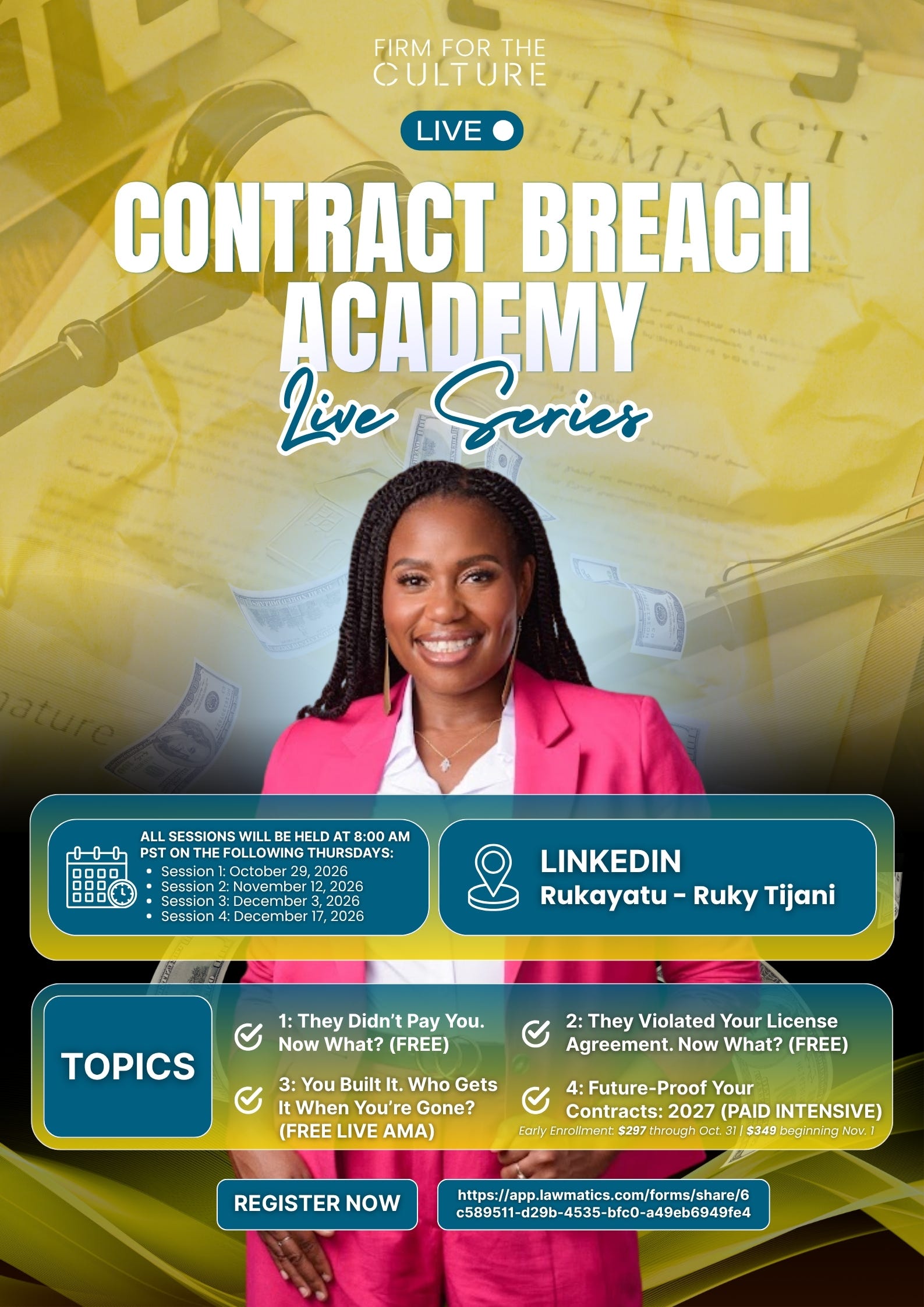
Here’s what’s coming:
November 12 | 8:00–9:30 a.m. Pacific | FREE
They Violated Your License Agreement. Now What?
We’re getting into license scope, unauthorized use of your IP, copyrights and trademarks, royalties, post-termination rights, remedies, and what to consider before you escalate.
December 3 | 8:00–9:30 a.m. Pacific | FREE LIVE AMA
You Built It. Who Gets It When You’re Gone?
We’ll be having a guest conversation about IP, contracts, estate planning, ownership, royalties, licensing income, succession, and what it actually means to build something that can outlive you.
And then we’re closing out the year with:
December 17 | 8:00–10:00 a.m. Pacific | PAID INTENSIVE
Future-Proof Your Contracts: 2027
This is our live contract strategy + vision-planning intensive.
You’ll work through a 2027 Contract Vision Workbook and leave with your own 2027 Contract Blueprint so your agreements can actually match the business you’re building next year.
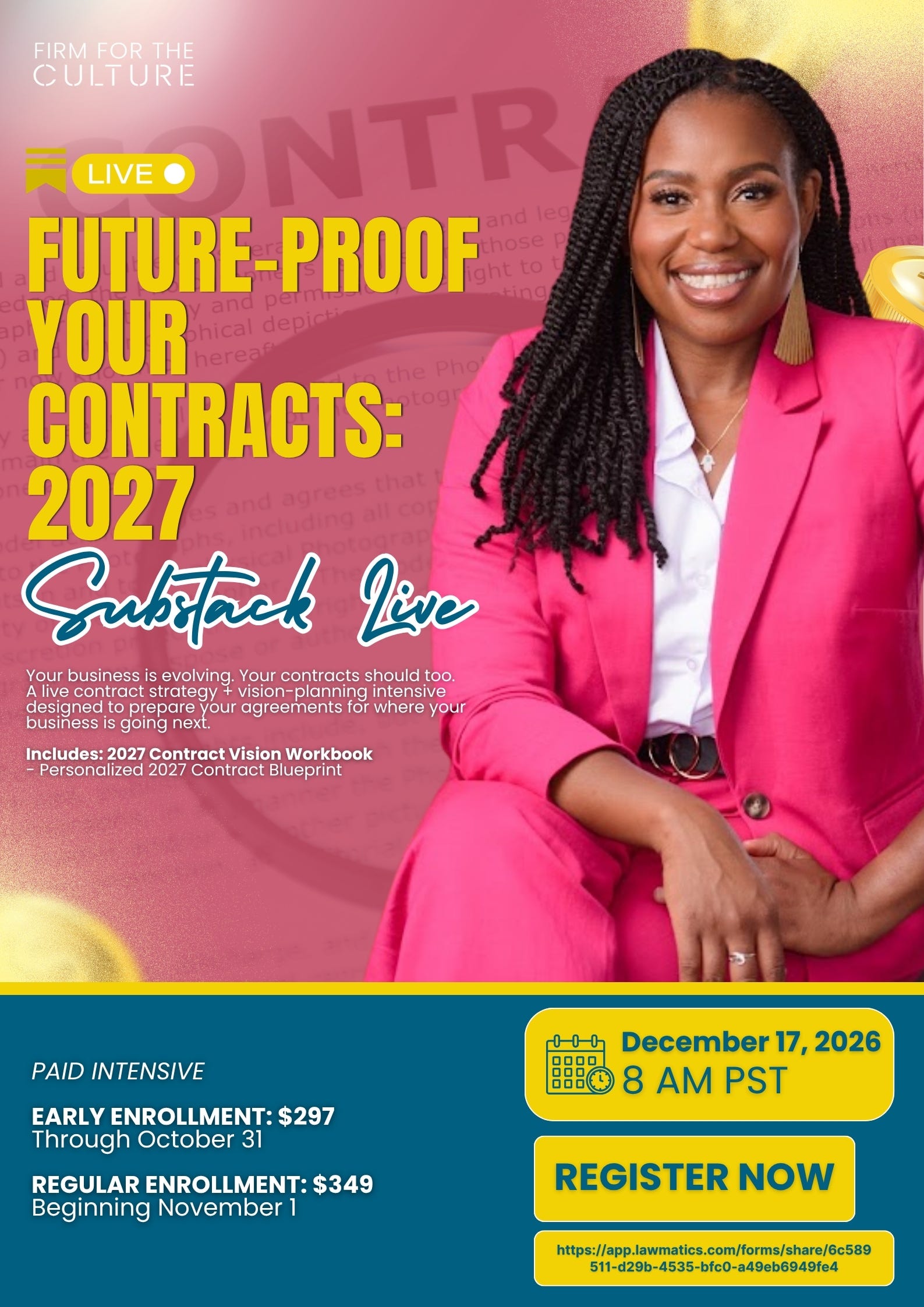
1 CLICK — REGISTER FOR CONTRACT BREACH ACADEMY
Now, let’s get back to the program.

When founders tell me somebody is using their IP in a way they never intended, I want to see the agreement.
Not because I do not believe them.
Because licensing disputes live in the details.

What exactly did you authorize?
That question sounds simple until you actually sit down and answer it.
Take territory.
Did the license cover one state?
The entire United States?
Anywhere the licensee does business?
What about the platform?
Were they allowed to put the content inside one controlled system, or did the agreement allow broader distribution?
Who was supposed to have access?
And then there is the term.
How long did you actually give them permission?
Three months?
A year?
Three years?
Did the agreement renew?
I have literally crossed out “in perpetuity” language before.
Because, as I have said before, ain’t nobody about to use it forever in a day.
If forever is really what you mean, okay.
But I want you to know that is what you are agreeing to before “forever” shows up in the contract.

And this is why I want you to be careful about saying:
“They were never allowed to do that.”
Okay.
Show me.
Where does the permission stop?
In the curriculum example, those boundaries were concrete.
One state.
A defined group of users.
A specific platform.
That gave the owner something meaningful to compare against the actual use.
If your license is vague, that analysis gets a whole lot harder.
Because there is a big difference between:
“I never imagined they would do that.”
and
“The agreement did not give them permission to do that.”
Those sentences may feel similar emotionally.
They are not the same strategically.
Founder Gem: Before you call it a violation, reread what you permitted. The agreement should tell you where the permission begins, where it ends, and whether the use you are concerned about actually crossed that line.
And once you know what the line was, there is another question.
Were you actually paying attention to what was happening on the other side of it?

This is one of those things nobody finds exciting when the licensing deal is new.
Monitoring.
Everybody wants to talk about:
We licensed the framework!
We licensed the curriculum!
Recurring revenue!
Love that for you.
But somebody still has to make sure the work is being used the way you agreed.

You can have a beautiful quality-control provision sitting in your agreement.
Great.
Are you actually using it?
Because this is the part that requires follow-through. Maybe that means a quarterly check-in. Maybe you review what the licensee is putting into the market. Maybe they submit samples for approval.
The point is that you should have some way of knowing whether the standards you negotiated are actually showing up in real life.
Because think about what licensing can involve.
Someone else may be teaching under your framework.
Using your brand.
Delivering your curriculum.
Representing a certification you created.
Putting your intellectual property in front of an audience you may never personally meet.
Your name can still be attached to that experience.
So yes, the clause matters.
But your behavior after signing matters too.

If you said there would be quality standards but never check them, you may not know there is a problem until the problem is already large.
And by then, everybody is suddenly opening a contract they have not looked at in two years.
No.
We can do better than that.
This is also why term and exit provisions deserve more attention than they usually get.
In one licensing structure I have taught, the term was five years unless terminated earlier.
That language gave the licensor room to reevaluate if the relationship stopped meeting the quality standards or the mission before those five years were up.
That is not me saying every licensor can terminate whenever they feel like it.
Please do not put that on me.
Your actual agreement matters.
But the broader lesson is important:
Do not wait until the relationship is failing to ask how the relationship can end.
And when the term does end, the agreement should also address what happens to the rights that were licensed.
Because you do not want to spend three years carefully negotiating control only to get fuzzy right at the exit.
Founder Gem: A quality control clause only helps if you use it. Monitoring is not extra administrative busywork. It is part of knowing whether the licensing relationship you negotiated is still the licensing relationship you actually have.
Now let’s say you have done that work.
You read the agreement.
You understand the boundary.
And you believe the licensee is operating outside it.
Now what?

This is the point where founders want the checklist.
I know.
“Okay, Ruky. What do I send?”
“How many days do I give them?”
“Can I terminate immediately?”
“When do I sue?”
And I am intentionally not giving you a universal answer.
Because there isn’t one.
Licensing agreements do not all work the same way, and what you are allowed to do next depends on the agreement in front of you.
I have taught that licenses can be revocable in some circumstances.
I have also taught agreements with fixed terms and specific early-termination provisions.
So no, you cannot leave this Founder’s Letter saying:
“Ruky said I can just snatch the license back whenever I feel like it.”
I did not.

Go back to your agreement.
If it has a termination provision, what does it actually say?
If the term has expired, what happens next?
What rights were supposed to revert?
And if the answer is not obvious?
That is exactly when I want you getting advice based on your agreement, not a random checklist you found online.
But there is another part of the analysis that is not purely legal.
What are you trying to accomplish?
Because a licensing relationship is still a business relationship.
The licensee may have crossed a boundary, but that does not automatically tell you what outcome makes the most sense.
Maybe the relationship is worth preserving if the use can return to what was agreed.
Maybe the way the IP is being used is creating a risk you are no longer willing to tolerate.
Maybe your business has changed enough that the licensing relationship no longer fits where you are going.
The point is that the response should serve something.

Not simply:
“You made me mad, so now I want the biggest consequence available.”
That is emotion choosing strategy.
And I would rather we reverse that order.
Understand the agreement.
Understand what the business needs.
Then decide what kind of response actually makes sense.
Founder Gem: Escalation is a business decision as well as a legal one. The question is not only whether somebody crossed the line. It is what outcome protects the IP and makes sense for the business you are building.

A License Agreement Is Not
“Set It And Forget It.”
That may be the biggest lesson here.
Licensing can be powerful precisely because you do not have to sell your intellectual property outright to create value from it.
That is what makes licensing so powerful. You can keep ownership while giving somebody else carefully defined permission to use the asset, create another revenue stream, and reach audiences you may not have reached on your own.
But keeping ownership does not mean control happens automatically.
You still have to design the boundaries.
You still have to monitor the relationship.
And if something goes wrong, you need to understand what the agreement actually allows you to do next.
That work started before anybody violated anything.
Which is annoying, I know.
Because once you discover a problem, you want the solution to begin today.
But the strongest position usually comes from work you did months or years earlier when everybody was still excited to sign.

The work you did when everybody was still excited to sign matters later. A clearly defined scope, a term you understand, quality standards you actually monitor, and an exit that makes sense give you something concrete to work with if the relationship changes.
That is what gives you something to work with later.
And if your current agreement does not give you that clarity?
Well...
now we learned something before the next license.
That matters too.

Pull up one licensing agreement you are currently using.
Not the template.
The actual signed agreement.
And read the permission again.
Can you clearly tell:
who can use the IP,
where they can use it,
how they can use it,
and when that permission ends?
Then ask yourself:
If they crossed one of those boundaries tomorrow, would I know it?
Because if you cannot answer that question...
your first problem may not be enforcement.
It may be clarity.
Tell me what you find in the comments.

STOP. You Missed a Clause.
She Kept the Name.
Join Us for Contract Breach Academy
If you finished this article thinking, “Okay, but what do I actually do when the licensee crosses the line?” come join me on November 12 from 8:00–9:30 a.m. Pacific for:
They Violated Your License Agreement. Now What?
We’re going deeper into license scope, unauthorized use, royalties, post-termination rights, remedies, and what to consider before you escalate.
This session is FREE.
Need Help Protecting What You’ve Built?
At Firm for the Culture, we help founders protect, maintain, enforce, and strategically grow their intellectual property portfolios.
Because getting the registration is a major milestone.
Keeping the asset protected as your business grows is the long game.

Can’t wait to help you protect your dynamic impact.
And #ThatsAWrap.
The Doors of the Church Firm Are Open.
Come on in and share the love.
Thanks for reading.
See you next time.
#ForTheCulture
👩🏾⚖️⚖️
❤️