

Hey Fam,
There is a point in some business disputes where the question changes.
At first, you are trying to work it out.
You send the email.
You have the conversation.
You go back to the contract.
You give the other side an opportunity to do what they said they were going to do.
And then, somewhere along the way, you realize:
Oh. We are really doing this.
That is usually when I get some version of:
“Ruky...should I sue?”

And I get it.
By that point, you are tired.
The relationship may already be strained.
Money may be involved.
Your intellectual property may be involved.
And sometimes you do not want another conversation.
You want somebody to do something.
Now listen.
I started my legal career in securities litigation on Wall Street. I later worked for a federal judge and practiced intellectual property litigation in Silicon Valley.
So court does not scare me.
But I also do not treat litigation like the legal version of pressing the big red button every time somebody acts up.
Because the question is not only:
Can you sue?
The question I care about first is:
What does your business actually need from this situation?
And that distinction matters more than founders sometimes realize.
Earlier this year, I wrote about the trademark dispute surrounding Lady Gaga’s Mayhem.
Lost International said it had been using “Mayhem” on surf equipment and apparel for years and objected when Gaga released her album and merchandise using the same word.
The company asked the court to stop that use while the larger dispute was still unfolding.
The court said no.
Cue the headlines.
Lady Gaga wins.
Case closed, right?
Not quite.
The decision came at the preliminary-injunction stage.
And one of the plaintiff’s biggest problems at that point was evidence. There was overlap in the word “Mayhem,” but the court did not have enough evidence of actual consumer confusion to give Lost International the emergency relief it wanted.
Which is why I wrote then:
“A denied injunction is not a declaration of victory.”
That line has been sitting with me.
Because “winning” a legal dispute can mean very different things depending on what you were actually trying to accomplish.
And if you are thinking about suing someone, that is where I want you to start.
Not with how angry you are.
Not with whether you technically can file something.
And definitely not with how satisfying it would feel to see your name next to Plaintiff.
I want to know what a win would actually look like for the business.
Then we can talk about the tool.
Ready?
Let’s get into it.

Loving This Post?
Show us some love by adding a “❤️” or commenting below; this will make our hearts sing. Also, please share, we want this to get to as many folx as possible.
But first, Church Announcements!!
Speaking of this exact problem...
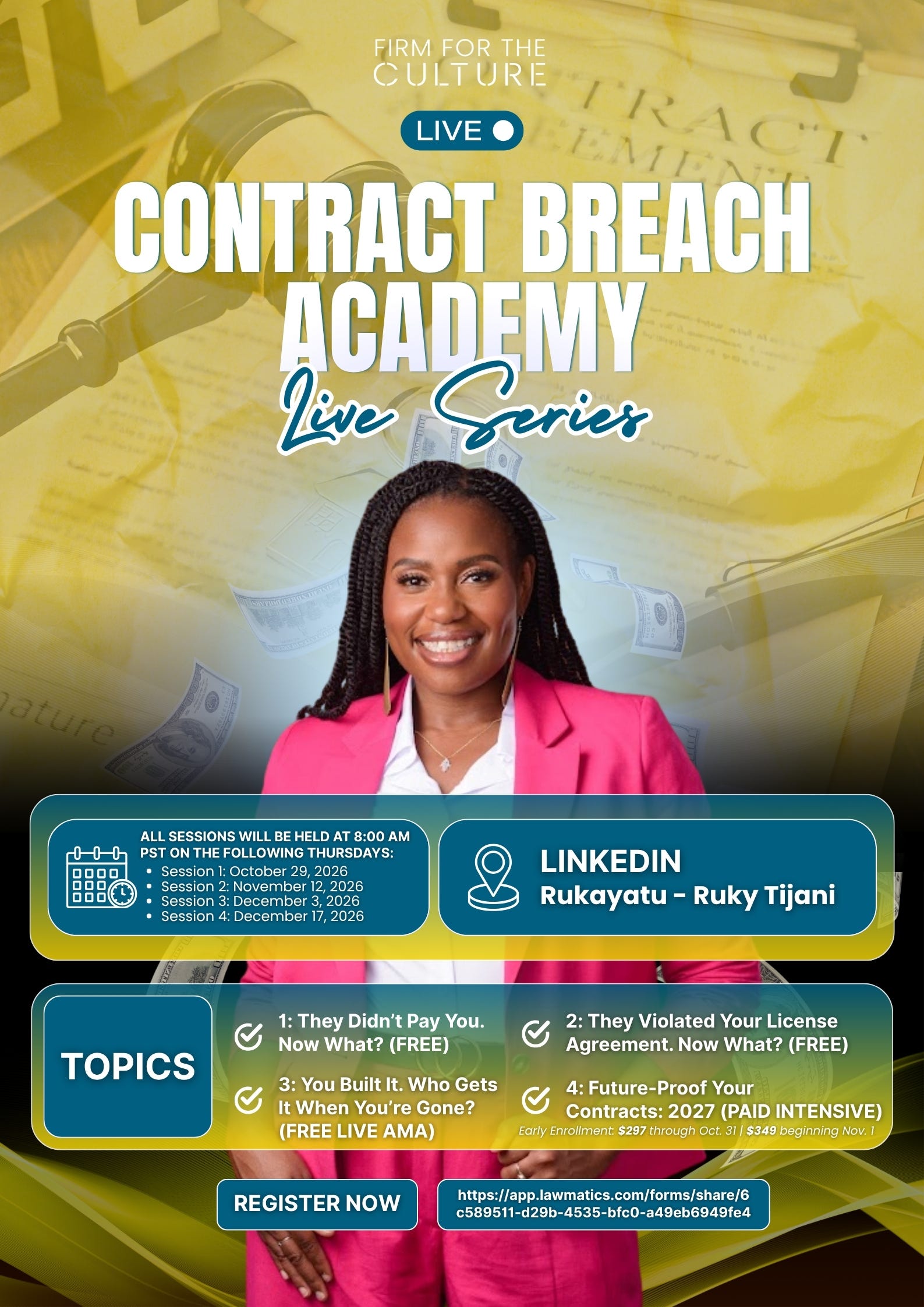
We’re officially kicking off our next education + workshop series at Firm for the Culture:
Because sometimes you did exactly what you said you were going to do.
You delivered the work. You met the deadline. You honored the agreement.
And the other side...didn’t.
Maybe they didn’t pay you. Maybe they used your intellectual property outside the scope of the license. Maybe the relationship changed, the contract broke down, and now you’re trying to figure out what happens next.
Too often, founders are made to feel like there are only two options when that happens:
Let it go or sue everybody.

But there’s a whole lot of strategy in between.
So this quarter, we’re talking about what it actually looks like to respond when someone breaches an agreement, how to understand the leverage you already have, and how to make decisions that protect the business you worked so hard to build.
Here’s what’s coming:
October 29 | 8:00–9:30 a.m. Pacific | FREE
They Didn’t Pay You. Now What?
We’re talking payment schedules, nonpayment, documentation, when to stop working, escalation, and the options available when somebody owes you money and the invoice is still sitting there unpaid.
November 12 | 8:00–9:30 a.m. Pacific | FREE
They Violated Your License Agreement. Now What?
We’re getting into license scope, unauthorized use of your IP, copyrights and trademarks, royalties, post-termination rights, remedies, and what to consider before you escalate.
December 3 | 8:00–9:30 a.m. Pacific | FREE LIVE AMA
You Built It. Who Gets It When You’re Gone?
We’ll be having a guest conversation about IP, contracts, estate planning, ownership, royalties, licensing income, succession, and what it actually means to build something that can outlive you.
And then we’re closing out the year with:
December 17 | 8:00–10:00 a.m. Pacific | PAID INTENSIVE
Future-Proof Your Contracts: 2027
This is our live contract strategy + vision-planning intensive.
You’ll work through a 2027 Contract Vision Workbook and leave with your own 2027 Contract Blueprint so your agreements can actually match the business you’re building next year.
Early enrollment is $297 through October 31.
Regular enrollment is $349 beginning November 1.

1 CLICK — REGISTER FOR CONTRACT BREACH ACADEMY
REGISTER FOR FUTURE PROOF YOUR CONTRACTS (EARLY BIRD PRICING)
Because being the bigger person does not require you to be the person who keeps absorbing the cost.
Now, let’s get back to the program.

When somebody comes to me with a legal problem, I do not want to begin with the biggest weapon available.
I want to understand the problem.

I remember working with a client where one of my first questions was essentially:
What are you most concerned about?
And:
What are your goals?
Because those answers shape everything that comes next.
If the goal is getting paid, that is one conversation.
If the goal is stopping somebody from using something they were never authorized to use, that is another.
If the real priority is ending a business relationship without creating an even larger mess, that matters too.
And sometimes, yes, the business needs relief that ultimately requires court intervention.
But notice what I did not say.
I did not say the goal was:
“Win the lawsuit.”
That is a legal event.
I want to know what happens to the business if you win.
Because those are not always the same thing.
That is what the Mayhem dispute illustrates so well.
The plaintiff did not receive the emergency relief it asked for.
That mattered.
But that one ruling did not magically resolve every possible issue in the larger dispute.
So if we only look at the headline and ask:
Who won?
we may be asking the wrong question.
A better one is:
What did this decision actually accomplish?

And founders need to bring that same discipline into their own disputes.
Before you decide you need a lawsuit, decide what result you actually need.
Because once you know that, you can start asking whether litigation is the best route to get there.
Founder Gem: A denied injunction is not a declaration of victory. A legal result and a business win are not automatically the same thing. Know what outcome matters before you decide which tool you need.
And once we know what you want?
Then we have to deal with the part people like a whole lot less.
Can you actually prove your position?

Fam.
I know.
Sometimes you look at a situation and think:
Come on. Look at what they did.
And listen, I may agree with you.
But the court does not decide cases based on everybody gathering around your laptop and saying:
“Oh wow. Yeah, that’s messed up.”
Proof matters.
That was central to the Mayhem dispute.
There was overlap in the name.
But overlap by itself did not answer the trademark question.
The evidence of consumer confusion mattered.
That is why I have said:
Trademark disputes are evidence-driven.
And I want founders to carry that broader lesson with them even outside trademark disputes.
There is what you believe happened.
And then there is what you can support.

Your contract.
Your records.
Your communications.
The rights you actually have.
The facts sitting underneath the story.
Those things matter before litigation ever enters the room.
Because litigation does not make weak evidence stronger simply because you filed a complaint.
And strong evidence can create leverage before you ever file one.
I have talked before about contracts only being as powerful as your ability to enforce them.
That does not mean every contract dispute should end in court.
It means the provisions you negotiate should actually mean something when they are tested.
And there is another piece founders sometimes forget:
How litigious is the other side?
Or, as I have said before, how “nook if you buck” are they?

Are they the type to negotiate when there is a legitimate disagreement?
Or do they drag people into court at the slightest dispute?
That matters.
Because you can feel very confident about your position and still need to understand who is sitting across from you.
Knowing that does not make you afraid of the fight.
It helps you understand the fight before you choose it.
Founder Gem: Trademark disputes are evidence-driven. More broadly, before you escalate any serious business dispute, know the difference between what you believe and what you can actually support. A strong feeling may start the conversation. Evidence is what gives the position weight..

Okay.
Now we get to the part nobody puts in the legal drama.
The bill.

Litigation can get really expensive, really quickly.
There can be filings with the court.
Depositions.
Requests for production.
Motions.
And all of that can get expensive really quickly.
Not to mention the amount of attention the dispute can start demanding from the business itself.
That does not mean litigation is the wrong choice.
Sometimes it is exactly the tool you need.
But this is where I want founders to separate:
“I have a claim.”
from
“A lawsuit is the best business response to this claim.”
Those are two different decisions.
And this is also why I put things like mediation and arbitration provisions into agreements.
Most of my clients are not sitting around hoping for an opportunity to spend their time in litigation.
Trust me.

Nine times out of ten, they do not want to go straight there.
There can be other steps before a complaint gets filed.
Sometimes there is room for negotiation.
Sometimes settlement resolves the problem.
Sometimes the agreement already names mediation or arbitration as part of the dispute process.
The point is not that one of those options is automatically better than litigation.
The point is that litigation is not the only serious response available to you.
And I have seen preparation change the dynamic without everybody racing to trial.
In one matter, having a fully drafted complaint ready to go helped make our position real enough that the dispute ultimately settled.
That was leverage.
Not noise.
Not an empty threat.
Readiness. Pasted text
And sometimes, after looking at all of the information, you decide the issue is not worth giving more of the business to.
That is a decision too.
You are allowed to conclude:
Yes, I could continue this fight.
No, I do not think doing so is the best use of my business’s resources.
That is not the same thing as being afraid to enforce your rights.
It is choosing intentionally.
Founder Gem: Litigation is a tool. It is not the goal. The goal is the business outcome. Use the tool that makes sense for the result you are actually trying to reach.

So...Should You Sue?
See?
You thought I was going to give you a yes or no.

Sometimes the most accurate lawyer answer really is:
It depends.
But I hope you hear that differently now.
It is not “it depends” because nobody knows anything.
It depends because the decision requires more than asking whether something went wrong.
I want to know what you need the outcome to accomplish.
I want to understand the evidence behind the claim.
I want to know what rights and leverage already exist.
And I want to understand what choosing litigation will require from the business compared with the other paths available.
That is what makes it a strategy decision.
Not:
“They made me mad, so let’s sue.”
Please do not spend litigation money just to be professionally irritated.
I love y’all too much for that.
The courtroom can be powerful.
But power is knowing when to use it.

Sometimes filing is the right move.
Sometimes a credible position gets everybody back to the negotiating table.
And sometimes walking away is the business decision that leaves you with more time, money, and energy to put toward what comes next.
The point is not becoming more combative.
It is becoming more intentional.

If a serious dispute showed up in your business tomorrow, what would you actually need to happen for you to call the outcome a win?
Not what would feel good for five minutes.
Not what would prove you were right.
What would leave the business in a better position?
And once you know that answer:
Is litigation really the only way to get there?
Tell me what you think in the comments.

Join Us for Contract Breach Academy
If this article has you thinking about what happens when a contract breaks down—or what you can do before it gets there—join us for Contract Breach Academy.
Across four sessions this quarter, we’re covering nonpayment, license agreement violations, ownership and legacy planning, and how to future-proof your contracts for 2027.
Whether you’re trying to understand your options after a breach or strengthen the agreements behind the next stage of your business, there’s a session for you.
Need Help Protecting What You’ve Built?
At Firm for the Culture, we help founders protect, maintain, enforce, and strategically grow their intellectual property portfolios.
Because getting the registration is a major milestone.
Keeping the asset protected as your business grows is the long game.

Can’t wait to help you protect your dynamic impact.
And #ThatsAWrap.
The Doors of the Church Firm Are Open.
Come on in and share the love.
Thanks for reading.
See you next time.
#ForTheCulture
👩🏾⚖️⚖️