
Hey Fam,
There is a place where all the people with the greatest potential are gathered.
One place that’s more familiar than we think.
Viola Davis said that from the Oscars stage years ago, and I have never fully stopped thinking about it.

The graveyard.
Not the graveyard of failure.
The graveyard of potential that never became execution.
Talent that never met courage.
Visions that were built — quietly, brilliantly, often ahead of their time — and then buried.
Not because they weren’t brilliant. Because nobody took the steps to protect them.
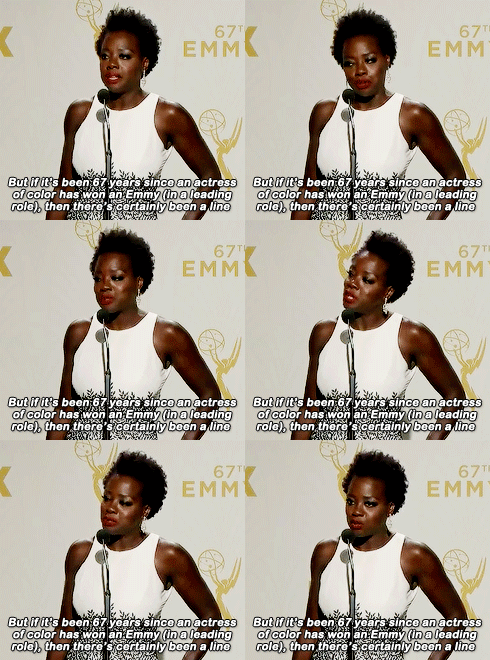
And then, at the 2026 NAACP Image Awards, standing on that stage receiving the Chairman’s Award, she said something else.
She described the definition of hell as the moment on your last day on earth when the person you actually became finally meets the person you could have become.
She wasn’t talking about intellectual property.
But I am.
Because its part and parcel of your diverse contributions to your community in particular and society at large.
The part I think about at my desk
As a full-time entrepreneur and attorney, the proverbial graveyard lands differently for me than it does for most people.
I don’t just see it in the headlines — the artists who signed away their catalogs, the founders who built household names and then watched someone else trademark them, the creatives who created culture and never saw a dime of what that culture was worth.

I see it in the consultation calls and DMs full of trepidation mixed with subtle courage and quiet exhaustion.
I see it in the people who built something real, something original, something worth protecting — and waited too long to do the legal work of owning it.
There is a specific kind of pain in that room.
It is not the pain of failure. It is not the pain of not working hard enough or not dreaming big enough.
It is the pain of potential that ran ahead of structure.
And Viola, dare I say, named it in a way nothing else has.
The gap between who you became and who you could have become is not always about effort. It is not always about talent. It is not always about vision.
Sometimes it is about the legal decisions you made — or didn’t make — while you were building.
When It Gets Real
When founders come to me, there is often a moment in the conversation where I can see it — the version of the business they imagined and the version they are actually standing in.
Sometimes the gap is small.
Sometimes it is enormous.
But it almost always traces back to the same place:
Creation without structure. Building without ownership. Visibility without protection.
The graveyard is full of that.
In this Founder’s Letter, we are going to talk about what actually lives in that graveyard, how the gap between who you became and who you could have become shows up in your intellectual property, and what it means to break that cycle — not just for yourself, but for the generation that is watching you build.
Ready?
Let’s get into it.

Loving This Post?
Show us some love by adding a “❤️” or commenting below; this will make our hearts sing.

The Firm for the Culture - THE SPEAKER PROTECTION Series
We’ve got a series of workshops, all for you!
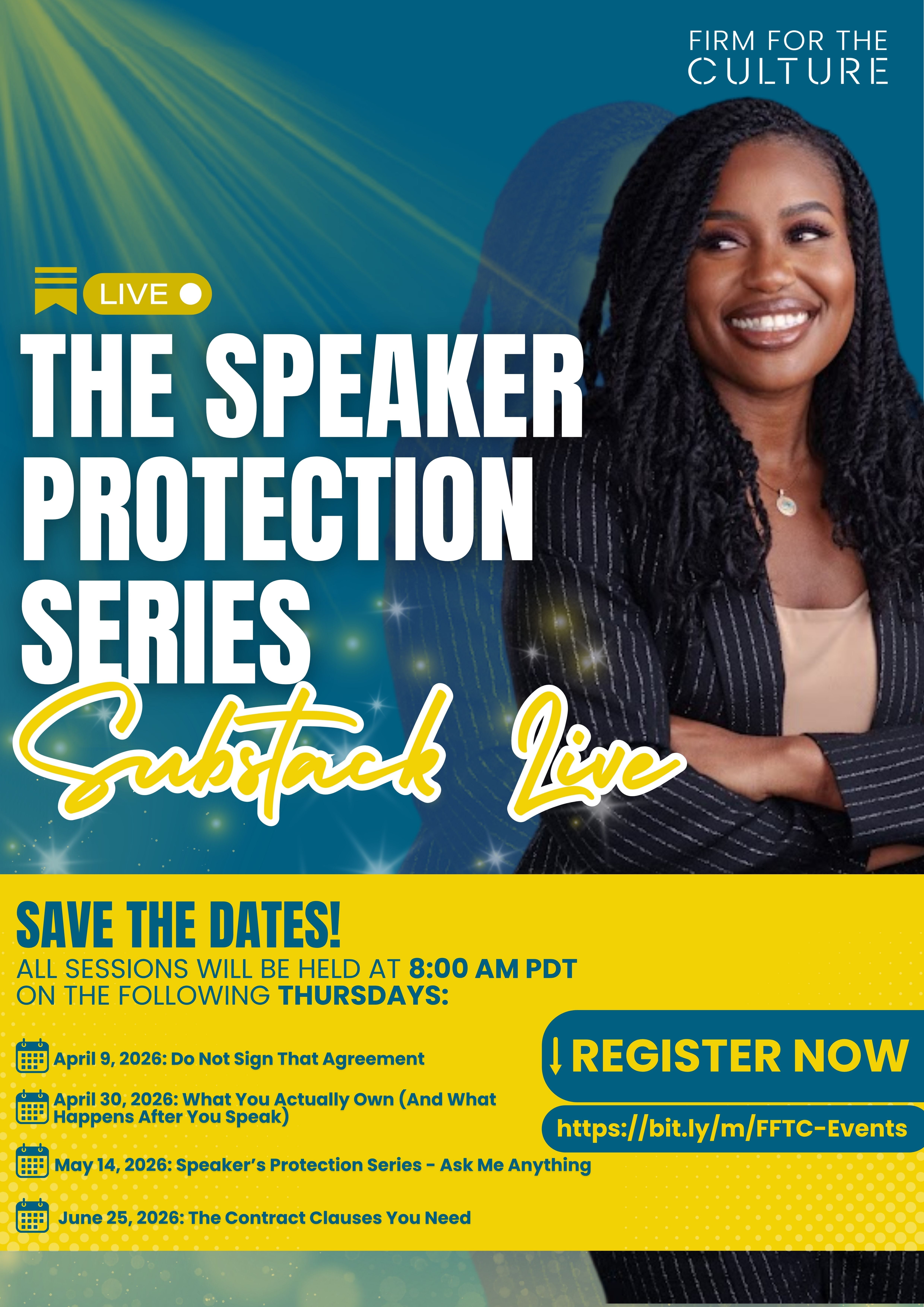
Speaking builds visibility. But it also creates intellectual property.
This series breaks down what actually happens to your ideas, your content, and your rights once you step on stage. From contracts to ownership to licensing, we’ll explore how speaking opportunities can either build long-term value—or quietly take it away.
We’ll cover: how speaking engagements intersect with intellectual property, what speakers often overlook when accepting opportunities, and how to approach speaking as both a visibility and ownership strategy.
What you’ll walk away with: A clearer understanding of how to protect, position, and leverage your content as a speaker—before, during, and after every engagement.
Here’s a preview for your viewing pleasure:
Workshop 2: The Speaker Protection Series: What You Actually Own (And What Happens After You Speak)
📅 April 30, 2026 at 8:00 a.m. PDT
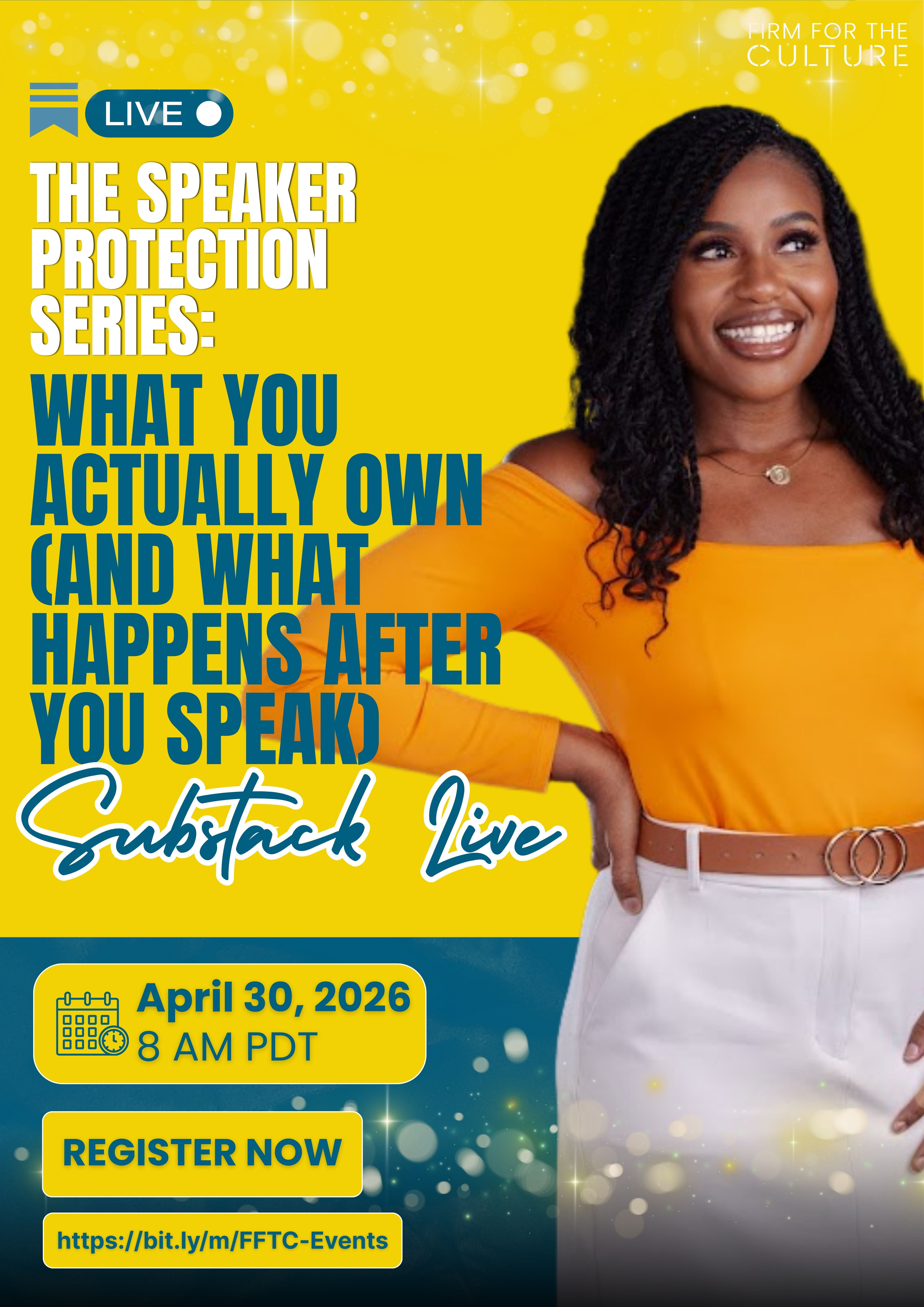
Just because you created it doesn’t mean you still own it.
This workshop unpacks what happens after your talk ends—who owns the recording, who can reuse your material, and what rights may shift once your content is shared or distributed.
We’ll cover: ownership vs. licensing, how event organizers structure rights, and what speakers often give away without realizing it.
What you’ll walk away with: A framework for understanding and protecting your ownership—so your ideas continue working for you long after the event ends.
Workshop 3: The Speaker Protection Series: Ask Me Anything + IP Basics
(Copyright, Trademark, Patent)
📅 May 14, 2026 at 8:00 a.m. PDT
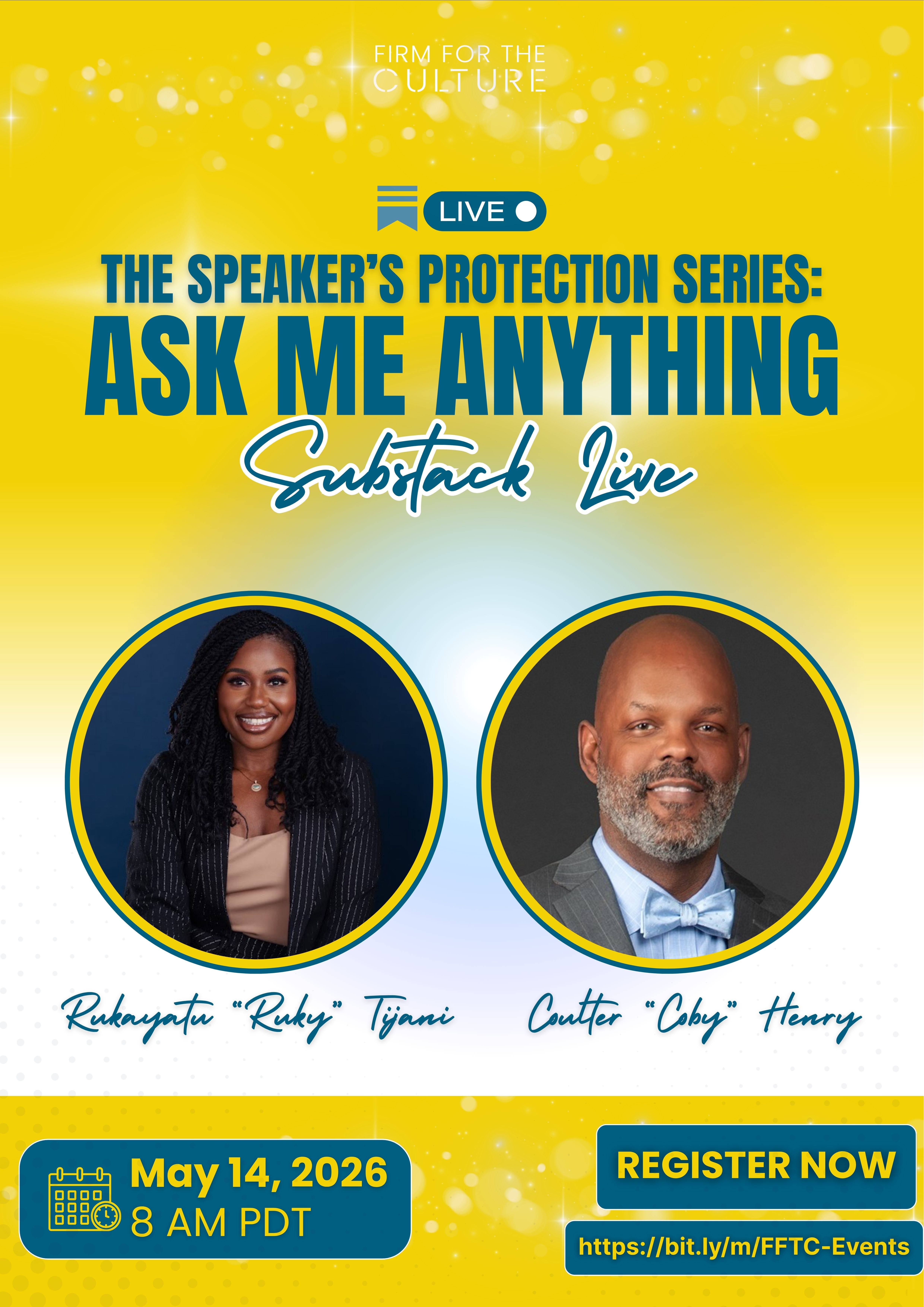
Before strategy, there has to be clarity.
This session brings everything back to the fundamentals—breaking down copyright, trademark, and patent in a way that’s clear, practical, and directly applicable to speakers and creators.
It’s also an open space to ask real questions based on real situations.
We’ll cover: what each type of protection actually covers, common misconceptions, and how these apply to your content, brand, and speaking engagements.
What you’ll walk away with: A solid foundation in IP and clearer answers to the questions you’ve been trying to figure out.
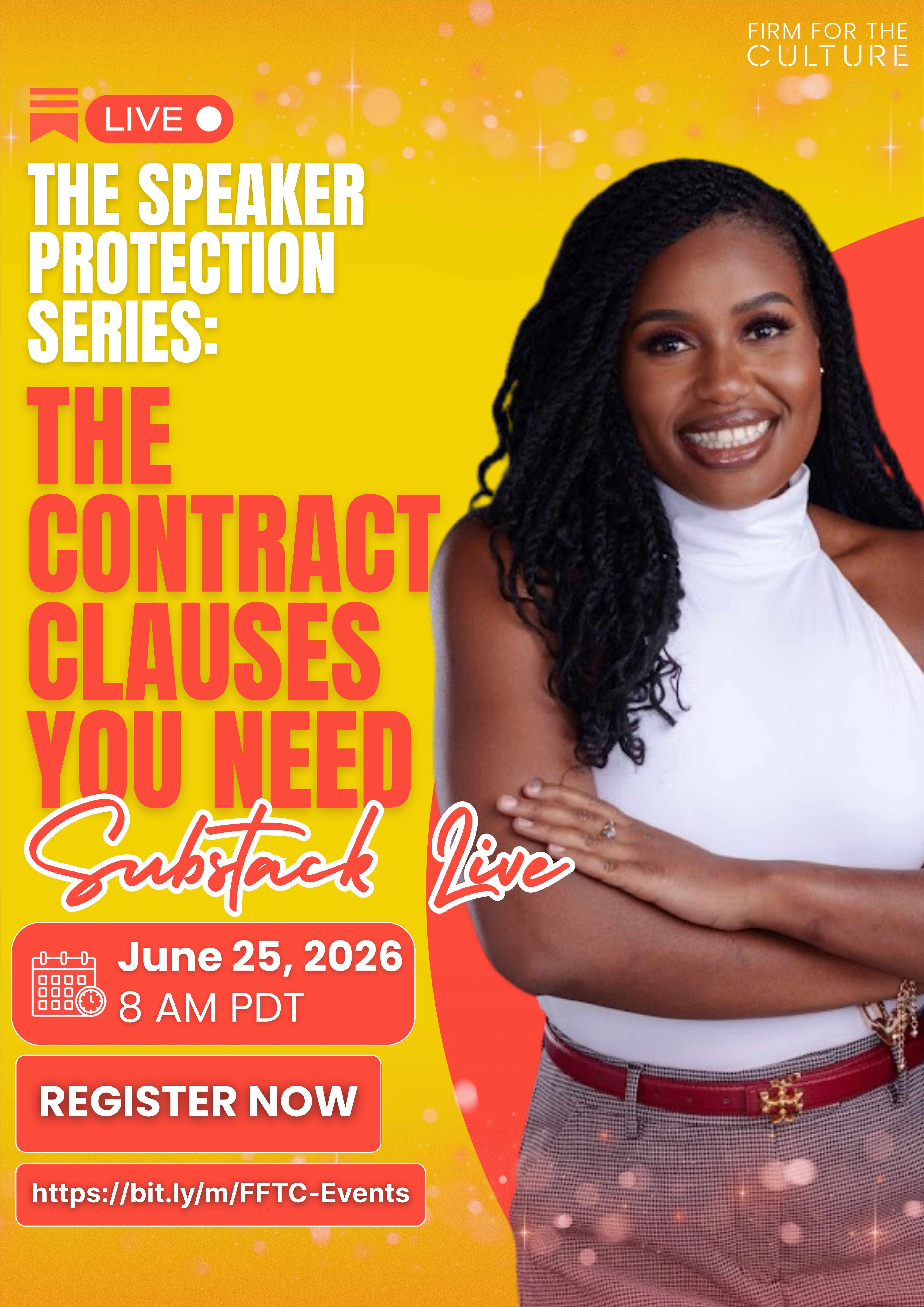
Workshop 4: The Speaker Protection Series: The Contract Clauses You Need
📅 June 25, 2026 at 8:00 a.m. PDT
Growth usually comes with paperwork. Protection comes with awareness.
This workshop focuses on the specific contract clauses that directly impact your control, ownership, and long-term leverage as a speaker.
We’ll cover: key clauses around ownership, licensing, usage, distribution, and how to structure agreements that actually protect your work—not just your participation.
What you’ll walk away with: A clear understanding of the clauses you need in place and how to approach contracts with intention and strategy.
Register for The Speaker Protection Series:: The Contract Clauses You Need workshop
For founders who are building brands. Creators who are shaping culture. Entrepreneurs who refuse to be extracted from.
Registration is FREE; in case you’re unable to make it, sign up and you’ll get the free notes.
After event recordings are $20.00 each.
Hope to see you there!
🔗 Sign up here: https://bit.ly/m/FFTC-Events
Viola was talking about the potential buried by fear, self-doubt, and all the ways we shrink from the full version of what we could be.
For many, that potential looks like missed opportunities, letting courage sit idle until someone else acts first.
For me, that potential looks like your intellectual property.
The pitch deck for the show that never got submitted — and then aired two years later with someone else’s name on it.
The script that lived in a Google Doc, never registered, never filed.
The signature sound that built someone else’s catalog. The brand name that became culture before it ever became a trademark.
The video reel that sat in a hard drive while someone else built the audience, secured the deal, and licensed the format.
The graveyard is full of brilliance that simply never got protected.
Brand names that were built into household recognition — and then lost to someone who filed first. Creative works that generated millions — for someone other than the person who made them. Business names that became culture — with no federal protection behind them, no ownership structure, no legal foundation to stand on when someone came knocking.
The graveyard is full of brilliance that simply never got protected.
Because, here’s the thing: much of what you’re seeing is not a failure of talent. The people in that graveyard were talented. They were visionary. They were, in many cases, extraordinary.
What they did not have was structure or the belief that their contributions were worth protecting and stewarding.
Sound familiar?
It should.
Structure is what bridges potential and ownership.
Structure is what takes the vision in your head and turns it into something you can defend, something you can control, something that can outlive you.
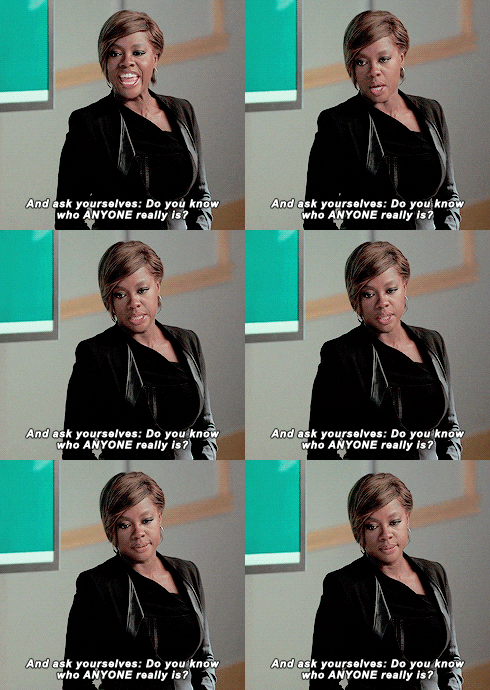
“Exhume those stories,” Viola said.
I would add: learn from them. Because a lot of what is buried in that graveyard did not have to end up there.
Founder Gem: Creation is the beginning. Protection is the commitment. Without it, you are not building a legacy — you are building someone else’s opportunity.

The person you became meets the person you could have become.
Here is how that sentence lands in a business context.
The person you became is the founder with a recognized brand, a loyal audience, a name people trust.
The person you could have become is the founder who also owns that brand — federally, legally, structurally — in a way no one can take from them.
The gap between those two people is not work ethic. It is not talent. It is not vision.
It is a trademark application. A copyright registration. An ownership agreement. A licensing structure built before someone else decided your creation belonged to them.
This is where the legal decisions compound.
Every year you build brand equity on a name you have not registered, you are widening that gap.
Every piece of content you produce without understanding what you own — and what you don’t — adds to it.
Every collaboration, every partnership, every licensing opportunity that moves forward on a handshake instead of a written agreement is another step toward becoming the wrong version of yourself.
The gap is closeable.
But it requires you to see it first.
Founder Gem: There is a version of your business where you built it. And a version where you own it. The difference is not talent. It is the legal decisions you made along the way.
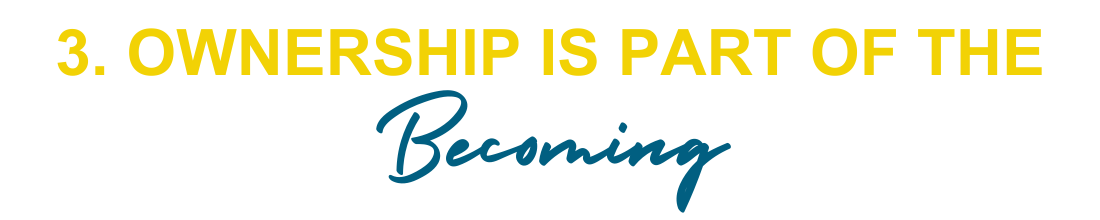
This is the part Viola was really speaking to. And the part that lands differently for this community.
She did not just say: close the gap. She said there is no becoming without healing. Without facing the truth. Without a radical acceptance of what is actually in front of you.
There is a reason so many founders in our community have a complicated relationship with legal structure.
For generations, people who looked like many of us built things they were never allowed to own.
The intellectual property.
The names. The legacies. Taken. Registered by someone else. Monetized by people who had nothing to do with the creation.
The legal system was not built to protect everyone equally, and that history does not disappear simply because access now exists.
So when I tell founders to protect their work — to file, to register, to structure — I am not just talking about legal strategy.
I am talking about something older than that.
Choosing ownership, in all its diverse forms, is an act of accountability to yourself.
It is saying: what I built and what I’ve done deserves to exist past the moment I built it or done it. It deserves to be mine. It deserves to be protected.
It is the refusal to end up in the graveyard with potential still inside of you.
And it is — in Viola’s words — part of the becoming.
The healing that comes from no longer waiting for permission to protect what you created.
The discipline of treating your work as something worth defending. The courage to take up the legal space you are entitled to — because you earned it, because you built it, because the person you could have become actually filed.
Founder Gem: Protecting your intellectual property is not just legal strategy. It is accountability to what you built, to those who built before you, and to what you are building for the generation coming after you.
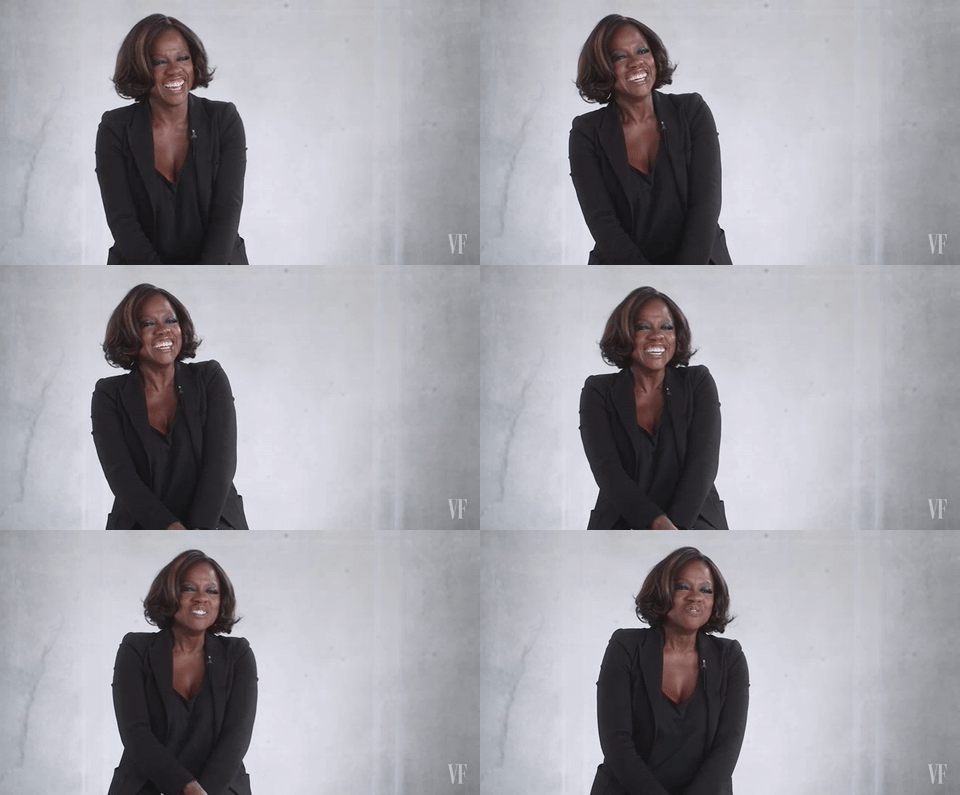
I think about the graveyard often.
Not as a threat — but as a reminder.
Every person I sit with is at a crossroads between the version of their business that exists and the version that could exist if they took the legal work seriously. Every conversation is a moment where the gap can start to close.
That is what this work is.
Not just filings and applications. Not just legal compliance.
It is the bridge between the person you became and the person you could have become.
And the bridge is still buildable. Today.
The question is whether you decide to walk across it.

Have you ever looked at your business and recognized that gap — the version that exists and the version that could exist with the right legal foundation .
Drop a comment—I read every one.
Want to know where your business actually stands on that gap?
Let’s talk — and make sure your name isn’t just recognized. It’s protected.
Book a Strategy Session with Firm for the Culture and let’s make sure your name isn’t just recognized—it’s protected.
Need Help Protecting Your Creativity?
If you are unsure—or if you know you need to take action—reach out to us.
We have helped countless founders and creatives safeguard their intellectual property, and we would love to do the same for you.

If you need further guidance, reach out to me and my team at Firm for the Culture.
We’re here to help you navigate the copyright, trademark, and thought leadership journey.
Can’t wait to help you protect your dynamic impact.
And #ThatsAWrap
The Doors of the Church Firm Are Open
Thanks for reading
See you next time.