

Hey Fam,
There is a version of your brand that exists before anyone files a single document.
It lives in the way you deliver your service, the name you chose at 2am, and the framework you’ve spent three years refining.
It exists in the way clients describe you to their friends — using your exact words, your exact phrasing, sometimes your exact name.

That version of your brand is real.
It has value.
And if no one has ever helped you structure it legally, it belongs to everyone.

I am an attorney. I am also a full-time entrepreneur. I know what it feels like to be so deep in building that legal infrastructure feels like a luxury — something you get to once the business feels “real enough.”

I see it often. Founders who have been executing at a high level for years, building something undeniable, operating with absolute intention — and then a partnership conversation surfaces, or a licensing inquiry lands, and suddenly the question isn’t are you talented? The question is what do you own?
The talent was never in question.
The structure was.

We talk a lot about the concept of trusting the process — showing up, staying consistent, executing with discipline.
But there is a version of “trusting the process” that becomes a liability: when the process you’re faithfully executing was never built to protect you.
This is where it gets specific.
A founder registers a business entity and assumes that means her brand name is protected.
It is not.
A business name filed with a state tells you you can do business.
A trademark tells the world — and the law — that the name belongs to you.
A content creator builds a newsletter audience around a distinctive framework and assumes the name is hers because she created it.
That assumption has no legal weight until she files.
A course creator licenses her methodology to a partner and assumes the contract is standard because both parties agreed on the terms.
The terms, however, don’t address what happens to the IP when the partnership ends.
These are not cautionary tales. These are not hypotheticals.
These are my intake sessions from the last couple months.
And in every one of them, the problem wasn’t lack of effort.
It was a process that never included an IP audit.
So we’re going to question, examine, and litigate your processes today.
In this Founder's Letter, we are going to talk about how to evaluate your IP foundation, how to critique what's actually working, and how to rebuild the process to include the legal structure your brand has already earned.
Ready?
Let’s get into it.

Loving This Post?
Show us some love by adding a “❤️” or commenting below; this will make our hearts sing. Also, please share, we want this to get to as many folx as possible.

But first, Church Announcements!!
Church Announcements: Women of Impact Workshop Series
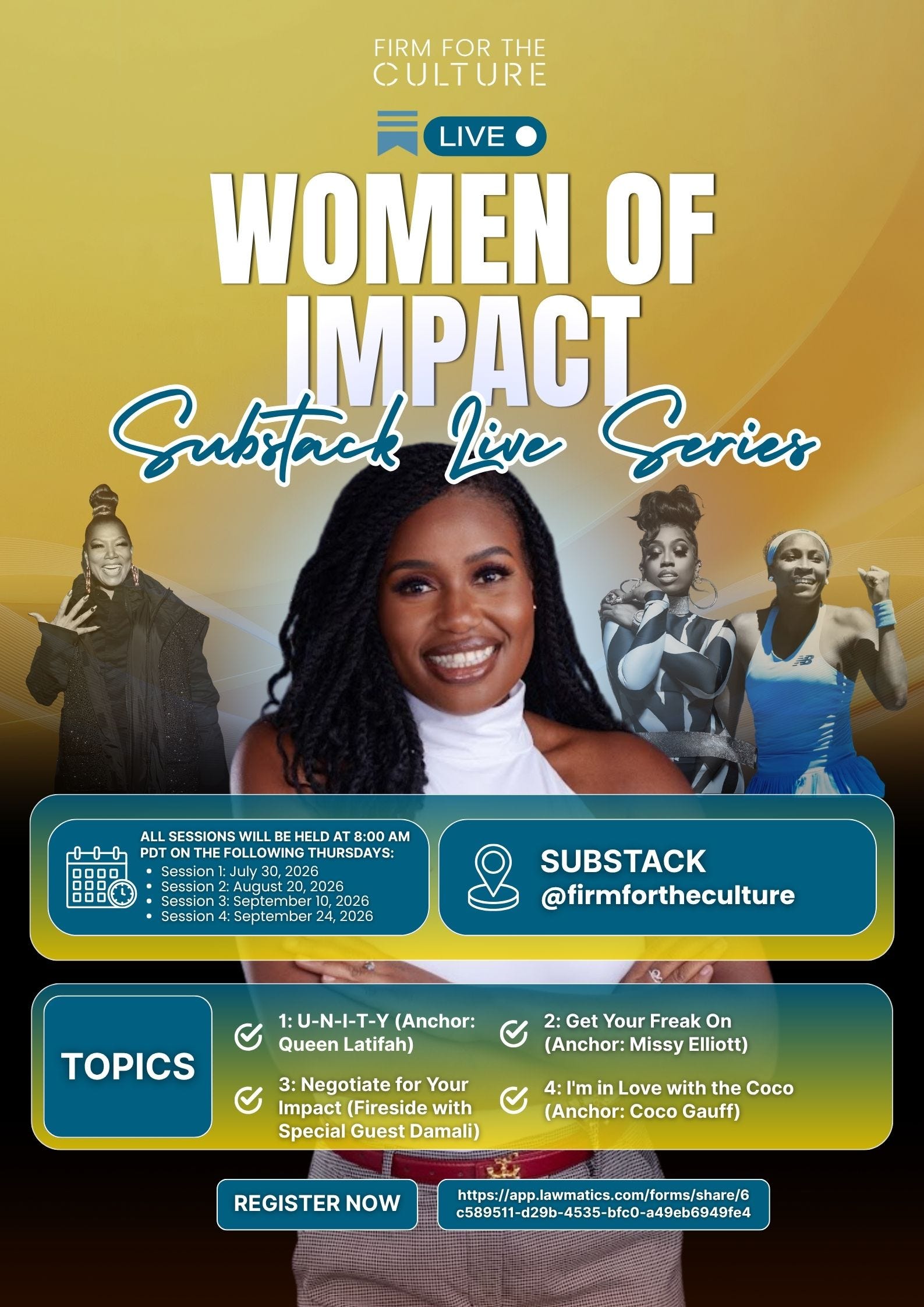
We have an upcoming Women of Impact workshop series—a four-part exploration of how influential women have protected their work, built powerful brands, and expanded their impact across industries.
July 30 — Women of Impact: U-N-I-T-Y (Queen Latifah)
Explore trademarks, licensing, and the strategies behind building a lasting brand.
August 20 — Women of Impact: Get Your Freak On (Missy Elliott)
Learn about copyright, creative ownership, and protecting original work.
September 10 — Women of Impact: Negotiate for Your Impact
Get practical guidance on negotiating confidently, communicating your value, and protecting your interests.
September 24 — Women of Impact: I’m in Love with the Coco (Coco Gauff)
Explore endorsements, image rights, NIL agreements, and personal-brand protection.
All four workshops begin at 8:00 a.m. Pacific Time, 11:00 a.m. Eastern Time.
One Click. All Four Workshops.
We have a new one-click sign-up that allows you to register for the entire Women of Impact series at once.
Sign up, even if you’re not able to attend, you’ll still get the workshop notes.


The first step isn’t filing anything. It’s taking inventory.
Most founders are further along than they realize — and also more exposed than they realize.
The gap between those two things is where the legal strategy lives.
An IP audit asks: what names, phrases, logos, methodologies, and original works are attached to this business?
Of those, which ones are currently in use?
Of those, which ones have been registered?
Of those, which registrations are still active, maintained, and current?

That last question matters more than founders expect.
A trademark registration isn’t a one-time filing that sits in a drawer.
It requires maintenance — a Declaration of Use between the fifth and sixth year, a renewal between the ninth and tenth, and ongoing attention to whether someone else is now using something that conflicts with your registration.
The process you trusted to protect you may have a gap in it.
Don’t think of it as a failure.
Instead, think of it as a data point.
And knowledge is power.
Founder Gem: An IP audit isn’t a sign that something went wrong. It’s the tool you use to find out what you actually own — and what still needs to be built.

A process built for speed is not the same as a process built for ownership.
The early-stage instinct — move fast, execute, launch — makes sense.
But the same speed that gets a brand to market also skips the steps that protect it.
File the name when you’re ready.
Register the course when the revenue justifies it.
Circle back to the contract when the relationship is stable.
The problem is that “circle back” often never happens.

And in the meantime, the brand compounds in value — while the legal foundation stays exactly where it was on launch day.
Critiquing the process here isn’t about assigning blame.
It’s about asking honestly: was this process designed to protect me, or was it simply designed to move me forward?
No judgment, I have to ask myself the same question as well.
Because here’s the thing, these two things can look identical in the short run and diverge significantly over time.
The brands that have real enterprise value — the ones that attract investors, licensing partners, and acquisition conversations — are the brands that treated IP protection as infrastructure, not an add-on.
Founder Gem: The process that got you visible isn’t the same process that makes you valuable. At some point, the work shifts from building the brand to protecting what the brand is worth.

By this point, you may be thinking, do I have to start over? There’s so much to be done!
Now, before you throw your whole business away and start from scratch, hear this:
The rebuild doesn’t require starting over.
It simply requires adding a layer.
For most founders, that layer looks like this: a trademark application for the brand name and any sub-brands that are actively driving revenue; a copyright registration for original works, course content, or creative assets that could be licensed; and a contracts review to make sure that any existing partnerships, collaborations, or client agreements actually reflect who owns what when the work is done.
That’s it as a small start.
We don’t have to build Rome today.

But it does have to be done.
The reason it keeps getting deferred is that it doesn’t feel urgent — until it is.
Until a competitor files for the name you’ve been using for three years.
Until a collaboration dissolves and both parties believe they own the thing you built together.
Until a licensing conversation stalls because the other party can’t verify your chain of title.
The rebuild is a decision.
You are deciding to run a business that is legally structured to match what you’ve already built.
You are deciding that the next version of this brand — the version that lands the partnership, survives the collaboration, and gets acquired at the number you have in your head — exists on a foundation that can hold it.
Founder Gem: You don’t rebuild the process to protect what you have. You rebuild it to protect what you’re building toward.

The original “Do Not Trust the Process” post I wrote in 2023 was about the importance of evaluating your systems — not accepting them on faith, but interrogating whether they’re actually working.
That principle is still true. I still believe it.
But there is a specific version of that principle that lives in this work — in IP law, in brand protection, in the legal architecture of a founder-owned business.
The process you trusted to carry your brand forward may never have been designed to carry your ownership forward.
And ownership is the thing that turns a business into a legacy.
The gap is still closeable. The question is when you decide to close it.

What is one part of your brand — a name, a framework, a body of work — that you know you haven’t legally protected yet?
Drop a comment—I read every one.

Want to know where your business actually stands on that gap?
Let’s talk — and make sure your name isn’t just recognized. It’s protected.
Book a Strategy Session with Firm for the Culture and let’s make sure your name isn’t just recognized—it’s protected.
Need Help Protecting Your Creativity?
If you are unsure—or if you know you need to take action—reach out to us.
We have helped countless founders and creatives safeguard their intellectual property, and we would love to do the same for you.

If you need further guidance, reach out to me and my team at Firm for the Culture.
We’re here to help you navigate the copyright, trademark, and thought leadership journey.
Can’t wait to help you protect your dynamic impact.
And #ThatsAWrap
The Doors of the Church Firm Are Open.
Come on it and share the love.
Thanks for reading
See you next time.
Thanks! On point as always. Saving this article. 👏🏾👏🏾👏🏾