
Hey Fam,
If you have ever spent five minutes with me, you already know two things:
I am an IP attorney
I am from Brooklyn, New York.
The second one usually comes out first.
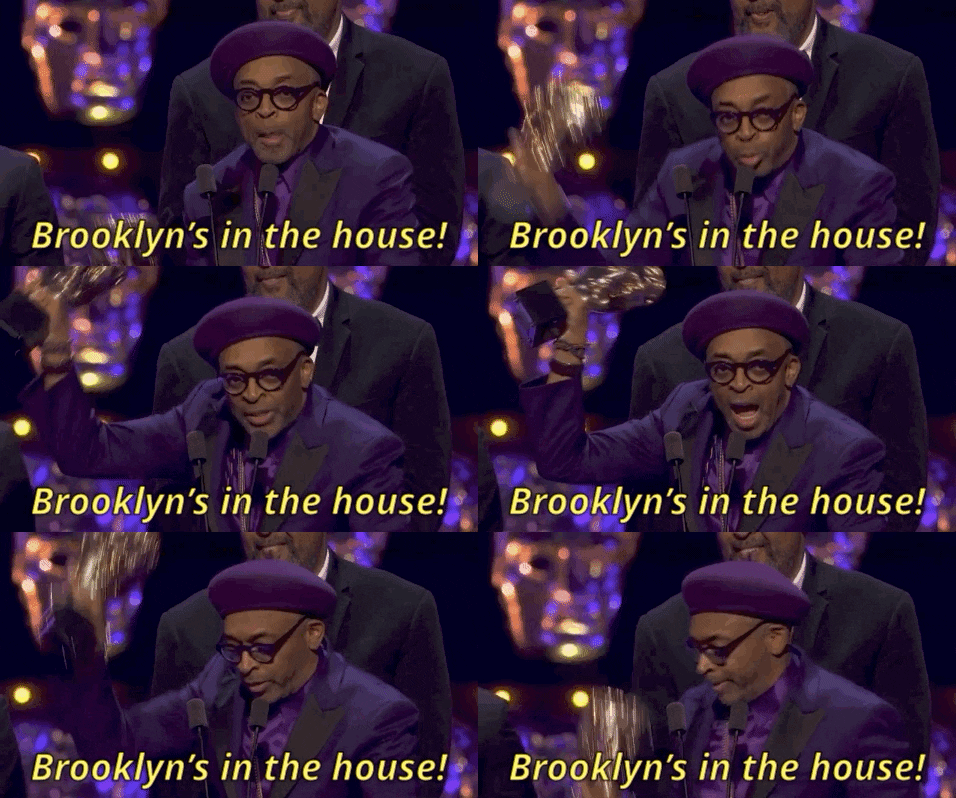
And I’m being extra loud in this season.
Why?
Well, there is no better time to be a New Yorker than right now.
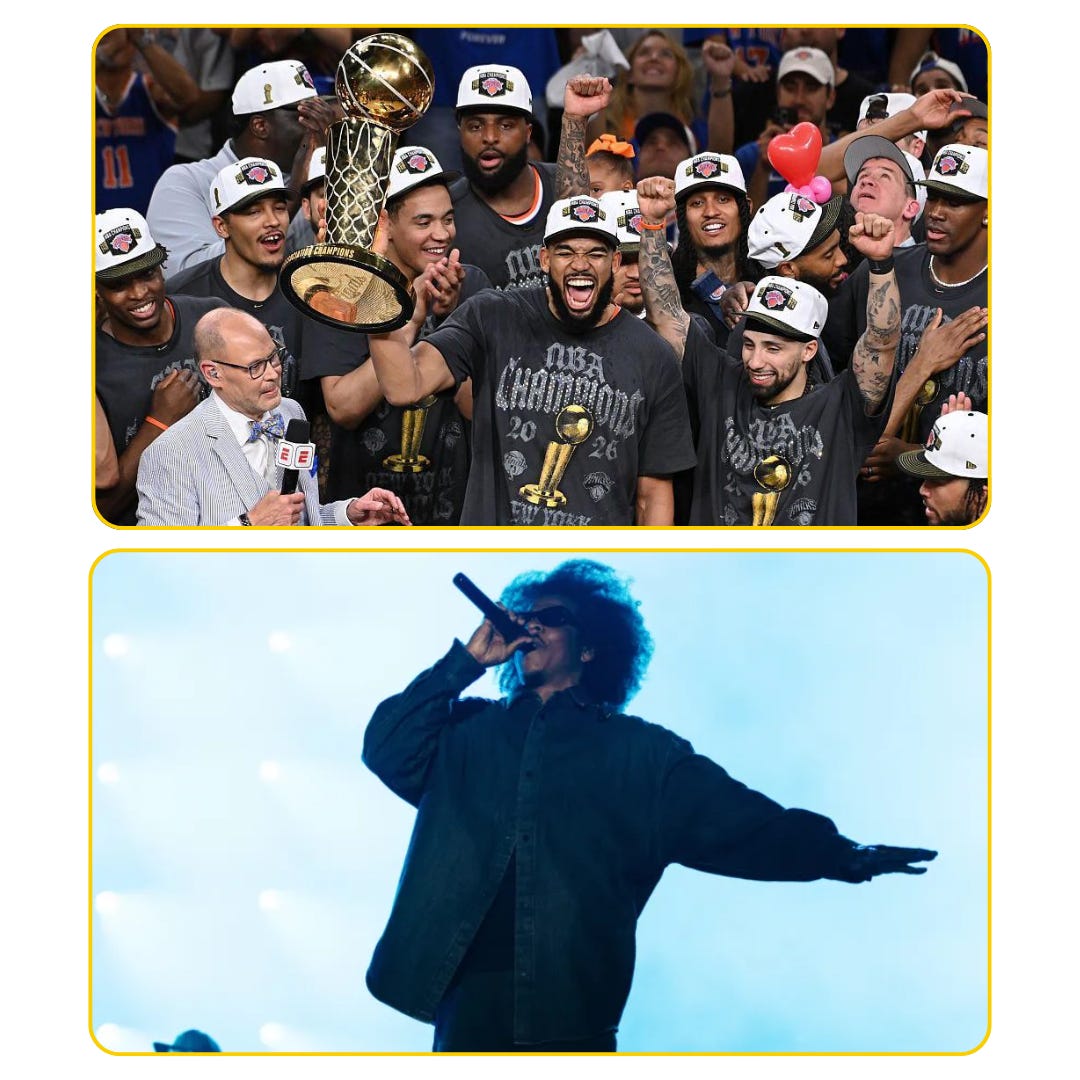
The Knicks just had their best season in over five decades.
Jay-Z performed at The Roots Picnic — his first major live appearance in years — and he has been speaking more publicly about what has happened to him, what has shaped him, and what is ahead of him; more words than he hashad in almost a decade.
The city is loud again in the best possible way:
And then came the news that stopped us mid-stride.
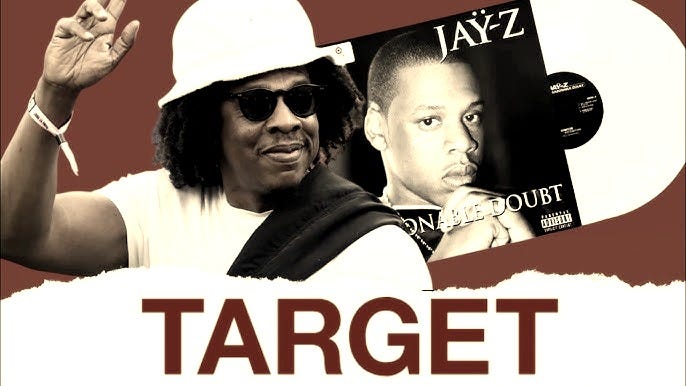
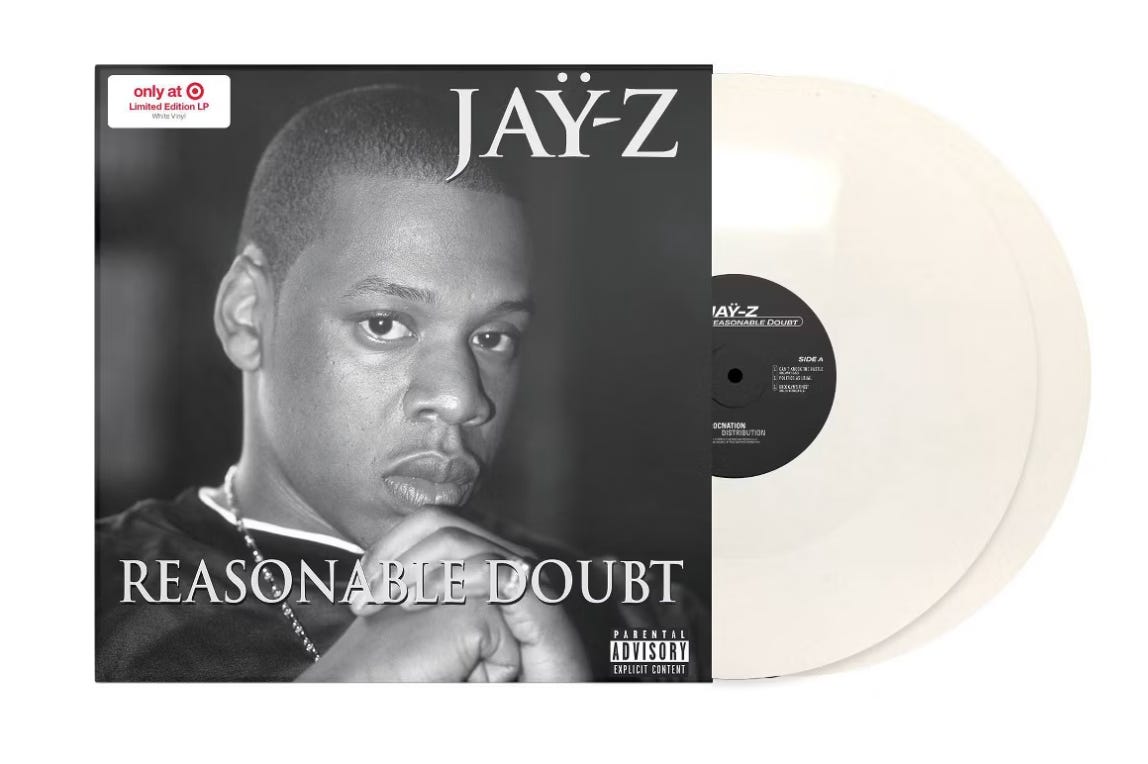
Jay-Z is partnering with Target to release a 30th anniversary exclusive edition of Reasonable Doubt — a white double vinyl, redesigned packaging, a collectible insert, and unreleased tracks including the Fool’s Paradise Remix of “Can’t Knock the Hustle.”
Dropping June 26, 2026.
Exclusively at Target:
Record scratch.
I am … torn.
And I know I am not alone.
For those who may not have been following, Target has been at the center of an organized boycott led by Black faith and civil rights leaders for some time now.
In January 2025, around the time of Donald Trump’s second Presidential Inauguration, Target announced it was rolling back the diversity, equity, and inclusion commitments it had made to the Black community following the murder of George Floyd.
The response was immediate.
Black women — led by Minneapolis lawyer and activist Nekima Levy Armstrong, former Ohio state senator Nina Turner, and organizer Tamika Mallory — launched what became a sustained national boycott beginning February 1, 2025.
Pastor Jamal Bryant later joined with a parallel 40-day "Target fast" through his church. The movement was grassroots, Black women-led, and, for many, still very much ongoing.
The message from community organizers has been clear: our dollars go where our values are reflected.
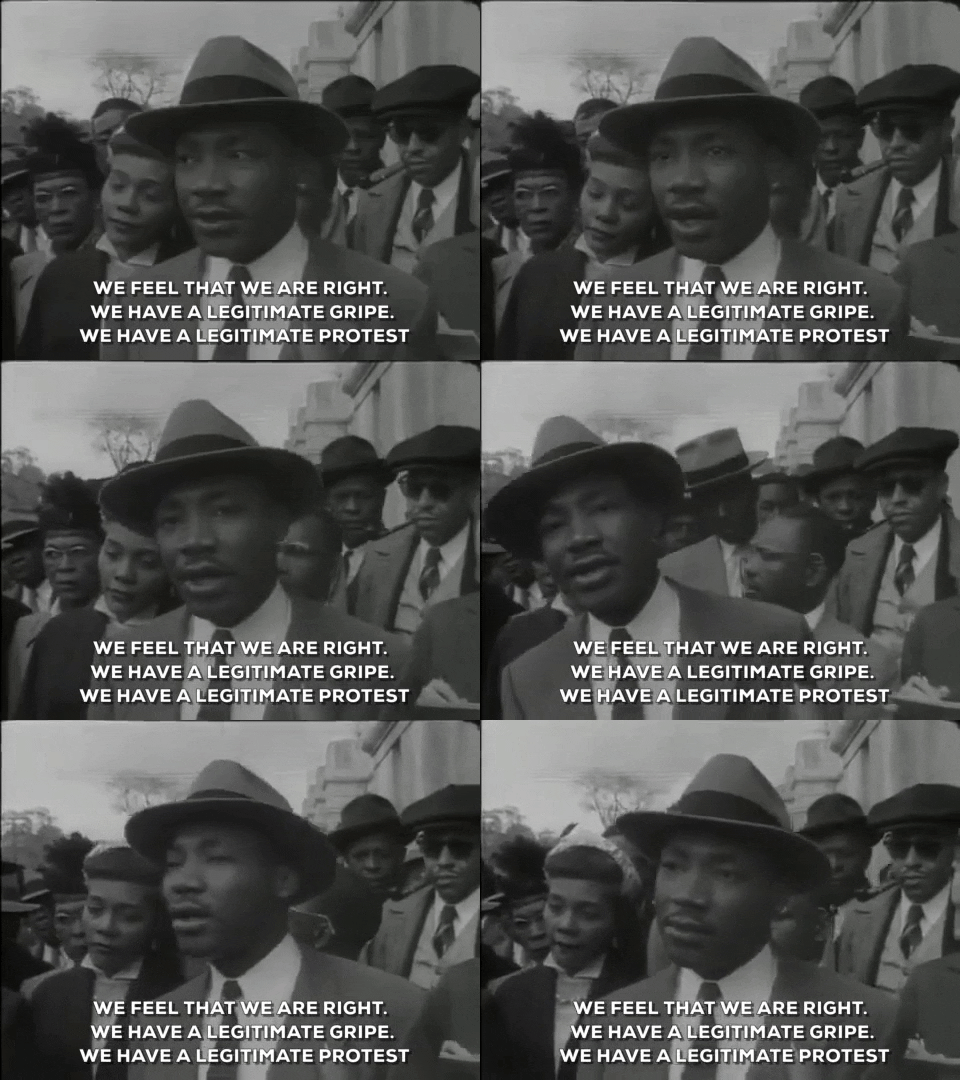
And now Jay-Z — a man who has built an entire public identity around ownership, independence, and doing things on his own terms — is putting the album that started it all behind a Target exclusive:
The internet had thoughts.
As did I.
But here is where I had to pause.
Because the question I kept coming back to was not whether Jay-Z should have done this.
The question I kept coming back to was: is Jay-Z actually the one who made this call?
It was time to put my IP hat on (**cue superhero music**):

So I did.
And what I found in the public records changed the entire picture for me.
Before we get into what I found, there are a few basics that will make this make sense.
Grab a cup of coffee, take a seat, get comfortable.
Because we’re about to do a legal deep dive (and I am so EXCITED!!!).
In this Founder's Letter, we're going beneath the headlines.
Today, we’re looking at the legal mechanics behind the Jay-Z/ Target controversy, who actually holds the power over Reasonable Doubt right now, and what we as founders can creative can learn from all of this.
Ready?
Let’s get into it.

Loving This Post?
Show us some love by adding a “❤️” or commenting below; this will make our hearts sing. Also, please share, we want this to get to as many folx as possible.

But first, Church Announcements.
The Firm for the Culture - THE SPEAKER PROTECTION Series
We’ve got a series of workshops, all for you!
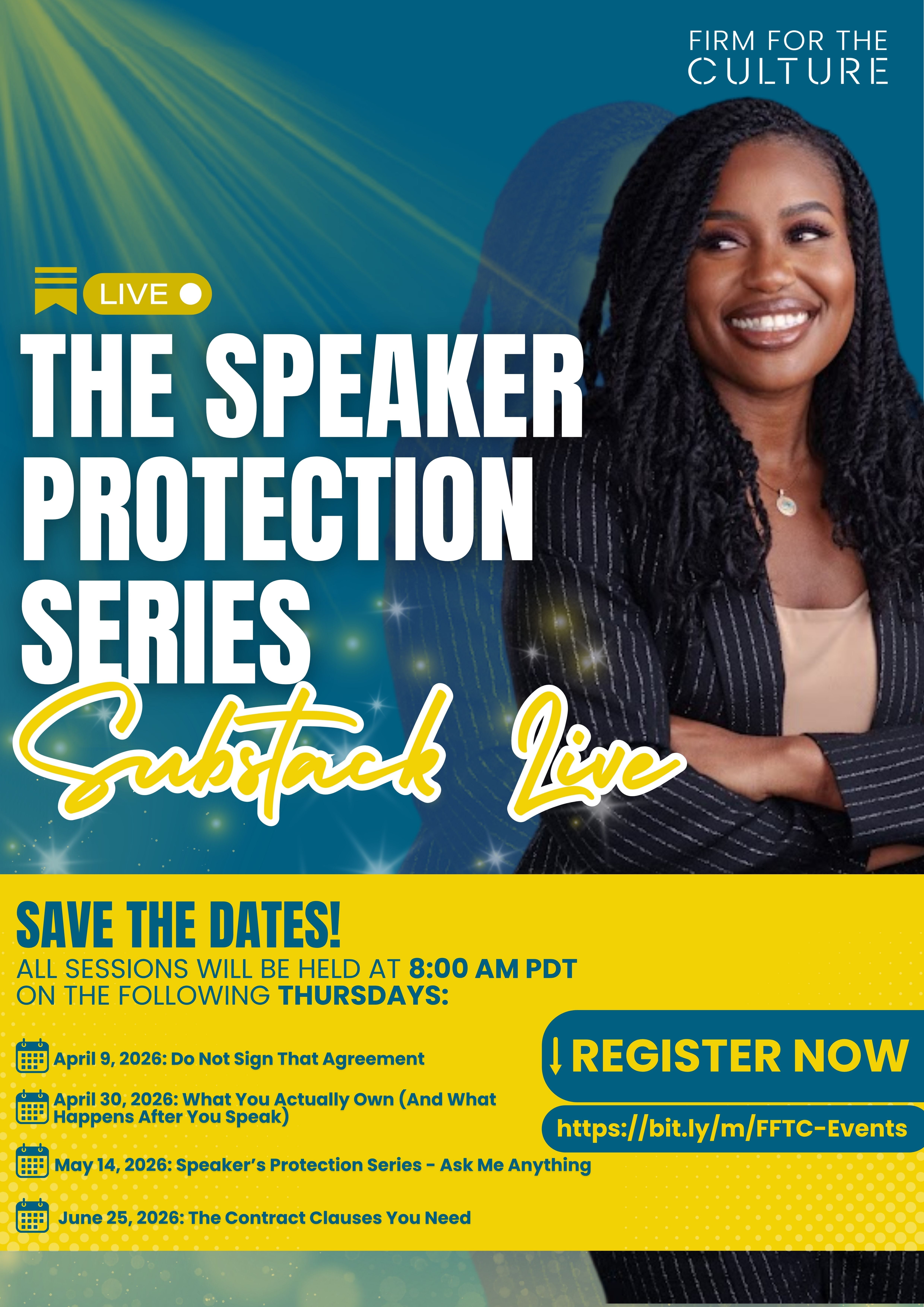
Speaking builds visibility.
But it also creates intellectual property.
This series breaks down what actually happens to your ideas, your content, and your rights once you step on stage. From contracts to ownership to licensing, we’ll explore how speaking opportunities can either build long-term value—or quietly take it away.
We’ll cover: how speaking engagements intersect with intellectual property, what speakers often overlook when accepting opportunities, and how to approach speaking as both a visibility and ownership strategy.
What you’ll walk away with: A clearer understanding of how to protect, position, and leverage your content as a speaker—before, during, and after every engagement.
Here’s a preview for your viewing pleasure:
Workshop 4: The Speaker Protection Series: The Contract Clauses You Need
📅 June 25, 2026 at 8:00 a.m. PDT
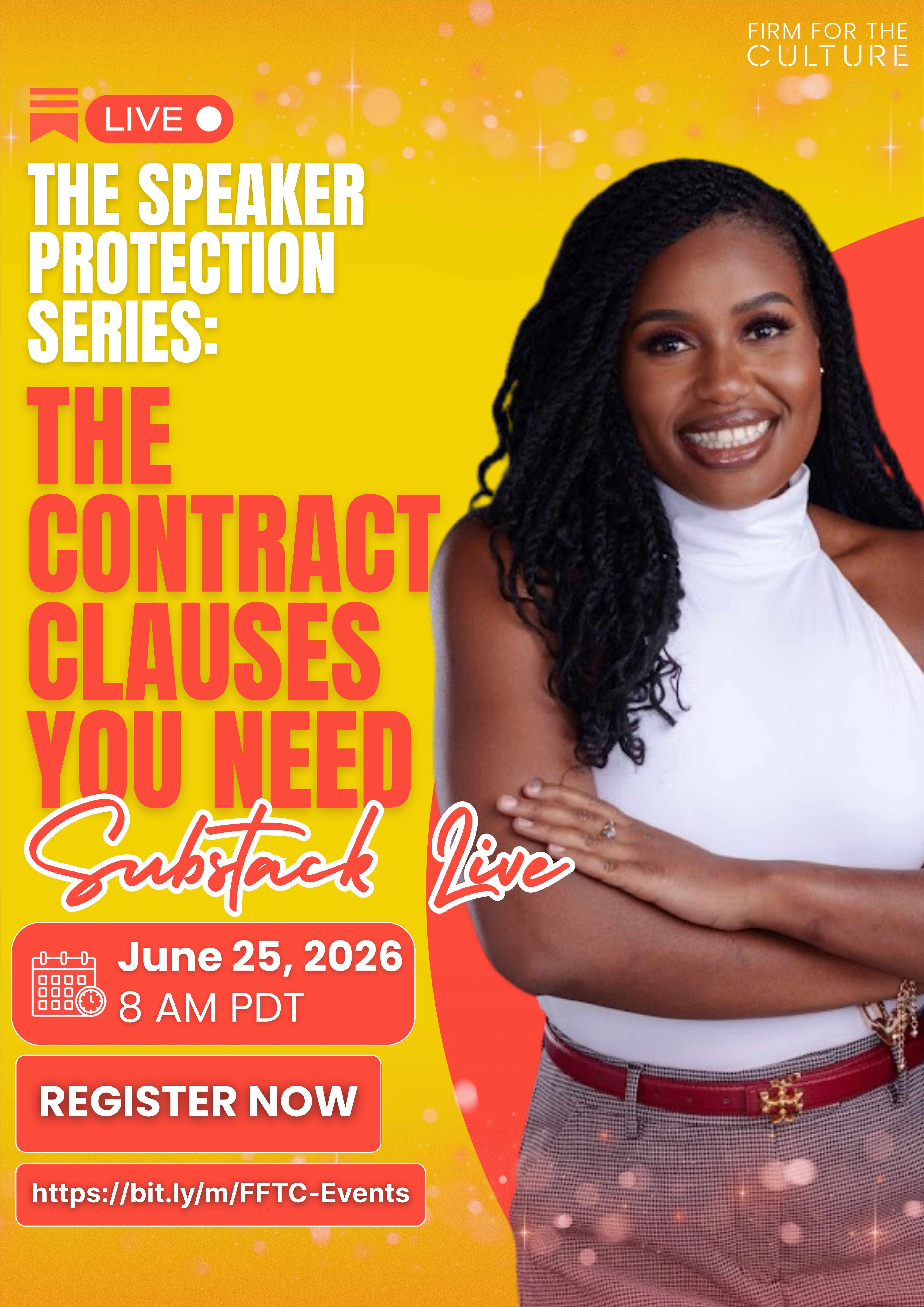
Growth usually comes with paperwork. Protection comes with awareness.
This workshop focuses on the specific contract clauses that directly impact your control, ownership, and long-term leverage as a speaker.
We’ll cover: key clauses around ownership, licensing, usage, distribution, and how to structure agreements that actually protect your work—not just your participation.
What you’ll walk away with: A clear understanding of the clauses you need in place and how to approach contracts with intention and strategy.
Register for The Speaker Protection Series: The Contract Clauses You Need workshop
For founders who are building brands. Creators who are shaping culture. Entrepreneurs who refuse to be extracted from.
Registration is FREE; in case you’re unable to make it, sign up and you’ll get the free notes.
After event recordings are $20.00 each.
Hope to see you there!
June 25, 2026 - The Contract Clauses You Need workshop
I remember my experience at the On the Run Tour.
I had just taken the New York Bar Exam (which I passed on first try), and I was eagerly anticipating getting out from under the rock I was in for over 3 months.
A few friends of mine, my UC Berkeley fam, purchased the best tickets we could find with a student’s budget.
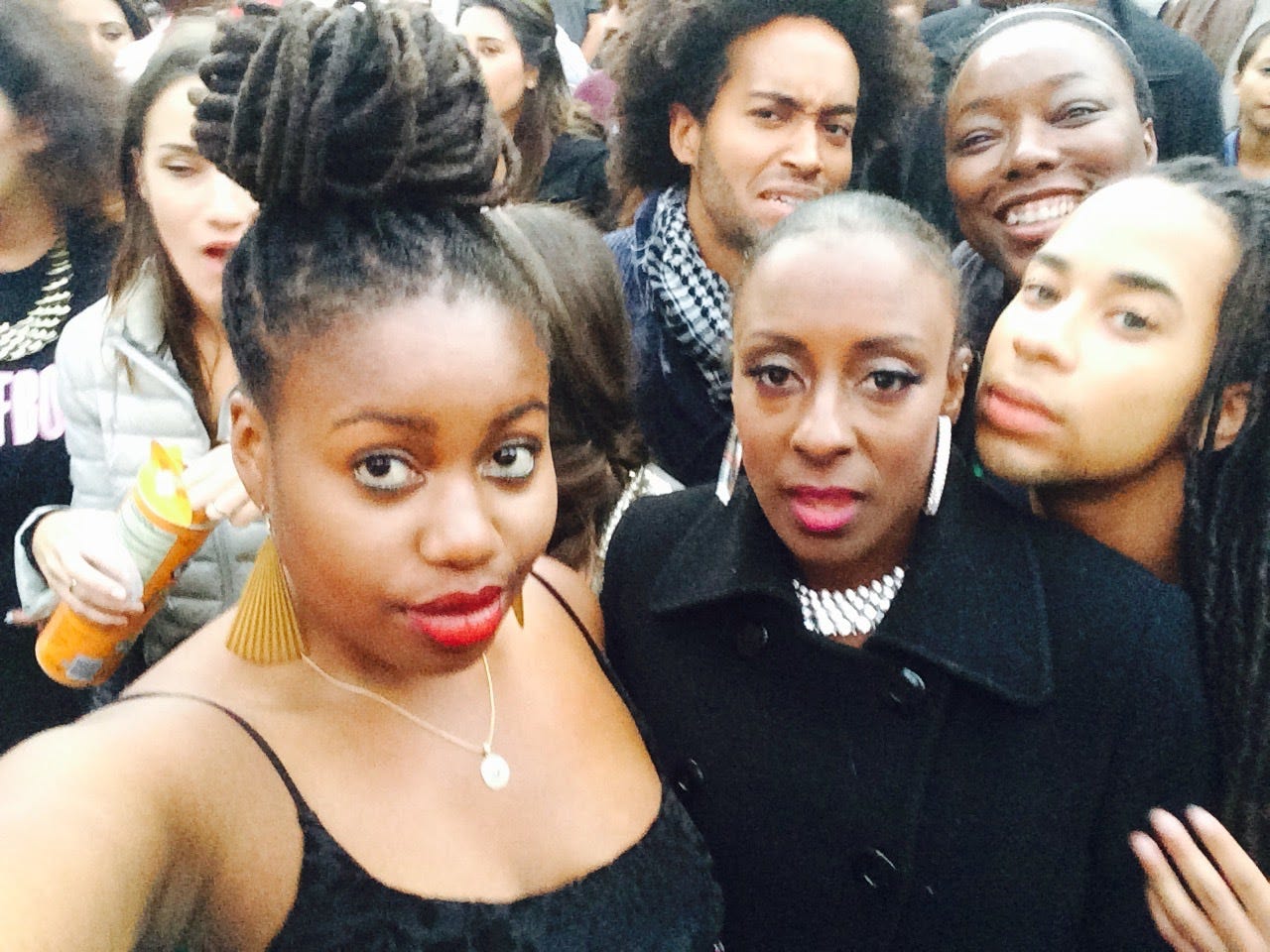
Nosebleed seats — the ones you grab because it's the only way you're getting in the building — and it did not matter.
Not even a little.
Beyoncé and Jay-Z on the same stage, in the same city, performing songs that had been the soundtrack to half my life.
The energy did not stop at the floor. It climbed. You could feel it from up there, that particular electricity that only happens when artists are fully, unapologetically in their power.
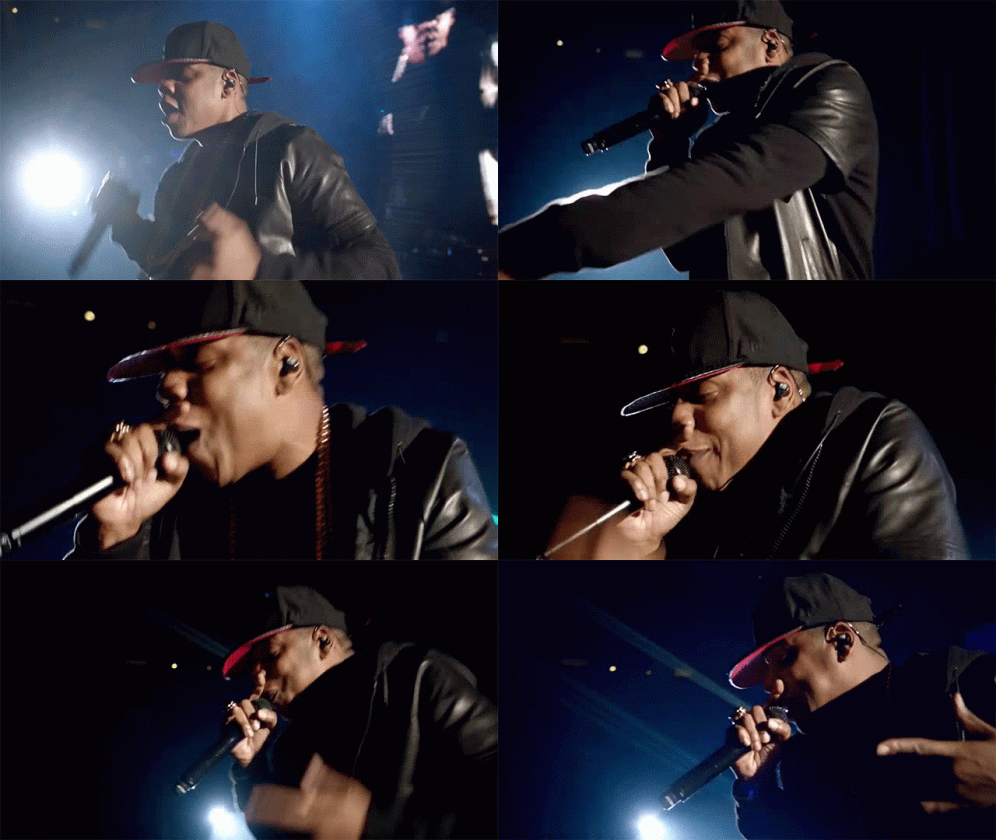
I left that arena convinced — the way you are convinced of very few things — that I had just watched two people who owned every single thing about what they had just done.
The music. The moment. All of it.
If you’ve ever experienced an artist you loved, you know what I’m talking about.
Standing in the crowd, watching your favorite artist move through a set like they were born to do exactly this, and thinking: that is someone who owns their craft.
And you would be right.
But owning your craft and owning your masters?
That is an entirely different thing.
The Law in a Nutshell
The United States Copyright Office draws a distinction that most people never encounter outside of a legal consultation with my firm.
According to the Copyright Office, a musical piece doesn’t have one copyright; it has several.
A musical composition — the melody, the lyrics, the notes on the page — is one copyright.
A sound recording — the actual recorded performance fixed to the master copy — is an entirely separate copyright.
And the Copyright Office states the distinction so beautifully: “Copyright in a sound recording is not the same as, or a substitute for, copyright in the underlying musical composition.”
They are separate works, often with separate owners, and with separate legal protections.
So what does this actually mean?
It means that an artist can write every word of a song, perform it, live it, and build a career on it — and still not own the recording the world knows.
The composition often stays with the songwriter or their publishing entity and it is often registered as a work of Performing Arts, as they are works created to be performed.
The master recording — the recording that gets licensed for commercials, synced to films, streamed on platforms, and as in Jay’s case, pressed onto vinyl — often belongs to the label.
The master recording is often registered as a Sound Recording, because that particular arrangement, those particular voices, and that particular performance in the studio, often on the label’s dime, is what is being protected.
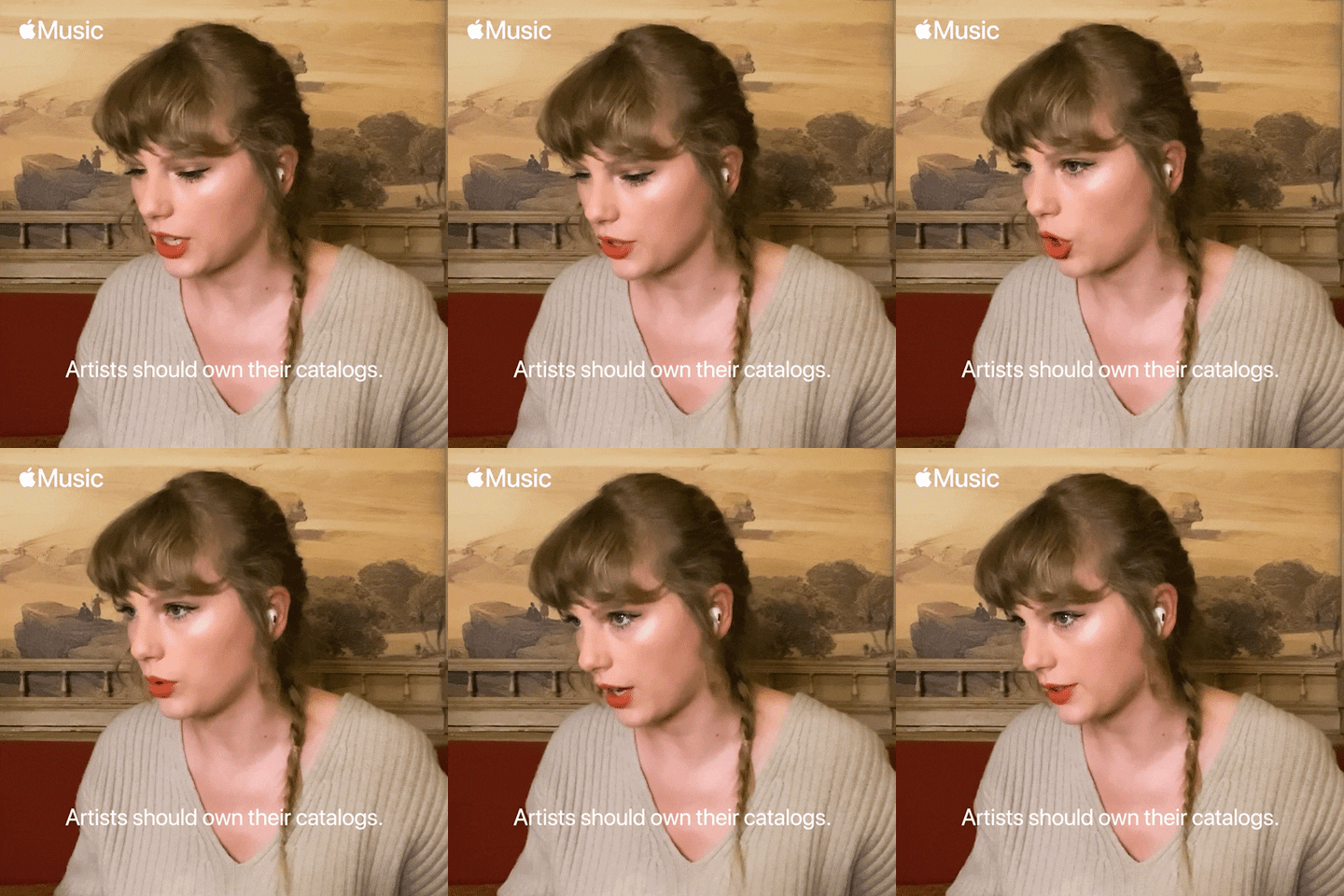
And this, my friends, is why the news is full of artists who are constantly fighting for their masters (cue Taylor Swift):
So where does Shawn “Jay-Z” Carter’s ownership fit into all of this?
“Take “Can I Live,” track two on Reasonable Doubt, as an example.
The Performing Arts registration — number PA0000817504, filed December 3, 1996 — tells you exactly what you need to know:
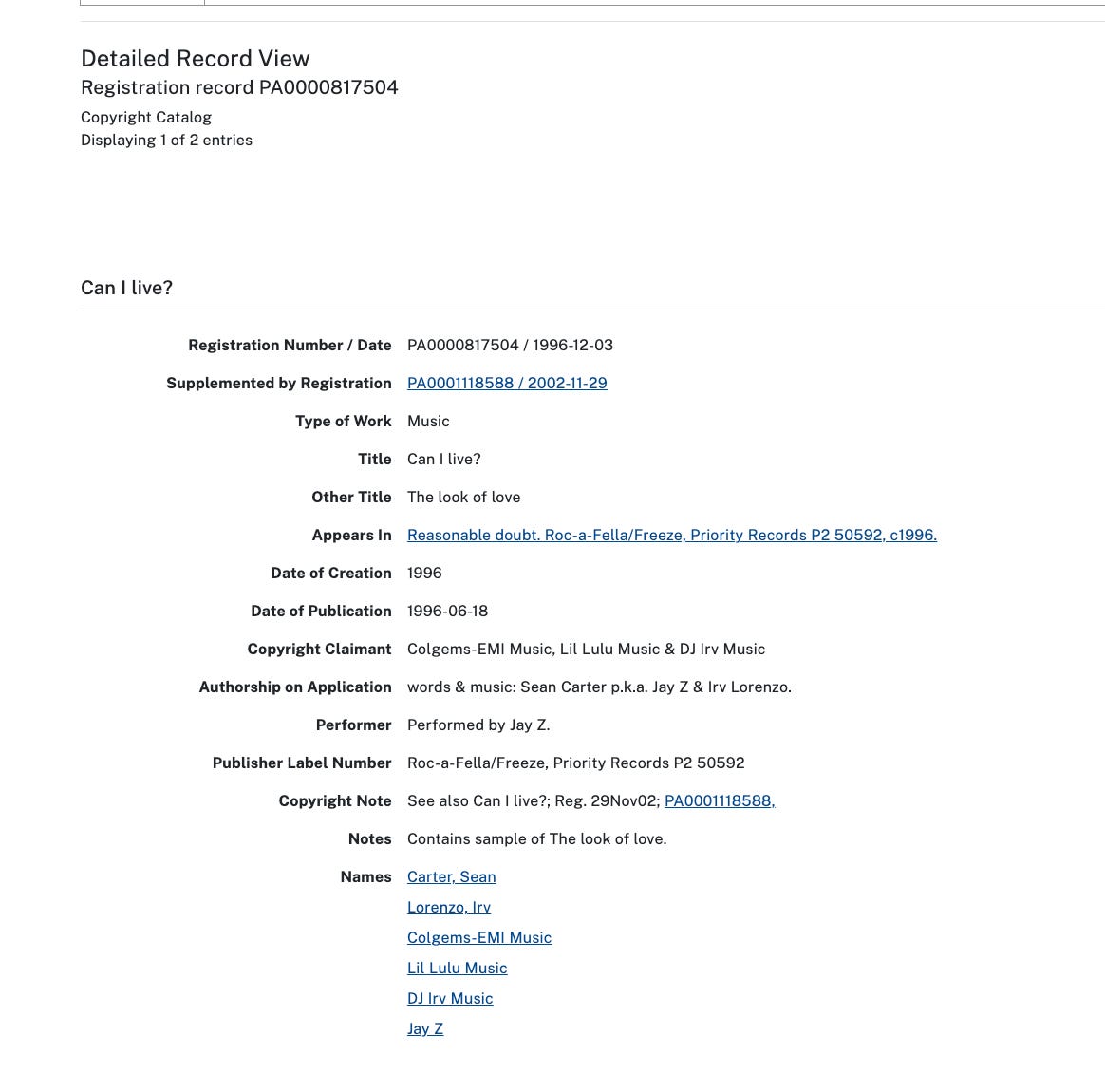
Authorship: words and music by Sean Carter p.k.a. Jay Z, and Irv Lorenzo.
Work made for hire: No (this part will be VERY VERY important later).
Copyright claimants on the composition: Colgems-EMI Music, Lil Lulu Music, and DJ Irv Music.
So here’s the story of this registration: Shawn Carter wrote the song.
He and his co-author created it.
And the PA registration — the Performing Arts copyright, the composition side of the ledger — reflects that clearly.
So Jay-Z has a stake in the composition through his publishing entity Lil Lulu Music.
So he likely has an ownership stake through that — but it's not a direct, personal holding.
It's held at the publishing company level.
But that Masters Copyright?
Much more complicated.
We dig into that below.
Founder Gem: There are at least two copyrights in every recorded musical work.
Knowing which one you own — and which one you signed away — is the difference between a legacy and a licensing check.
The music industry has a long history of artists — particularly Black artists — signing recording agreements early in their careers that were extraordinarily favorable to labels and extraordinarily unfavorable to the people who actually created the music.
Young.
Hungry.
Often unrepresented or underrepresented.
No leverage. No precedent.
The deal in front of them was the only deal being offered.
Jay-Z signed his deal with Roc-A-Fella Records — the label he co-founded with Dame Dash and Kareem “Biggs” Burke — in the mid-1990s.
Reasonable Doubt was released June 25, 1996. The masters to that album, like the masters to most recording agreements of that era, transferred to the label as part of the deal.
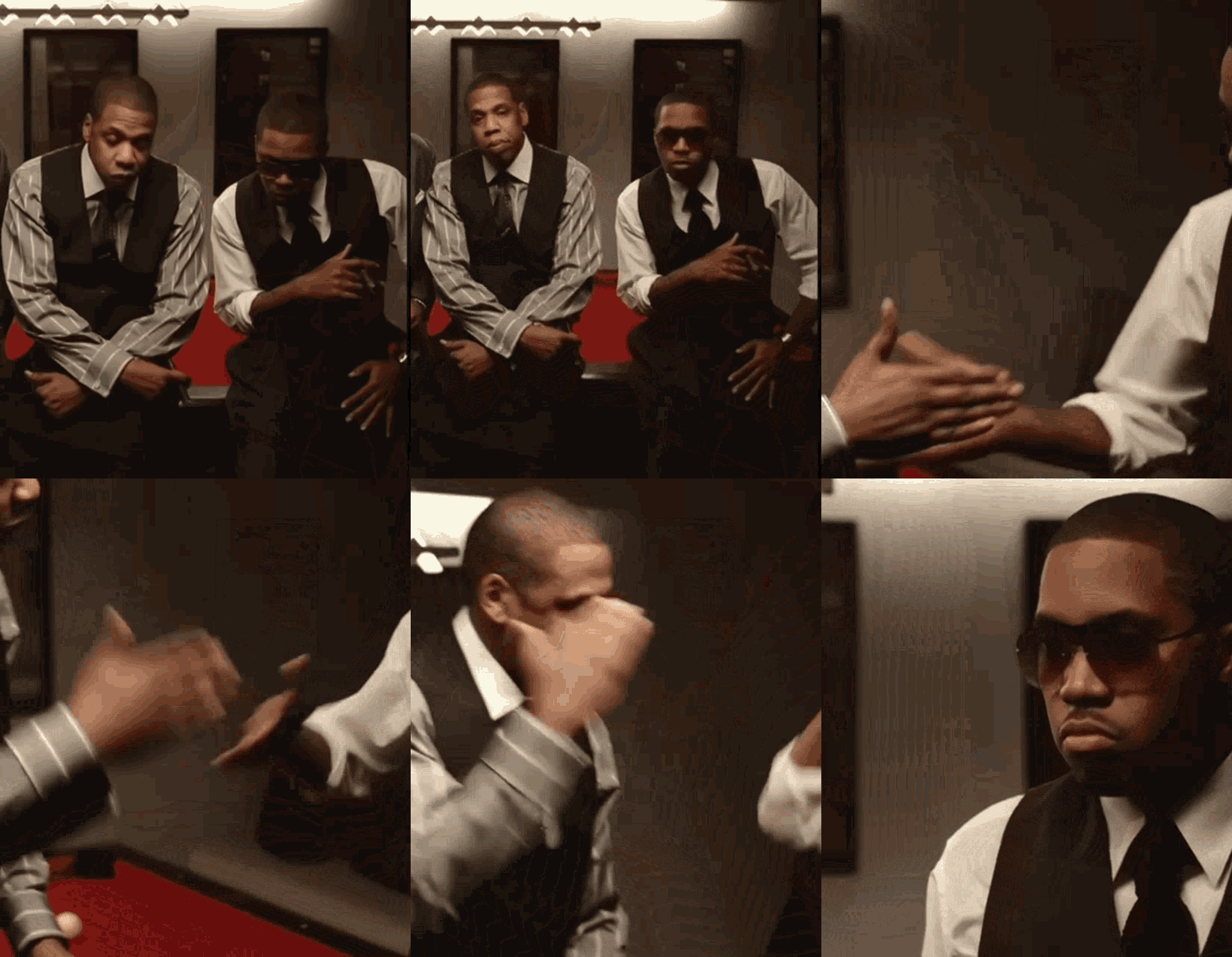
And Roc-A-Fella Records, Inc., according to public documents, still owns the copyright in the masters.
Let’s pause for a second, because I want to make sure you understand what this means, because here is where it gets complicated.
As mentioned, Roc-A-Fella Records, Inc. was co-founded by three people: Jay-Z, Dame Dash, and Kareem "Biggs" Burke.
Jay-Z is not the sole owner of that company.
This means he is not the sole decision-maker over what happens to those masters, including the Target Vynyl deal.
And since their humble beginnings, it’s likely the case that a more extensive Roc-A-Fella corporate board is calling the shots here, with UMG (Universal Music Group) as the distributor.
A lot of hands in the pot, so no one person can act unilaterally here.
In fact, in 2021, Dame Dash tried to sell his ownership interest in Reasonable Doubt as an NFT — without Jay-Z's consent.
Jay-Z had to go to court to stop it. That case is public record (shoutout to my mentor Alex Spiro and my alma mater law firm Quinn Emanuel for handling this case):
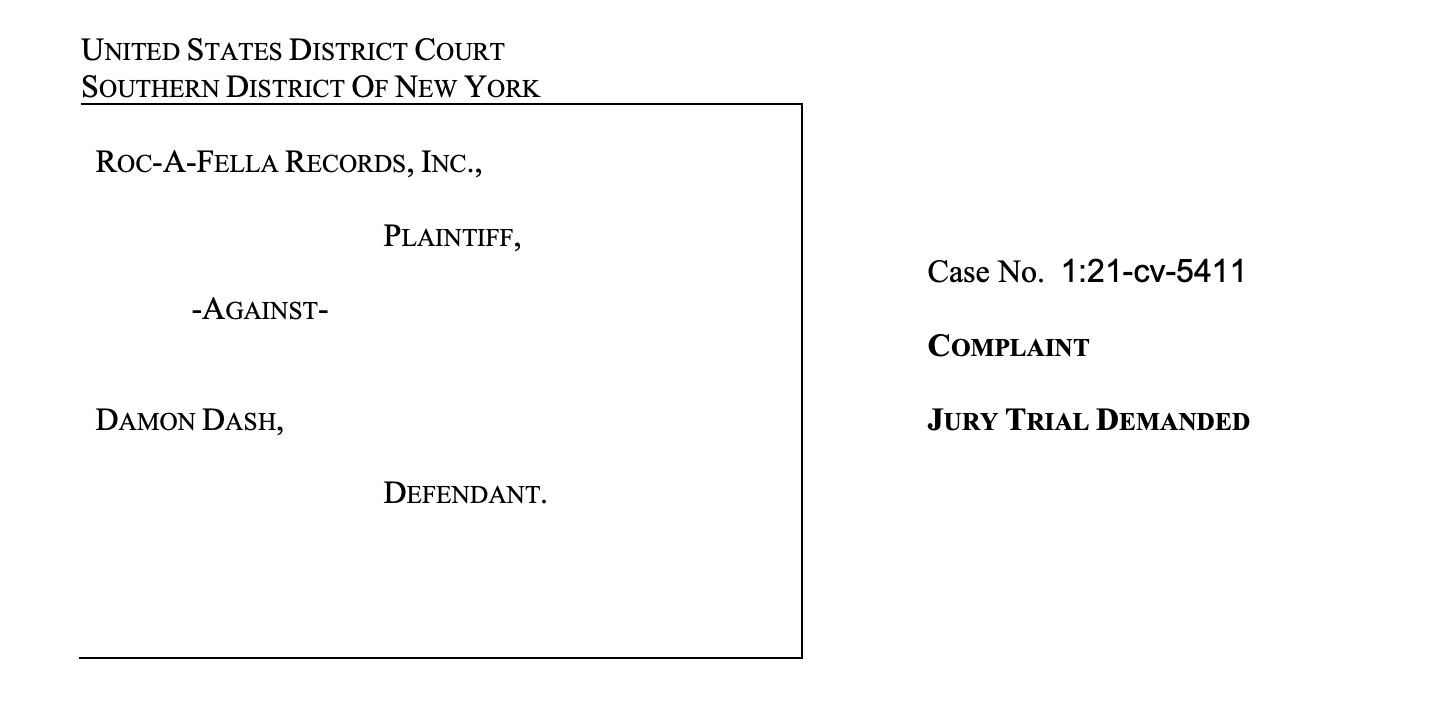
And it tells you everything you need to know about how clean — or rather, how messy — the ownership picture inside Roc-A-Fella actually is.
So the simpler answer?
Jay-Z, at least in his personal capacity IS NOT THE ONE CALLING THE SHOTS.
So if a Billionaire Mogul like Jay is not calling the shots, what’s a typical artist to do?
Fortunately for artists, Congress anticipated this dynamic.
The Copyright Act of 1976 includes a provision — Section 203 — that gives authors the right to terminate grants of copyright that were made on or after January 1, 1978, thirty-five years after the execution of the original grant.
The right cannot be waived in advance.
It cannot be contracted away.
It is a statutory right that exists regardless of what the original agreement says.
What it means in plain terms: an artist who signed their rights away at twenty-six can take them back at sixty-one (as long as it was not a work for hire).
The deal is not permanent.
The law literally built in a second chance for artists and creatives alike.
On July 29, 2024, Shawn Carter — personally, as the author — served a Notice of Termination of Grant under 17 U.S.C. Section 203 on Roc-A-Fella Records, Inc. by certified mail, return receipt requested:
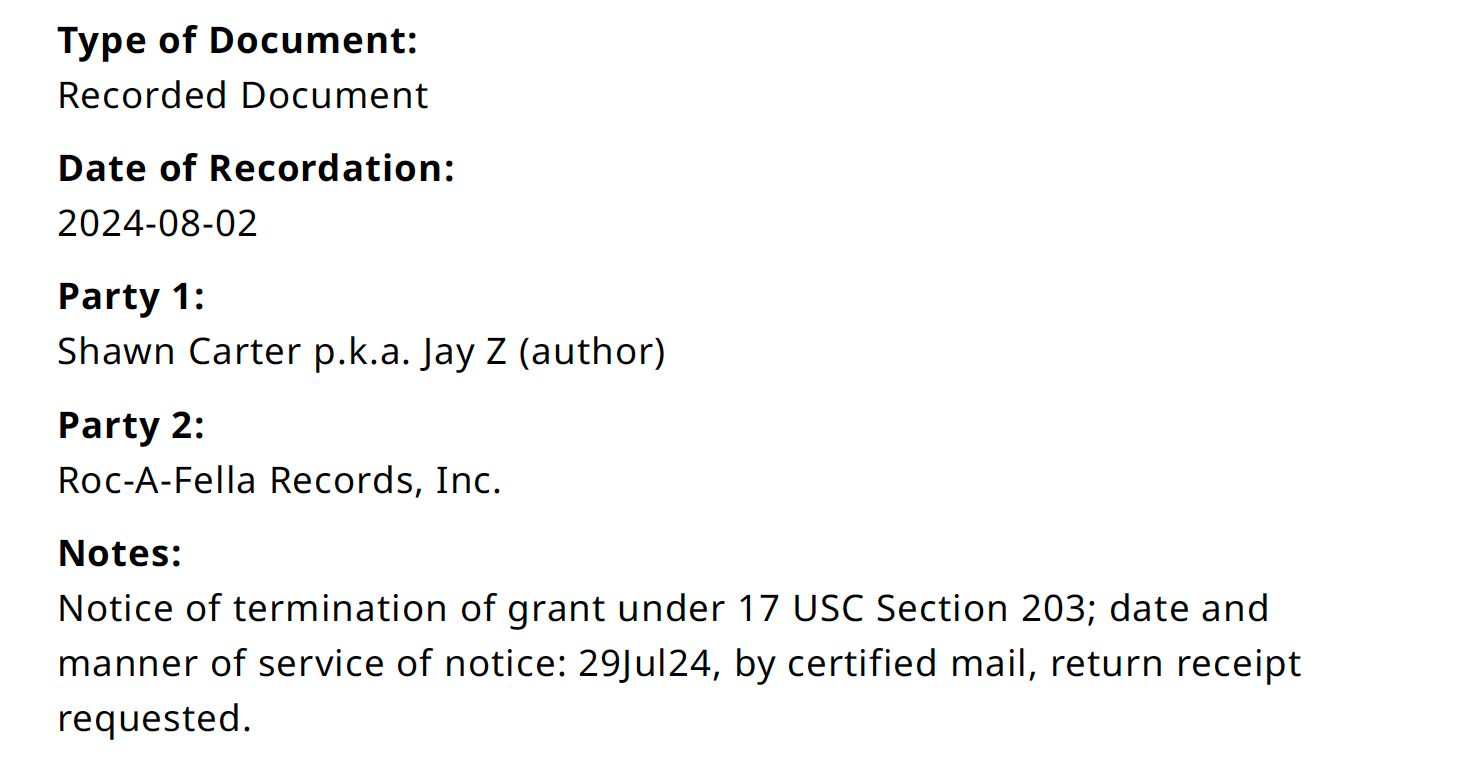
The notice was recorded at the U.S. Copyright Office on August 2, 2024.
The list includes Dead Presidents II, Can’t Knock the Hustle, Can I Live, D’Evils, Regrets, Friend or Foe, Bring It On, Cashmere Thoughts, Brooklyn’s Finest, and nine other sound recordings from Reasonable Doubt.
The termination date for most of them? June 25, 2031.
Remember. This. Date.
Founder Gem: Section 203 exists because Congress understood that the value of creative work is often unknowable at the time of the deal. You cannot waive this right. And your label cannot take it from you.

Okay, you still with me?
Shout out to you for making it this far, because here is where it gets really interesting.
What the §203 termination document confirms is this: Roc-A-Fella Records, Inc. holds the rights to these sound recordings (a lá, the Copyright Office screenshot above (because…receipts)).
Jay-Z would have nothing to terminate if that were not the case.
And here is the critical legal reality the headlines are missing entirely.
Those masters do not revert to Shawn Carter until June 25, 2031.
Until that date, the current rights holder(s) control(s) the sound recordings.
Shawn Carter, as the “author-in-waiting,” does NOT currently have the unilateral right to authorize a Target-exclusive vinyl release of these masters, much in the way Dame Dash didn’t have the unilateral right to sell his share of Roc-A-Fella.
What is likely happening is something far more intentional, and frankly, more nuanced, than a simple sellout.
Because here’s the thing: Jay-Z has re-emerged in 2026 in a way we have not seen in years.
The Roots Picnic performance.
The public reflections.
The anniversary rollout.
The combed out locs (shout out to Cécred).
What this moment likely represents is a coordinated effort — with the cooperation of the current rights holders who have every financial incentive to participate — to drive the value of the Reasonable Doubt catalog as high as possible before the reversion.
Because in 2031, when those masters come home to Jay, their value will be determined in large part by the cultural moment they are living in right now.
The Fool’s Paradise Remix of “Can’t Knock the Hustle” — the unreleased track on the Target vinyl — is also listed on the 203 termination notice.
Jay-Z is not just celebrating the album.
He is, in all likelihood, building the very portfolio he is about to own.
Founder Gem: Leverage does not always look like ownership. Sometimes it looks like momentum — building the value of what is coming back to you before it arrives.

I went to Target.com yesterday:
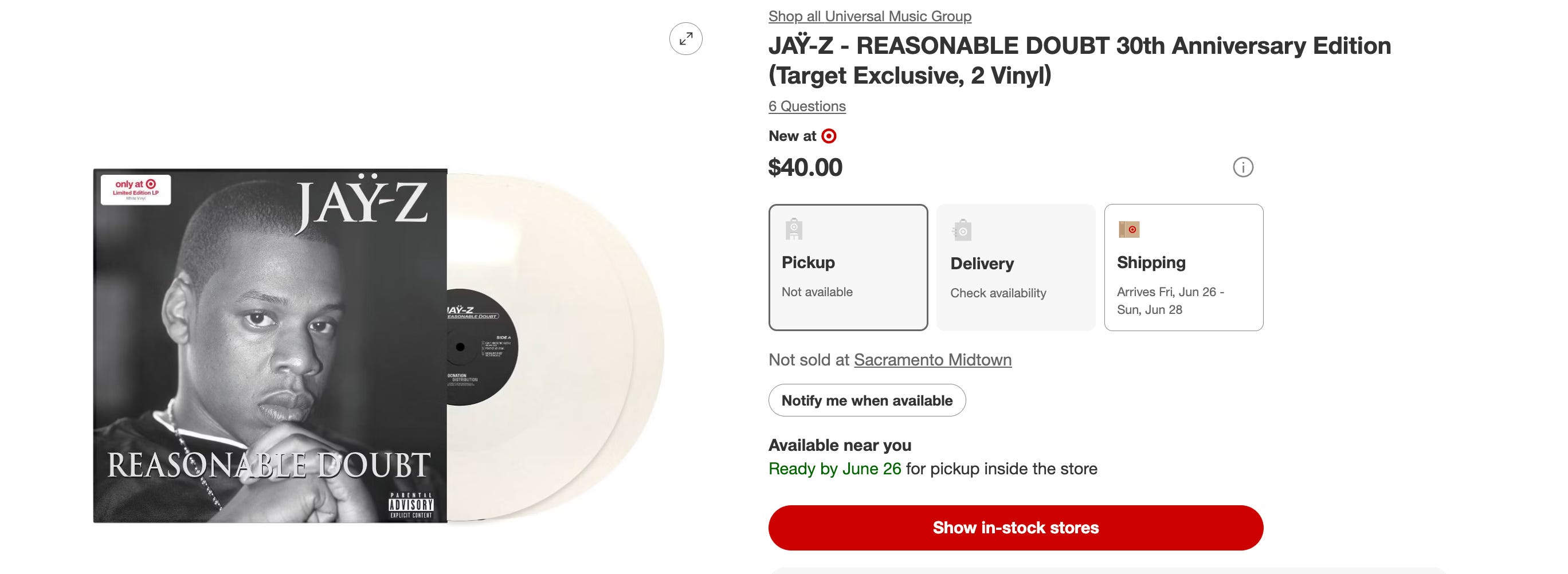
And there it was — a face I have looked at my whole life.
A young man from the Marcy Houses in Brooklyn, New York, less than 40 minutes from my own stomping grounds.
My borough.
My Brooklyn.
A face that has seen so much, and yet in that photograph, there is still so much ahead of him.
The whole career.
The whole empire.
Thirty years of music that would follow.
And many difficult decisions he never anticipated having to make.
Has Jay-Z sold out?
I do not think that is the right question.
The right question is: who currently owns what, what does the law say, and what does the man at the center of this already understand about where it is all going?
Because here’s the thing, there’s still so much we don’t know here.
We don’t know, for certain, the current ownership structure of Roc-A-Fella.
We don’t know just how big, or how little, Jay-Z’s control and leverage was in this matter.
And because of that, we just don’t know how much accountability belongs to all involved.
But what I know is this:
As a fellow Brooklynite, I am proud of every person who came out of these “concrete jungles” and built something the world could not ignore.
Watching New York have its moment right now — the Knicks, Jay-Z, all of it — does something to me that is hard to put into words.
But I am also an IP attorney.
And when I see a story the culture is reading one way, I cannot help but look underneath it.
The answers — at least the ones the Copyright Office will give you — suggest that Shawn Carter already knew exactly what he was doing.
The question, as always, is whether we understand the legal infrastructure that makes it possible.

What do you think — is this a strategic move or a misstep regardless of the legal picture? And are you still boycotting?
Drop a comment—I read every one.

Want to know where your business actually stands on that gap?
Let’s talk — and make sure your name isn’t just recognized. It’s protected.
Book a Strategy Session with Firm for the Culture and let’s make sure your name isn’t just recognized—it’s protected.
Need Help Protecting Your Creativity?
If you are unsure—or if you know you need to take action—reach out to us.
We have helped countless founders and creatives safeguard their intellectual property, and we would love to do the same for you.

If you need further guidance, reach out to me and my team at Firm for the Culture.
We’re here to help you navigate the copyright, trademark, and thought leadership journey.
Can’t wait to help you protect your dynamic impact.
And #ThatsAWrap
The Doors of the Church Firm Are Open.
Come on it and share the love.
Thanks for reading
See you next time.
I really appreciate this deep dive. I was not aware of this story (I kinda live under a rock + the algorithm shows me what I’ve built around) and appreciate your articulation of all the legalities many wouldn’t understand where to start. This was really interesting to read just how complex an artist-sound writers journey can be.. this really reminds me of Lauryn Hill and I assume it’s a very similar situation.