

Hey Fam,
Only in America could a defamation trial double as a viral marketing moment.
Here we have a courtroom.
A side-eye.
And a resulting moment that will live rent-free on the internet.
When Cardi B testified at the Los Angeles Superior Court in the case of Emani Ellis v. Belcalis Almanzar, no one likely anticipated that a routine legal proceeding would morph into a cultural moment.
But with an entertainer like Cardi — whose every gesture becomes a meme, whose every look becomes a language — it’s not far-fetched to see how this courtroom cameo became part of internet history.
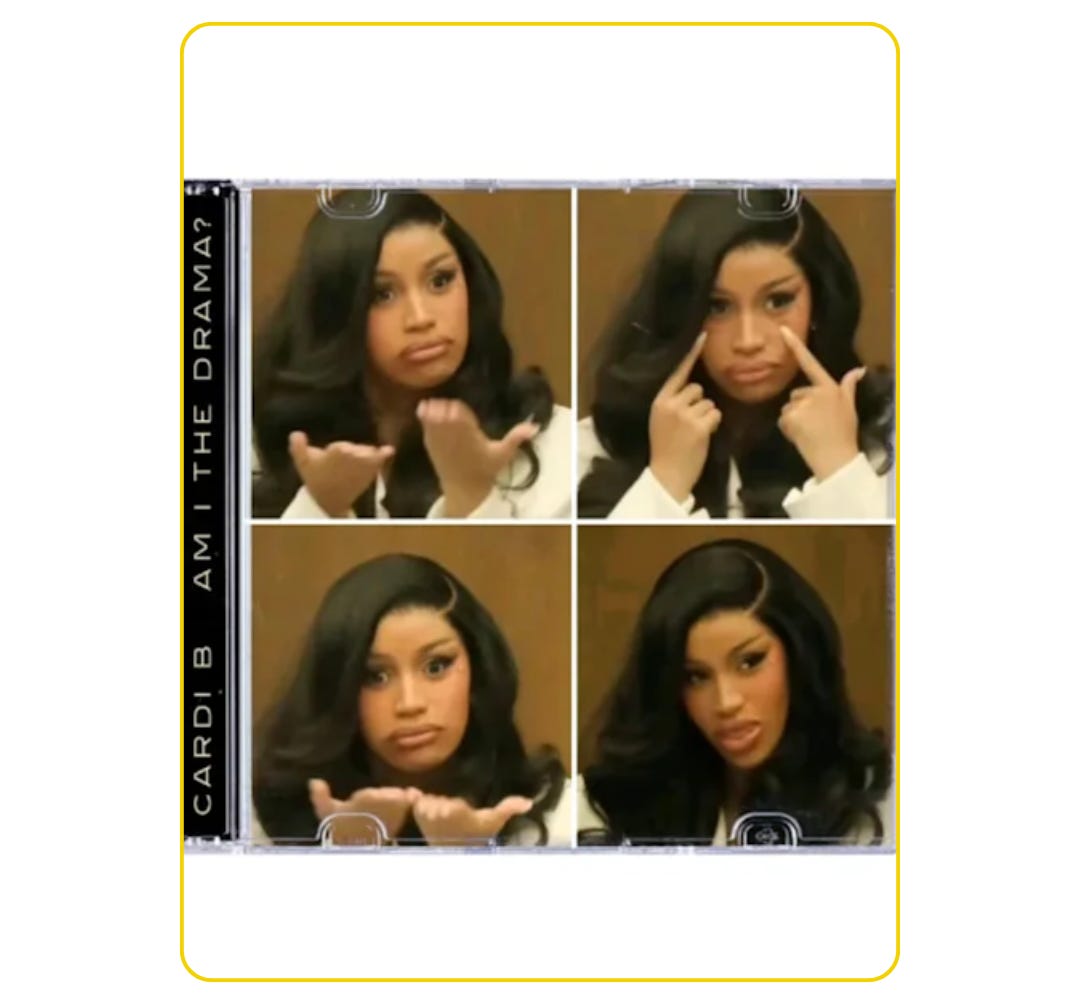
But this memeable moment didn’t happen by accident.
It required the cooperation of multiple stakeholders — the judge, the courthouse, and even the media outlets who filmed the proceedings.
After all, the photos and memes that became the centerpiece of Cardi B’s Am I the Drama? rollout didn’t magically appear in her marketing folder.
That was law at work.
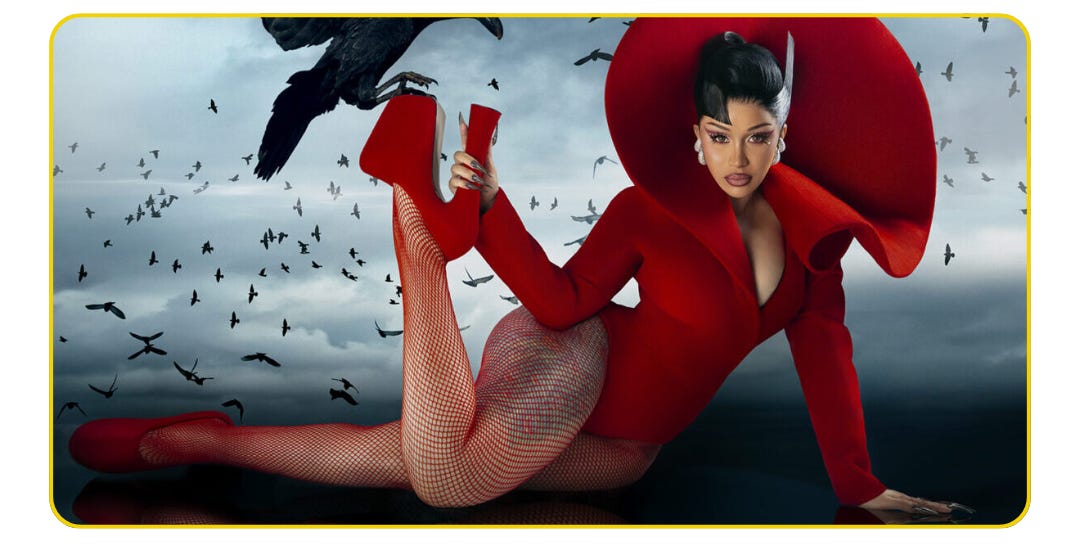
So how exactly did Cardi B turn a formal courtroom proceeding into a memeable — and marketable — moment?
In this Founder’s Letter, we’re diving into three legal hurdles that had to be cleared for this memeable moment to become marketable:
Ready?
Let’s get into it.
Loving This Post?
Show us some love by adding a “❤️” or commenting below; this will make our hearts sing.
But First, Church Announcements:
Introducing the “Leverage Your Brilliance” Series
Starting this October, I’m thrilled to announce a new four-part workshop series designed for creators, thought leaders, and culture-shapers who want to protect, monetize, and leverage their brilliance.
Whether you’re a speaker, musician, educator, or entrepreneur — your ideas are valuable.
And it’s time to treat them that way.
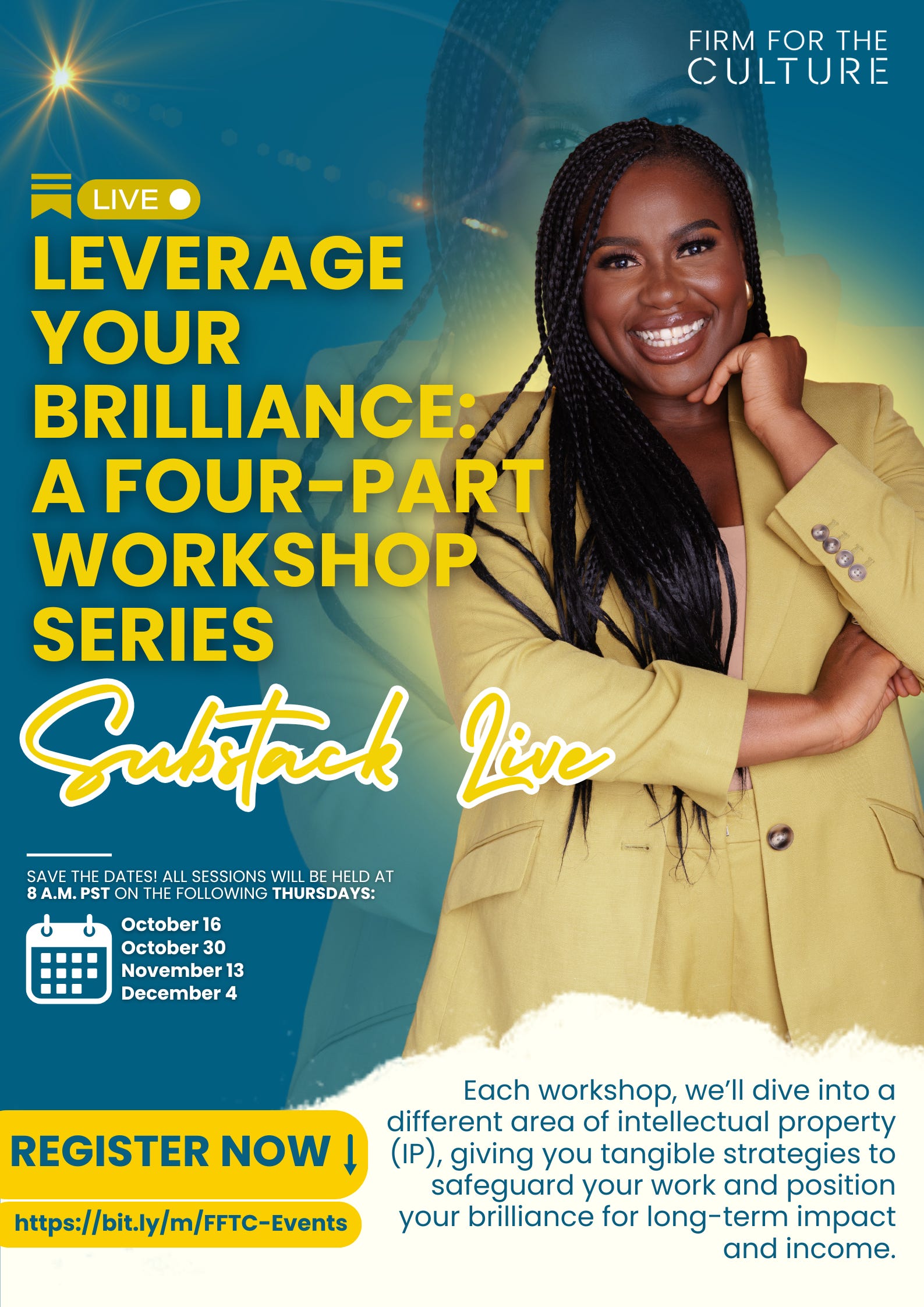
Each week, we’ll dive into a different area of intellectual property (IP), giving you tangible strategies to safeguard your work and position your brilliance for long-term impact and income.
All sessions will be held at 8 a.m. PST on the following Thursdays:
So Register Here to Save the Dates:
October 16
October 30
November 13
December 4
Workshop Lineup:
What to Do Before You Brand: October 16, 2025
The pre-legal foundation that helps you build a brand worth protecting.
Copyrights for the Culture: October 30, 2025
From music to course materials, learn how to protect the creative works you’ve poured your soul into.
Introduction to IP Licensing: November 13, 2025
A breakdown of how licensing works, what to watch for, and how to get paid while keeping ownership.
Social Impact Licensing: Success Stories: December 4, 2025
Real-life case studies of brands who’ve turned impact into income without compromising their mission.
Sign Up for Our First Workshop Here:

Let’s close the year strong — with strategy, clarity, and protection for the intellectual property that’s been building your legacy all along.
Now, back to our regularly scheduled program…. :)

Hurdle #1: Cardi needed to determine ownership of the images
Here’s the thing: Courtrooms typically do not allow for photographing, recording, or broadcasting proceedings.
Under California Rule of Court 1.150, which governed Cardi B’s Los Angeles Superior Court case, the Judge needed to approve any and all requests to film or photograph proceedings, and even then, the court had to balance “fairness and dignity” in such proceedings.
In other words, there was no default right to film.
And even when permitted, the access typically went to media outlets (think Court TV or Law & Crime), not individual parties or their teams.
So if Cardi didn’t have a camera on a tripod in the well — who did?
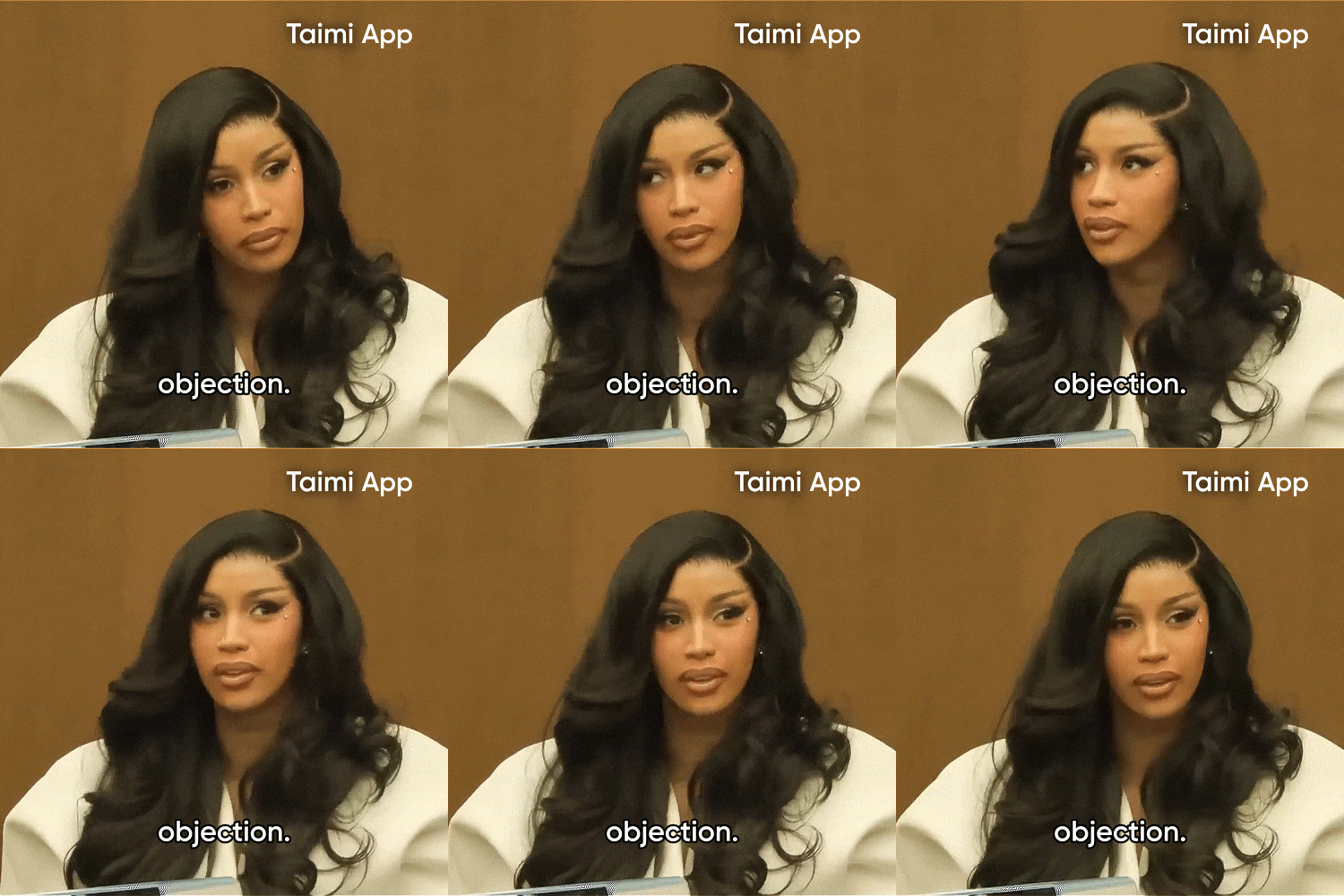
Likely an approved media organization operating under a judicial media order.
Court TV, for instance, streamed the proceedings on YouTube and (crucially) offers a licensing request process.
But that still doesn’t mean Cardi can simply use the images all willy nilly…
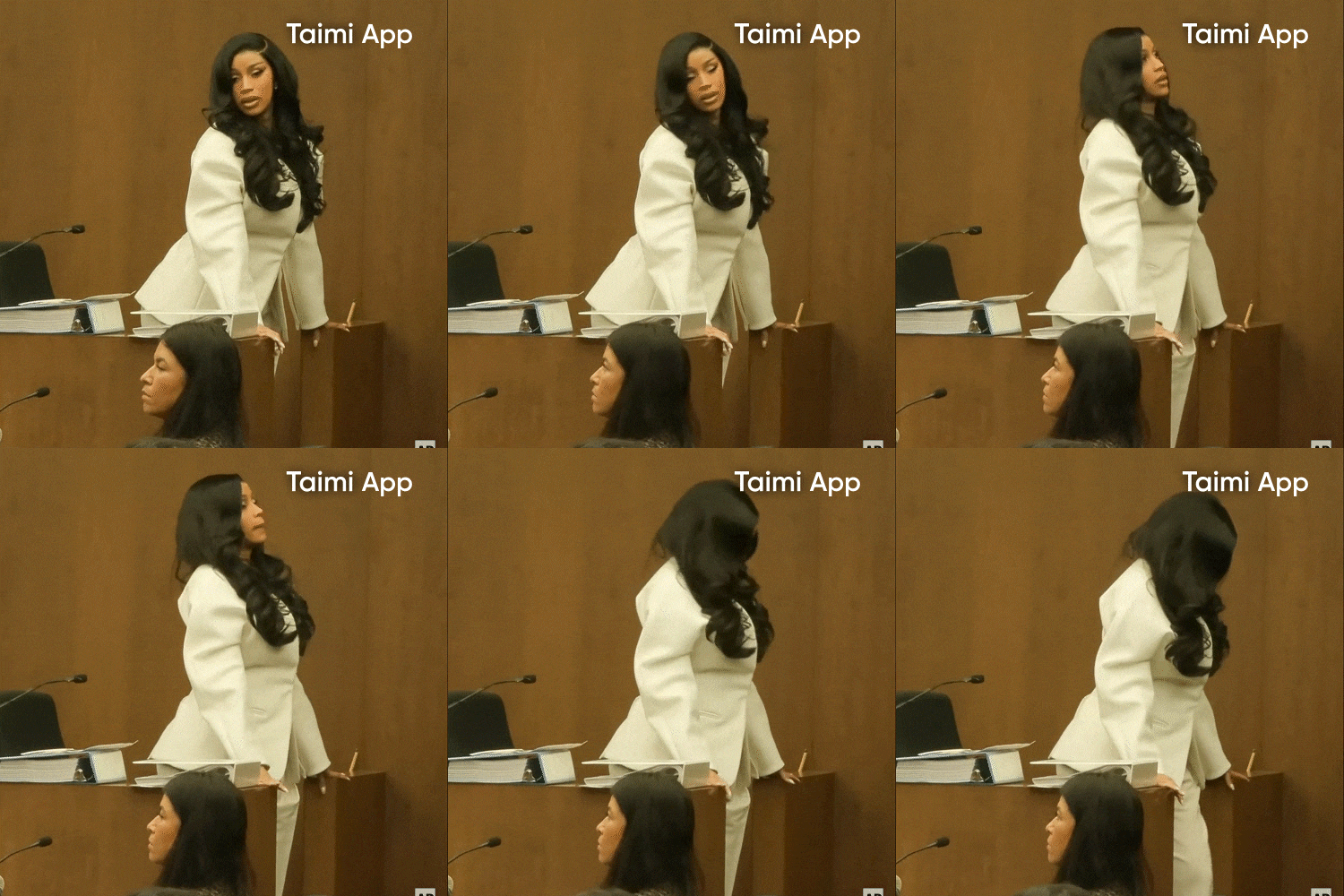
Even if you are the face, the pose, the meme — that doesn’t make you the copyright owner of the photo or video.
The creator (or their employer) holds that right.
So in order for Cardi’s team to use the images on her album, they would need to trace chain-of-title:
Who shot the image/footage?
Are they an employee (work-for-hire) or a freelancer (who owns unless assigned)?
Did the media outlet acquire the rights by agreement?
Are there courtroom order restrictions (e.g., on editing, redistribution, or context)?
Practical takeaway:
Possession is not ownership. A screenshot isn’t a license. Before you repurpose a viral clip, you need (a) the right owner, and (b) the right agreement.
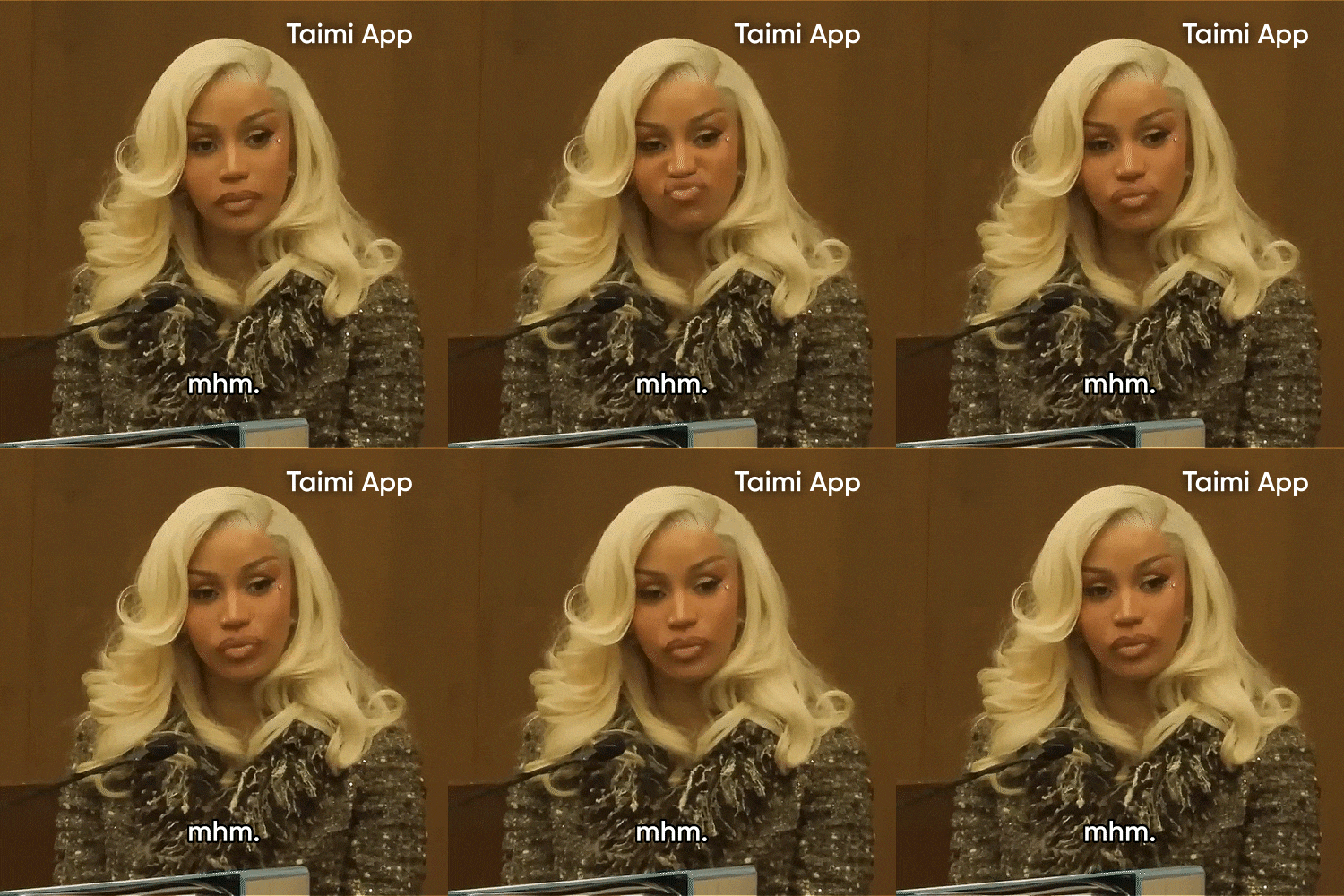

Hurdle #2: Cardi needed to know the legal rights at stake; it didn’t matter that she was in the photos.
In Copyright law, protection attaches automatically the moment the shutter clicks or the camera rolls — no form or symbol required.
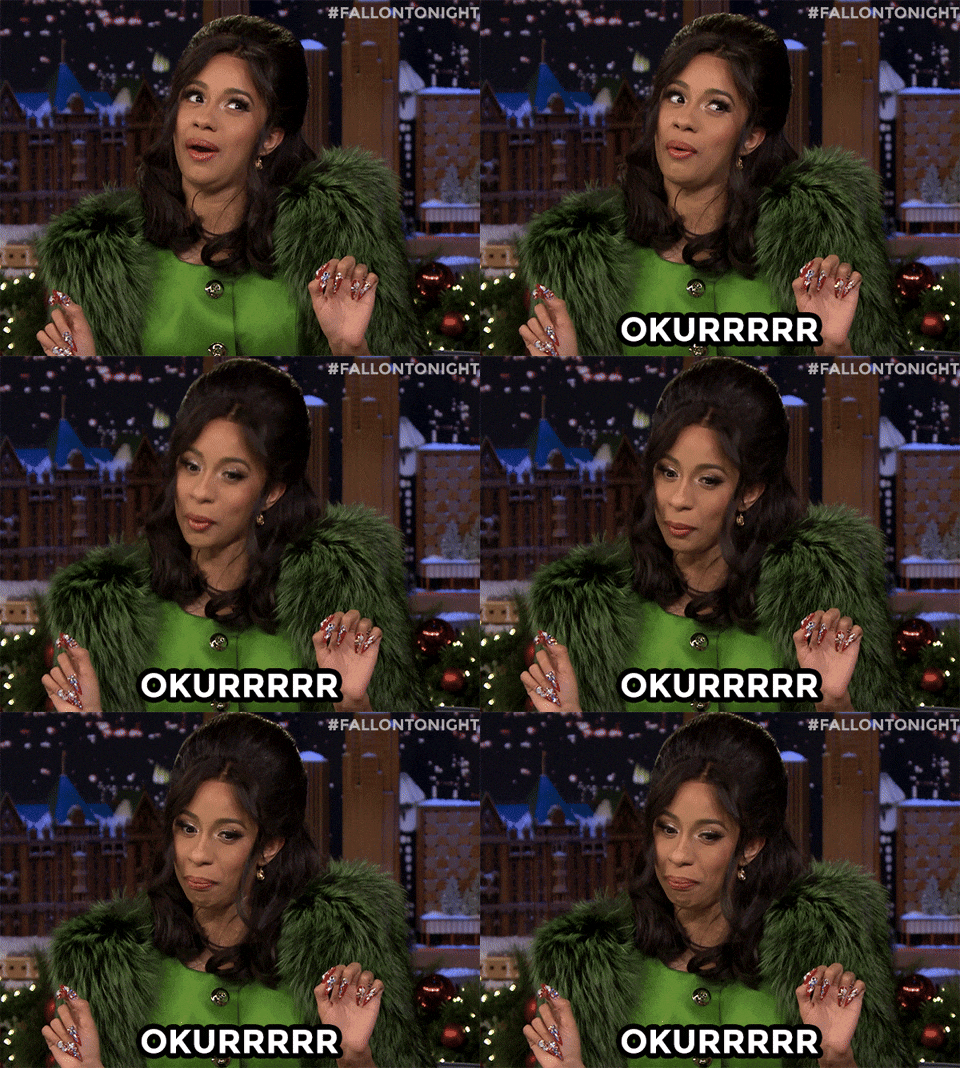
But registration with the U.S. Copyright Office is what unlocks real enforcement:
Prerequisite to sue in federal court.
Access to statutory damages and attorneys’ fees (often the difference between “we’ll settle” and “good luck with your case”).
A public record that strengthens chain-of-title and deters infringement.
Two common gotchas:
One: “But it’s me in the picture!”
Still not your copyright. You may control right of publicity (your name/likeness used for commercial endorsement), but that doesn’t substitute for the photographer’s copyright.
And even if you’re not Cardi B in the photo, you still must clear copyright or risk DMCA takedowns, demand letters, and, with a registered work, litigation exposure.
And ain’t nobody got time for that…
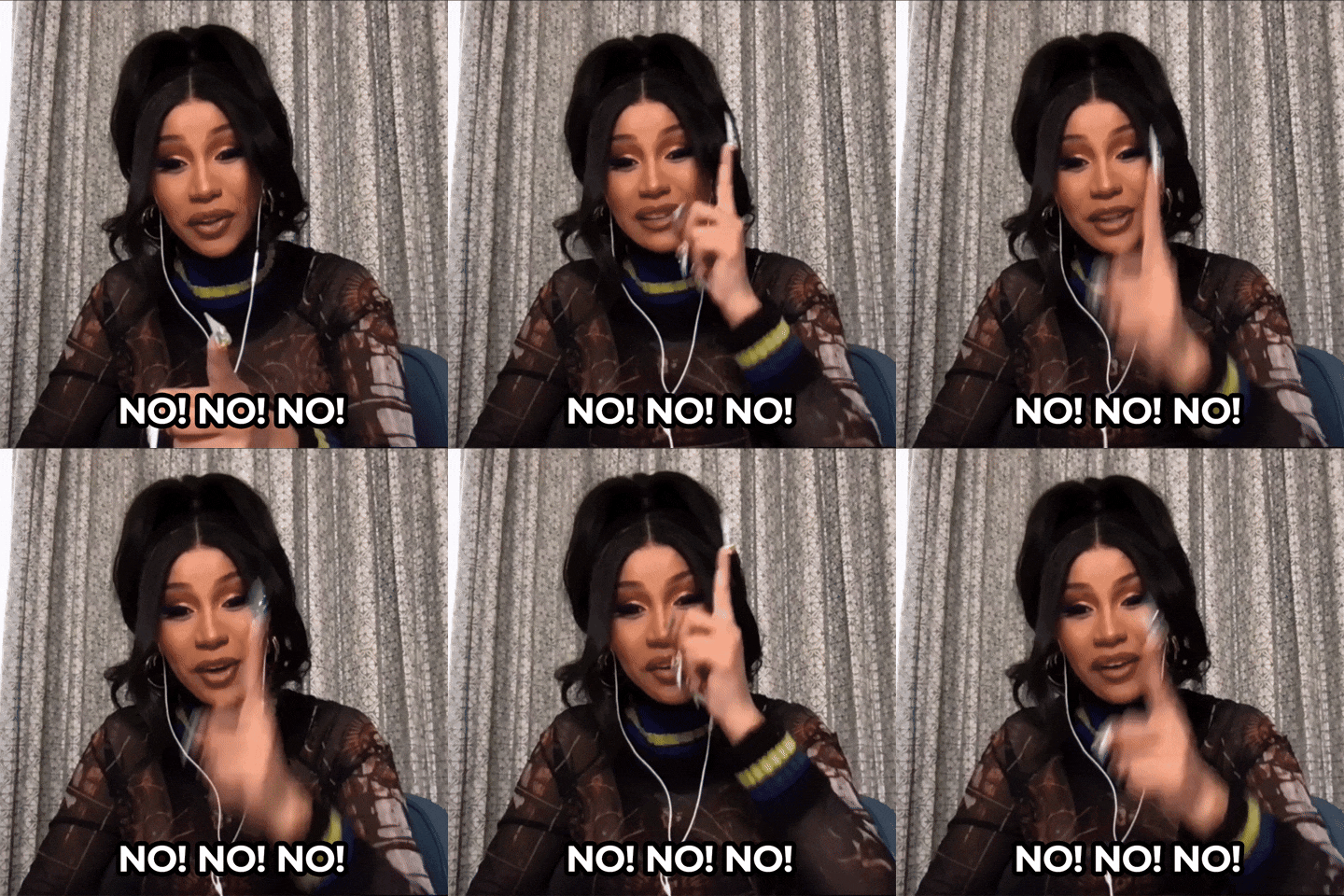
Two: But what about “Fair use?” Fair use is often a valid defense to Copyright infringement, but it’s not a get out of jail free card.
Album art and ad creative are commercial and (usually) not transformative enough to qualify for the Fair Use Defense
In other words, don’t bank on it.
Read more about Fair Use Here:

Practical takeaway:
The owner’s registration raises the stakes.
Clear the photo before you use the photo.
Even if you’re in the photo.

Hurdle #3: Cardi needed to choose the right deal and pay someone the right amount of coins…
Once Cardi’s team figured out who held the camera (and the copyright), there were two ways forward — own the moment or rent the rights.
Either way, the paperwork had to be tight.
Here are the two options they likely considered:
Option #1: Assignment (buy it outright).
In this route, Cardi (or any creative) would cut the check and buy the copyright altogether. It’s the equivalent of saying, “I don’t rent — I own.”
When you buy out the rights, you’re not just getting permission to use the photo; you’re taking full control of it. You decide how, where, and for how long that image shows up — whether it’s on an album cover, a tour backdrop, or a billion reposts on social media.
Owning the copyright also means you become the enforcer. If someone else tries to profit off that image without your consent, it’s your lawyers — not theirs — who send the cease and desist.
Of course, full ownership comes with a bigger price tag. It’s a “pay more now, stress less later” kind of deal. But for artists and brands building legacy (not just content), it’s often worth every penny.
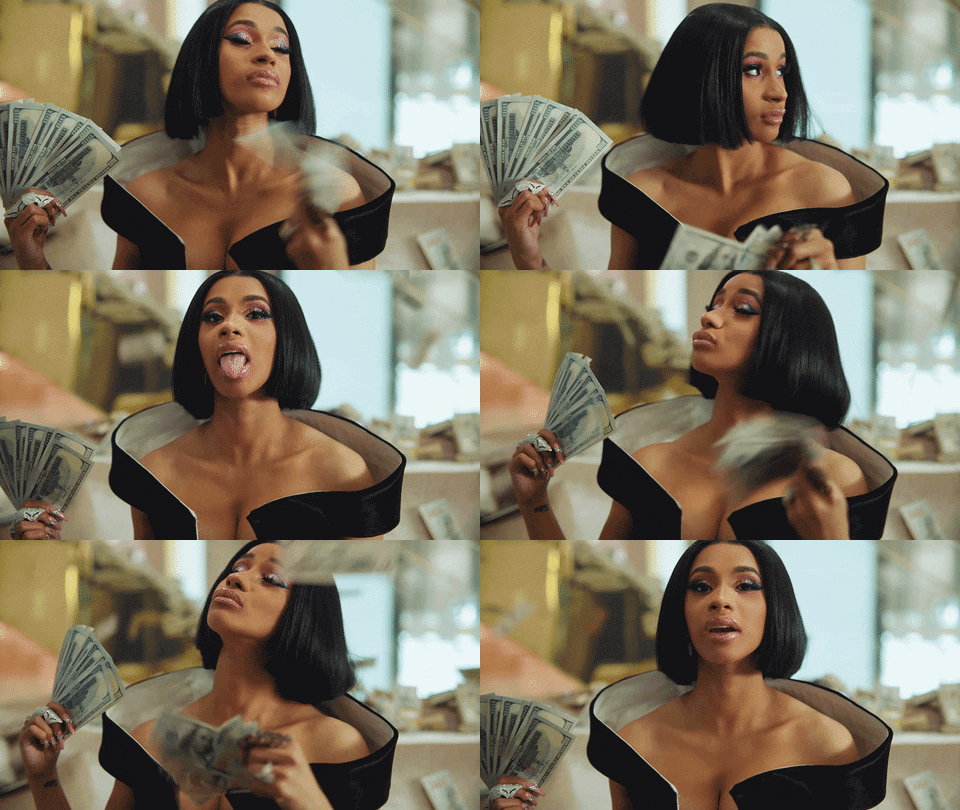
Option #2: License (rent the rights).
If buying the rights outright is like owning the house, licensing is more like renting the penthouse suite — you get to enjoy it, but only within the terms of your lease.
A license gives you permission to use the photo or video, but only for the specific purposes and time period you’ve agreed to. Maybe that means Cardi’s team could use the image for her Am I the Drama? album cover, social rollout, and a few press appearances — but not for a merch line or future tour visuals unless the contract said so.
Every license comes with its fine print: what platforms you can use it on (social, print, streaming, billboards), where it can appear (U.S. only or worldwide), and how long you can run it before it expires. Even small details like cropping, color edits, and text overlays might need approval.
It’s flexible, but not forever — and you only get what’s written, nothing more.
So while it might cost less upfront, a license demands precision. Miss a clause, and you could find your campaign hitting a legal wall faster than a viral meme disappears from Twitter.
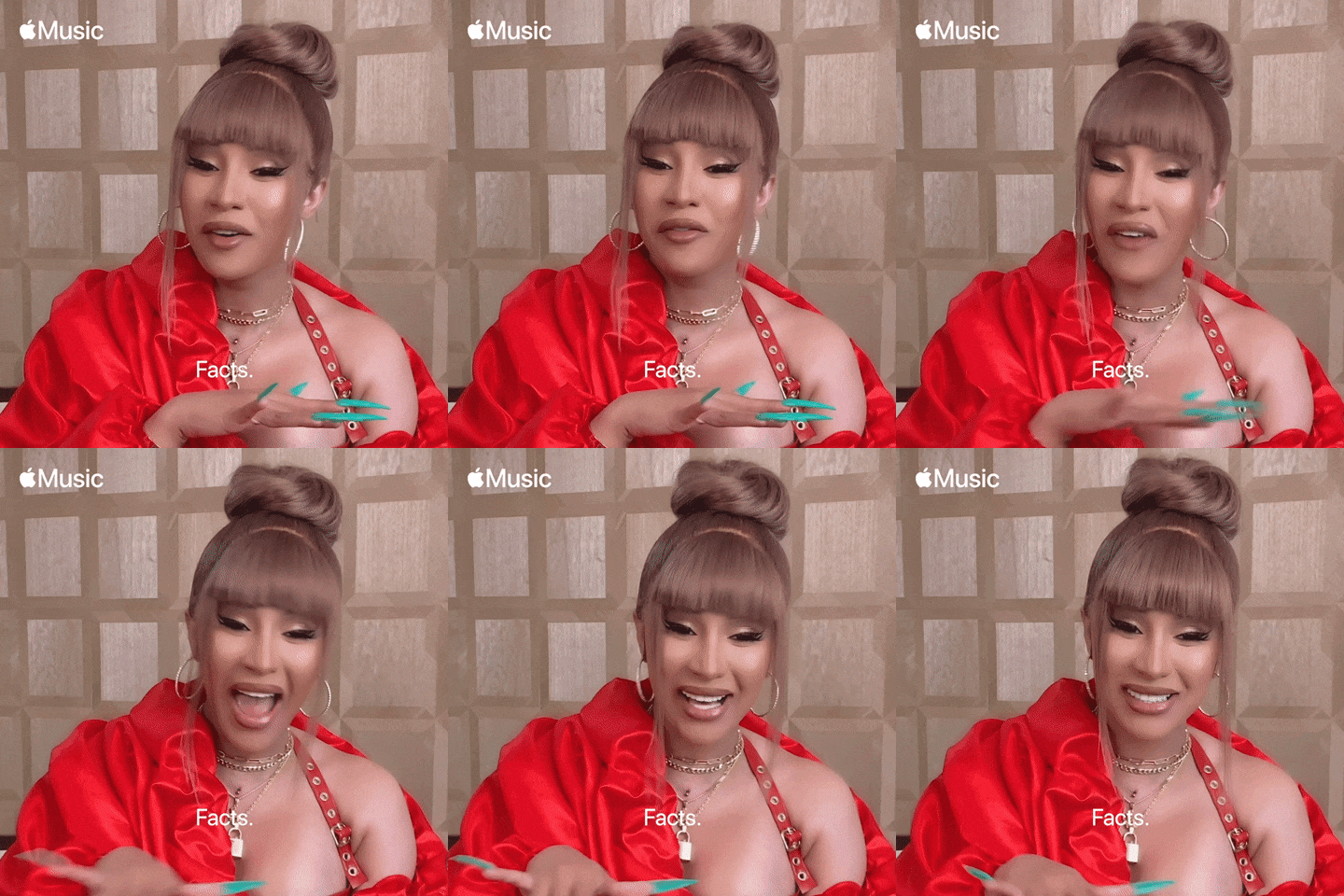
What likely happened here: Court TV, which streamed the Emani Ellis v. Belcalis Almanzar proceedings live on YouTube, has built a reputation as the-go-to outlet for broadcasting high-profile trials — from the Menendez brothers and Depp v. Heard to the O.J. Simpson case.
It’s their lane, and they stay in it.
So when Cardi’s courtroom moments started circulating online, it’s likely that Court TV (or another credentialed media outlet) was the source.
And while Court TV does make much of its footage publicly viewable, that doesn’t mean it’s free for commercial use. Their standard site permissions allow non-commercial use only.
Cardi, however, wasn’t just reposting for commentary — she was using those images for her Am I the Drama? album rollout.
You can’t get more commercial than that.
So it’s safe to assume that Cardi’s team secured a commercial-use license, one with clear scope covering album artwork, promotional campaigns, and possibly merchandise like tees or tote bags.
Depending on how her rollout evolves, that license likely spells out exactly how — and how far — those iconic courtroom visuals can travel.
Practical takeaway:
The right deal turns a fleeting meme into a lawful asset. The wrong deal turns a rollout into a risk.

What looked effortless was, in reality, meticulous.
A judge’s order.
A media pipeline.
A copyright owner.
A negotiated grant.
That’s how a courtroom moment travels from meme → marketing → money.
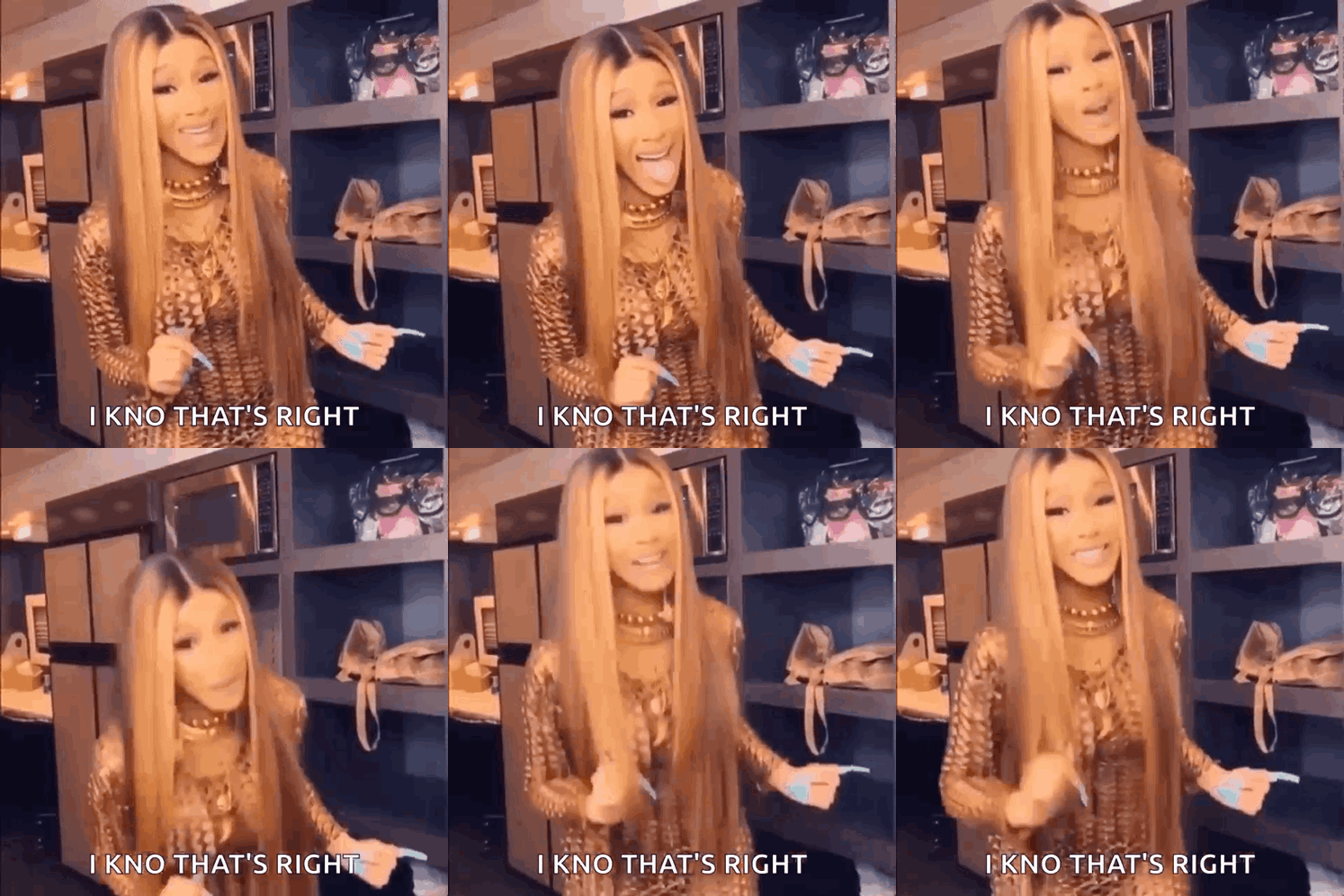
The bigger lesson for founders and creatives: don’t build on borrowed moments.
Build on cleared ones.

Drop it below — let’s unpack the IP together.
Need Help Protecting Your Creativity?
If you are unsure—or if you know you need to take action—reach out to us.
We have helped countless founders and creatives safeguard their intellectual property, and we would love to do the same for you.
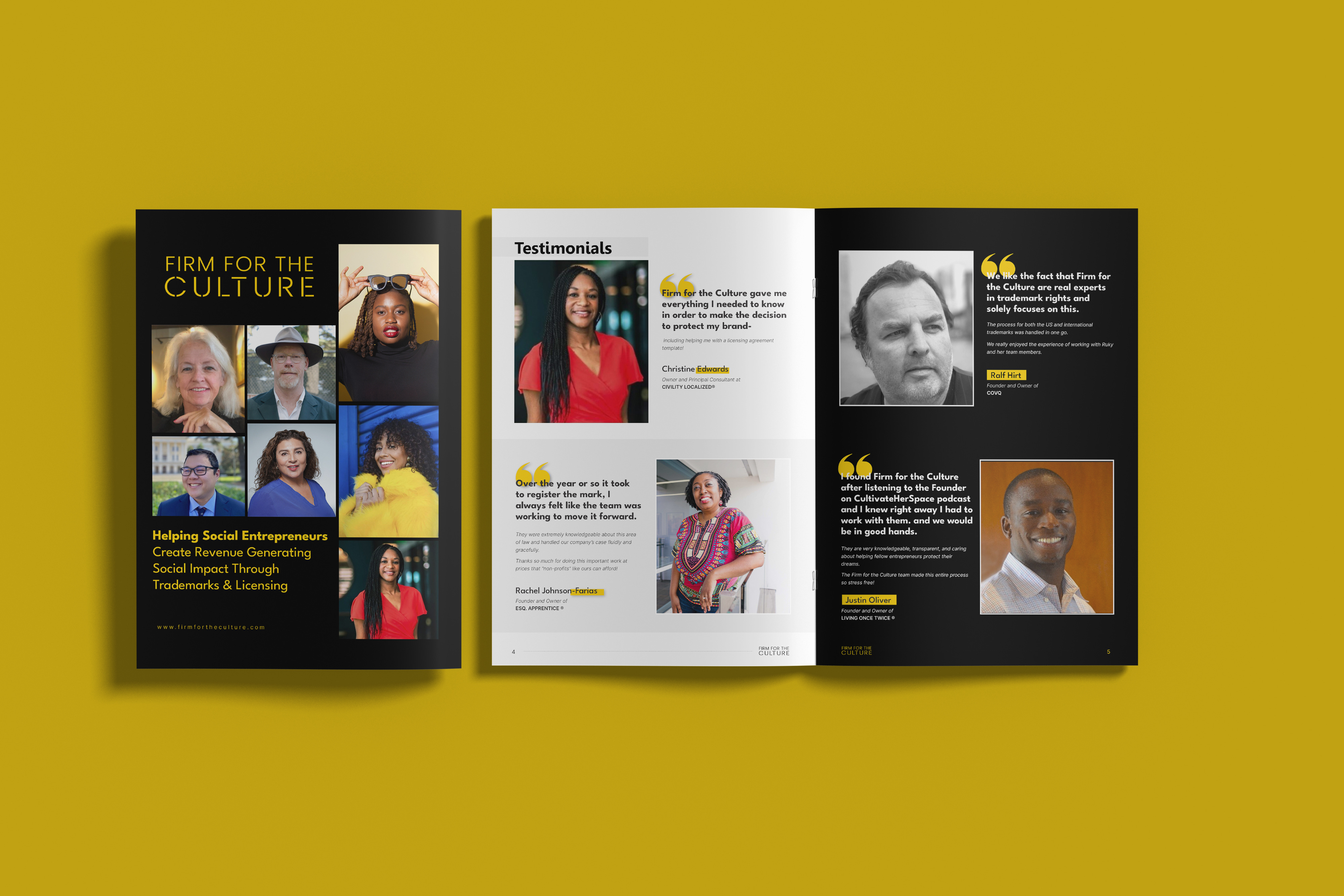
If you need further guidance, reach out to me and my team at Firm for the Culture.
We’re here to help you navigate the copyright, trademark, and thought leadership journey.
Can’t wait to help you protect your dynamic impact.
And #ThatsAWrap
The Doors of the Church Firm Are Open
Thanks for reading
See you next time.
I love the amazing perspective so many of you young people of color are bringing to the forefront. And how can I not relish a statement such as, "I am what an intellectual property attorney looks like." No wonder the devil is growling in Washington.
This resonates deeply. Thank you for this powerful message!